[0010]In order to maintain the advantages in accordance with the present invention, it is preferred however when the sensor is arranged in the interior or in an
interior space of the lifting column. The sensor is thus placed in this embodiment in the lifting column and is enclosed on the outside by the lifting column. The sensor is thus protected from
weathering influences and can thus supply reliable measure data over considerably longer operating periods.
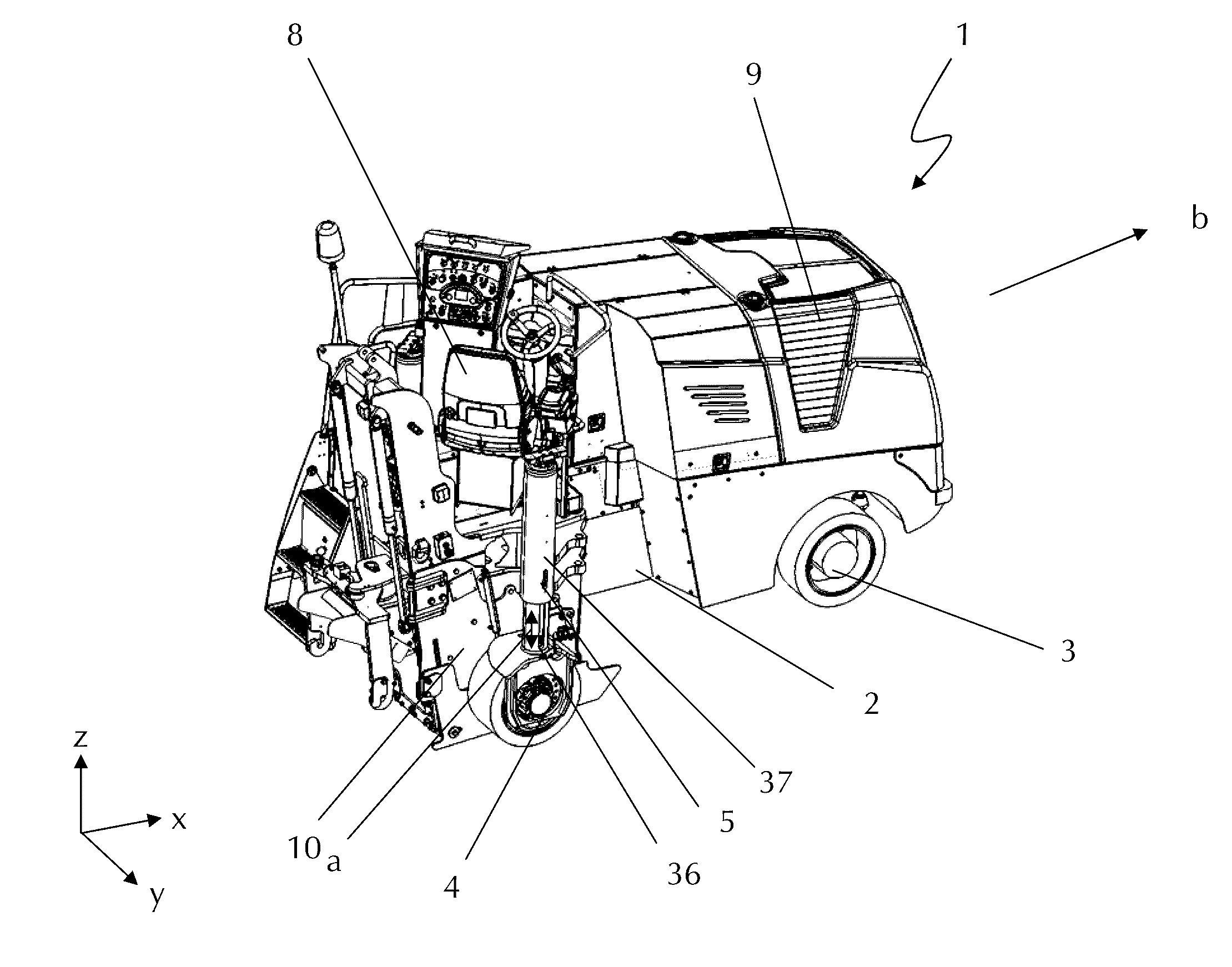
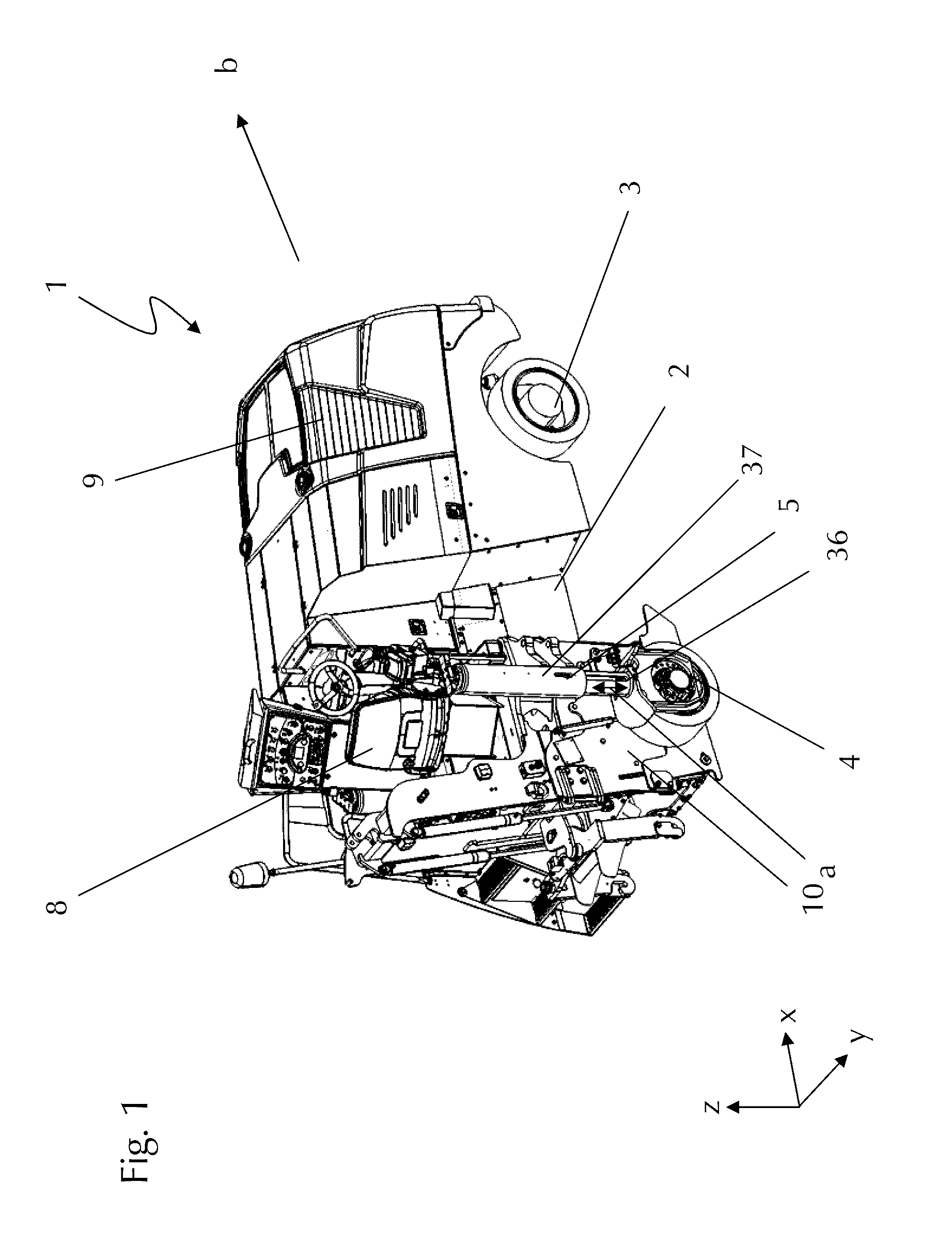
[0013]It is also possible to use various alternatives for implementation of the lifting column. The lifting column principally comprises an apparatus with which height adjustment of the machine frame is enabled, with which specifically the adjusting movement of the lifting column in the vertical direction is achieved. Preferably, the lifting column comprises a cylinder /
piston unit for this purpose. The lifting column in this embodiment comprises a cylinder, along the cylinder axis of which a
piston is guided in a longitudinal displaceable way in the cylinder in an at least partly overlapping manner. The
piston can thus be displaced at least partly into the cylinder and can be pulled at least partly out of the piston. A hydraulically actuatable cylinder / piston unit is further preferred in one embodiment. This is advantageous in respect that modern road construction machines usually already comprise an existing hydraulic
system, so that the present invention can be implemented rapidly in such construction machines. In order to perform the lifting movement, the piston is thus substantially displaced in the vertical direction in relation to the cylinder.
[0014]The lifting column further preferably comprises, in one embodiment, a casing which screens the lifting column towards the outside. The casing is also part of the lifting column in this embodiment. The casing substantially fulfils a screening function and protects the interior of the lifting column from damage from the outside, e.g., from introduction of
dirt, etc. Such a casing can be a sleeve for example, in the interior of which the device for height adjustment such as the
hydraulic cylinder / piston unit is arranged. The sleeve is preferably arranged with several elements, especially two elements, comprising an upper sleeve and a bottom sleeve. The upper and the bottom sleeve are adjusted to one another in such a way that the one sleeve, e.g., the bottom one (also designated below as the wheel carrier sleeve), is smaller than the other sleeve with respect to the
diameter, e.g., the upper sleeve (also designated below as the frame-side sleeve), so that the two sleeves can be slid into one another at least in part. Furthermore, additional sealing elements or the like can be provided in order to seal the overlapping region of the two sleeves to the interior against
dirt and / or
humidity. The casing can further comprise respective fastening elements such as fixing links with which they are linked to the machine frame. It is now provided in accordance with the present invention that the sensor of the path measuring device is integrated in the lifting column.
[0016]In order to enable determining the extent of the lifting movement or the specific lifting position with the sensor of the path measuring device which is integrated in the lifting column, the sensor comprises, in one embodiment, a cylinder sensor element arranged in the cylinder of the
hydraulic cylinder / piston unit or in the
interior space of the
hydraulic cylinder / piston unit and a piston sensor element which is arranged in the piston or at least in the
interior space of the cylinder / piston unit in the piston. Especially when using an MG sensor, the positioning of the cylinder sensor relative to the piston sensor occurs in the manner that its distance changes with a lifting adjustment of the cylinder / piston unit. The sensor rod of the MG sensor is further arranged in the cylinder / piston unit in a further preferred embodiment in such a way that its longitudinal axis lies coaxially on the longitudinal axis or lifting axis of the cylinder / piston unit. As a result, relatively long actuating paths can be detected reliably for example in a relatively easy manner. It is advantageous with respect to the arrangement of the MG sensor in the cylinder / piston unit when the permanent
magnet, the cylinder sensor element and the
signal transducer are a piston sensor element, especially a
modular unit on the
signal transducer with the sensor rod. Alternatively, the MG sensor can also be arranged with a sensor element in the casing and with a further sensor element in a part of the piston / cylinder unit or also exclusively in elements of the casing.


 Login to View More
  Login to View More