
Structure of a Cutting Tool
a cutting tool and tool structure technology, applied in the field of hand tools, can solve the problems of imperfect holding effect, and achieve the effects of improving the holding effect, improving the structure of the cutting tool, and being easy to assembl
- Summary
- Abstract
- Description
- Claims
- Application Information
AI Technical Summary
Benefits of technology
Problems solved by technology
Method used
Image

Examples
Embodiment Construction
[0018]The present invention will be apparent from the following detailed description, which proceeds with reference to the accompanying drawings, wherein the same references relate to the same elements.
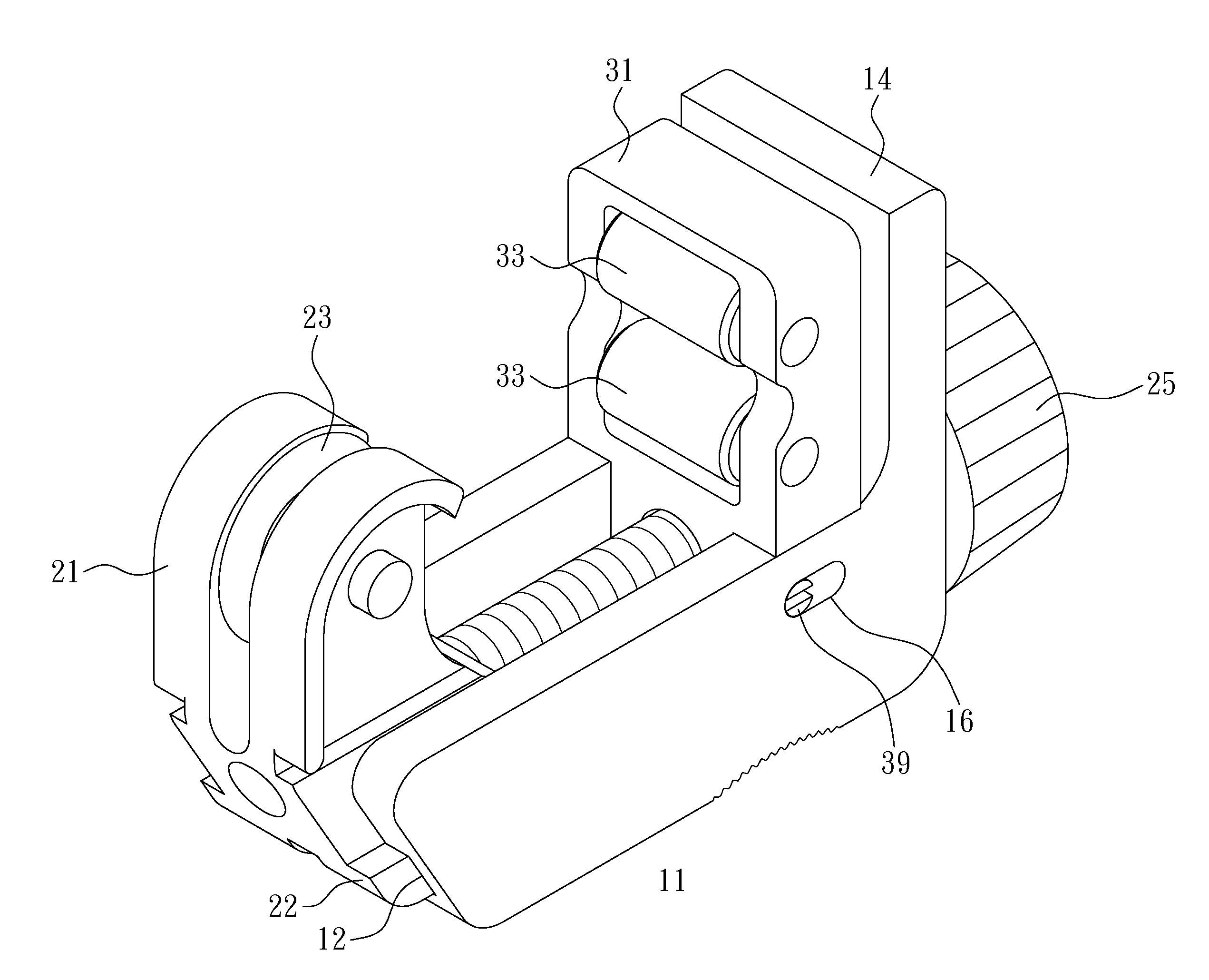
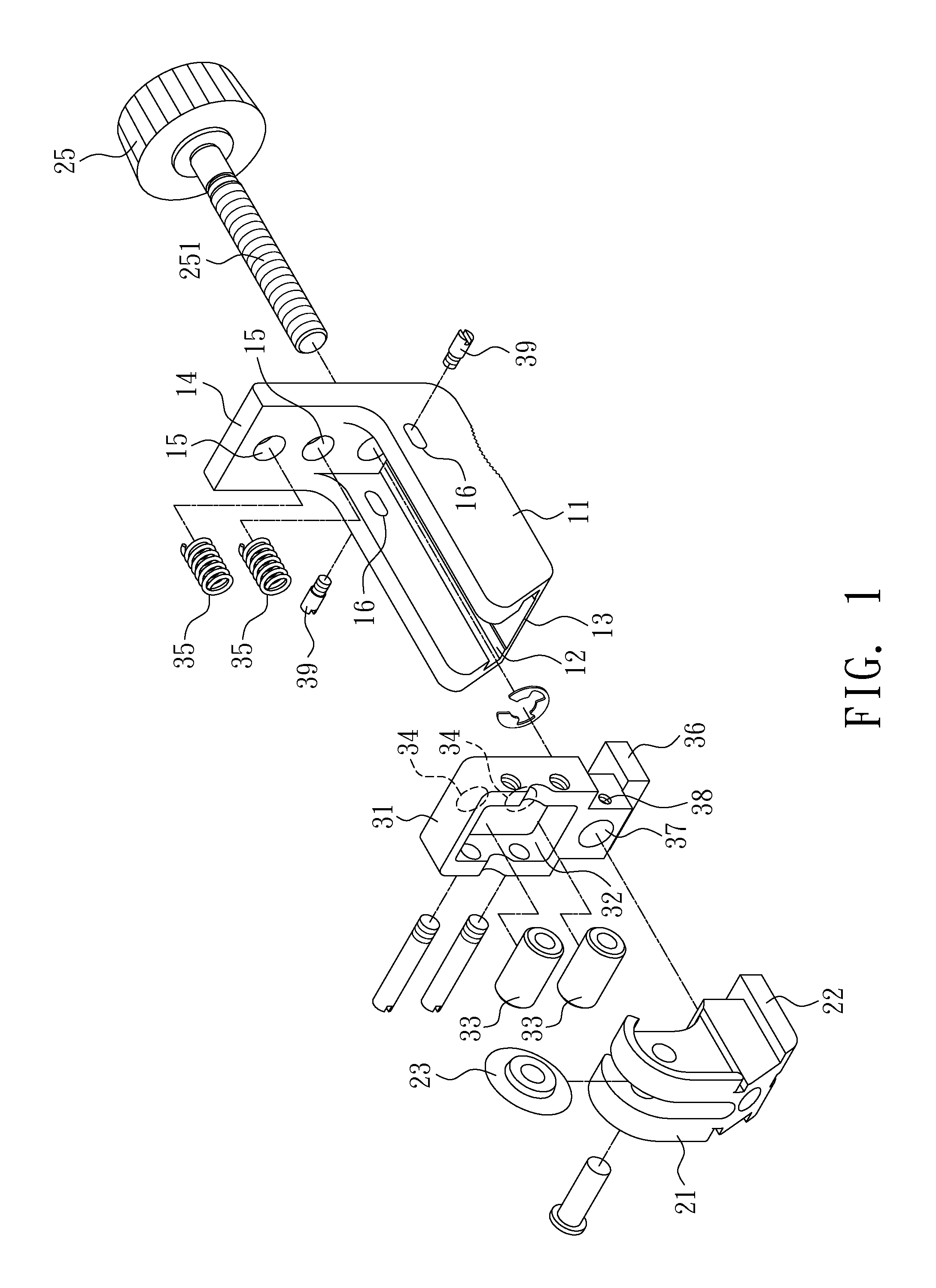
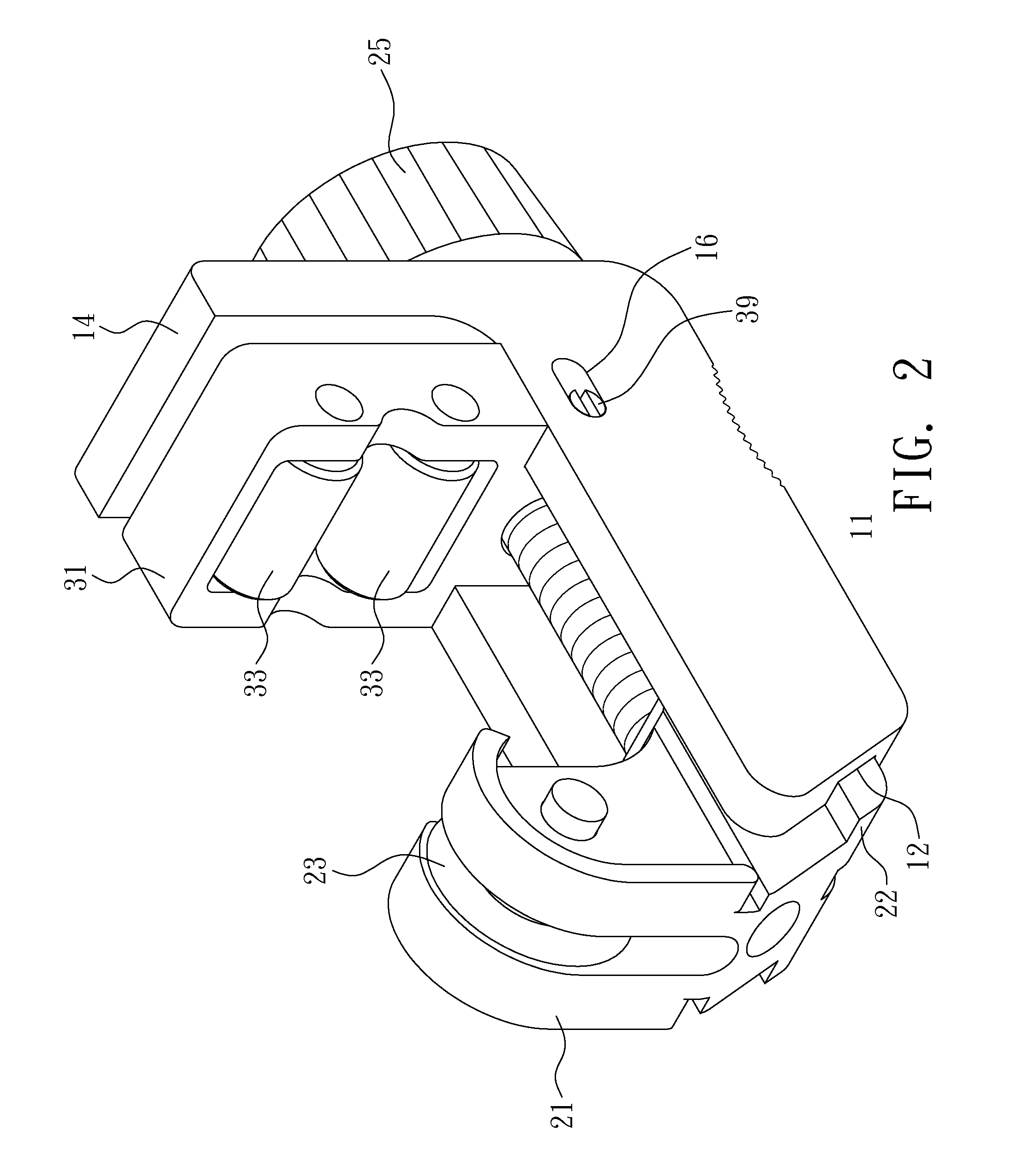
[0019]Please refer to FIGS. 1 to 3. An improved structure of a cutting tool according to the invention includes a body 11, a moving base 21, and a roller base 31.
[0020]The bottom of the body 11 has a track groove 12 extending in the transverse direction. One side of the track groove 12 is formed with an opening in communications with the exterior. The other side is extended upward with a stopping wall 14. The end surface of the stopping wall 14 facing the track groove 12 is formed with two recesses 15. A sliding groove 16 is formed on the two sidewalls of the body 11 opposite to the track groove 12.
[0021]The bottom of the moving base 21 is formed with a sliding part 22 to be mounted in the track groove 12. The moving base 21 slides in the track groove 12 of the body 11 via the sliding...
PUM
| Property | Measurement | Unit |
|---|---|---|
| structure | aaaaa | aaaaa |
| driving force | aaaaa | aaaaa |
| elastic | aaaaa | aaaaa |
Abstract
Description
Claims
Application Information
 Login to View More