Supercharge Your Innovation With Domain-Expert AI Agents!

Mhc oligomers, components thereof, and methods of making the same

a technology of mhc oligomers and oligomers, which is applied in the field of mhc oligomers, components thereof, can solve the problems of decreased specificity and higher background binding of such complexes, and the inability to provide such a specific attachment site in a convenient way, so as to improve the steric conformation

Inactive Publication Date: 2012-09-27
PROIMMUNE
View PDF0 Cites 0 Cited by
  • Summary
  • Abstract
  • Description
  • Claims
  • Application Information

AI Technical Summary

Benefits of technology

This approach results in MHC oligomers with improved binding to TCRs, high yield, and superior purity, enabling precise and controlled oligomerization and reduced dissociation from TCRs.

Problems solved by technology

These peptide oligomers would however not be well suited for forming isolated MHC-peptide multimers, since it is usually necessary to incubate soluble.
This would lead to very incomplete oligomerisation of the complexes and a situation where multiple sections of MHC-binding peptide in the resulting complexes are not bound to an MHC-peptide complex, which in turn can lead to decreased specificity and higher background binding of such complexes.
In fact not many convenient ways exist to provide such a specific attachment site.
The drawback of this technique is that monomeric antibody epitope interactions are typically not as strong as would be desirable and the resulting molecule could be quite large if it is multimerised in two-step process, e.g. by binding epitope specific antibodies first and isotype specific antibodies second to the resulting MHC antibody complexes.
Any chemical site-specific modification of a polypeptide that has been produced by recombinant protein expression is difficult as most known targeted coupling methods are specific to one or several amino acids.
This has an uncontrollable effect on the ability of the complex to bind to its complementary T cell receptor successfully.
Biotinylation thus involves a substantial number of process steps, including several rounds of protein purification, and an enzymatic biotinylation reaction that can lead to significant loss of active MHC complexes.
Further, controlling the biotinylation efficiency of monomeric MHC subunits and quality of the final multimeric product is difficult.
For example, where a specific MHC complex comprising homogeneous peptides is to be synthesized and the synthesis yield is very low, protein losses in the biotinylation reaction, and lower than 100% biotinylation efficiency can drive the yield of the finished product below an acceptable level.
This methodology also limits the multimerization method for the biotinylated complex to binding it to avidin family proteins, such as streptavidin, which tetramerises it or to cross-linked variants of such proteins.
With cross-linked avidin family protein variants it is however difficult to control the valency of the complexes accurately.
In situations where such a tetrameric or non-uniform valency multimer is not desirable or the use of streptavidin or molecules related to streptavidin is unwanted this methods also has serious limitations.

Method used

the structure of the environmentally friendly knitted fabric provided by the present invention; figure 2 Flow chart of the yarn wrapping machine for environmentally friendly knitted fabrics and storage devices; image 3 Is the parameter map of the yarn covering machine
View more

Image

Smart Image Click on the blue labels to locate them in the text.
Viewing Examples
Smart Image
  • Mhc oligomers, components thereof, and methods of making the same
  • Mhc oligomers, components thereof, and methods of making the same
  • Mhc oligomers, components thereof, and methods of making the same

Examples

Experimental program
Comparison scheme
Effect test

Embodiment Construction

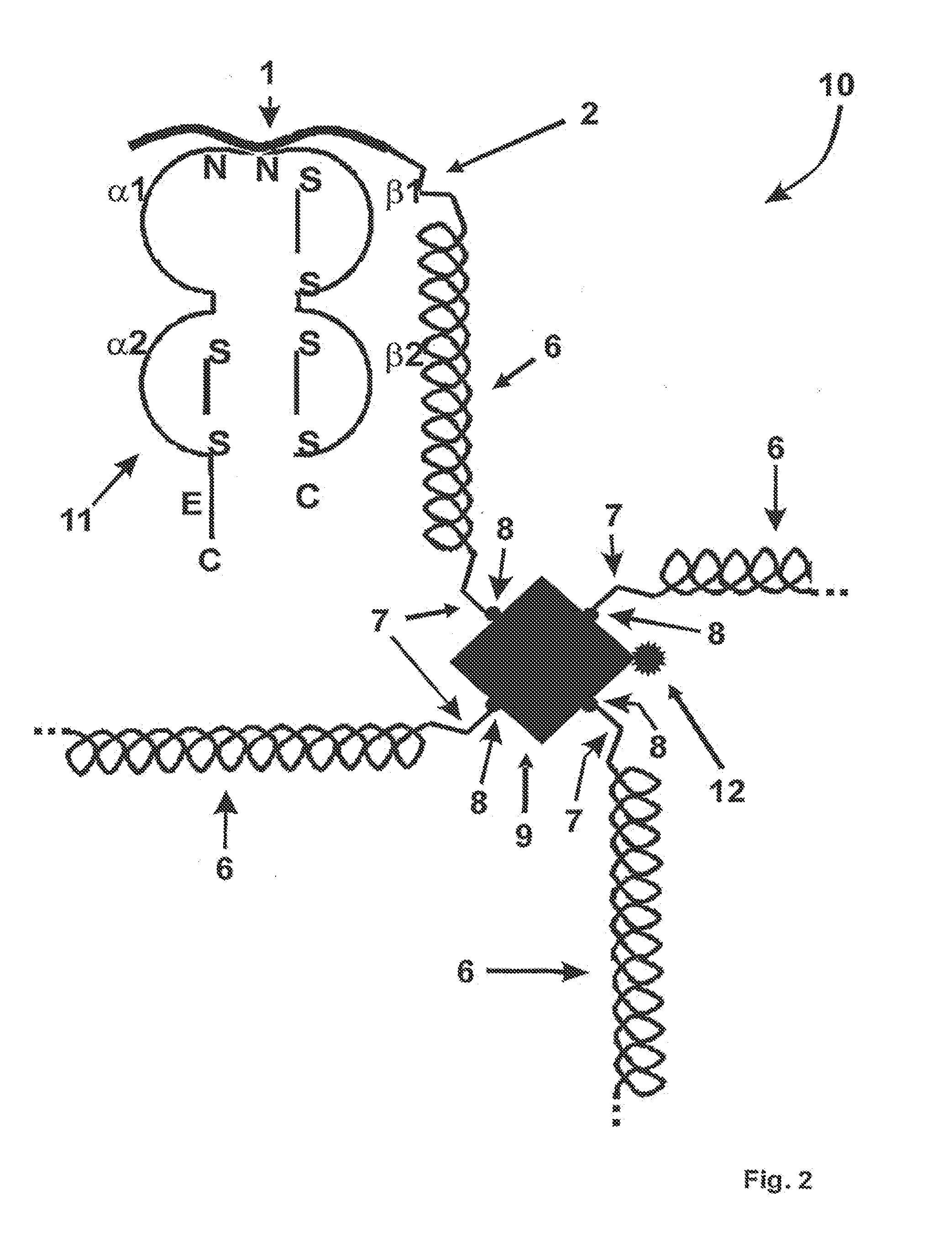
[0044]The MHC binding polymer according to the invention comprises a first segment and a second segment, wherein the first segment comprises a peptide capable of binding in a binding groove of an MHC molecule, and wherein the second segment comprises a linking segment and a recognition site for coupling the MHC binding polymer with a specific partner, wherein the linking segment is a polymer with a length of at least 10 Angstrom in its native conformation. The linking segment can provide space for binding, firstly, between an MHC-peptide complexes and the TCR, and, second, of the MHC-peptide complexes in an oligomers of the invention, e.g. as tetramer or pentamer, or multimer of other well defined valency. Preferably, the linking segment has at least 20 carbon atoms along its polymeric backbone. Further, preferably, at least a portion of the MHC binding polymer is synthetic.

[0045]Native conformation herein means the conformation that the second segment or linking segment assumes und...

the structure of the environmentally friendly knitted fabric provided by the present invention; figure 2 Flow chart of the yarn wrapping machine for environmentally friendly knitted fabrics and storage devices; image 3 Is the parameter map of the yarn covering machine
Login to View More

PUM

PropertyMeasurementUnit
lengthaaaaaaaaaa
lengthaaaaaaaaaa
lengthaaaaaaaaaa
Login to View More

Abstract

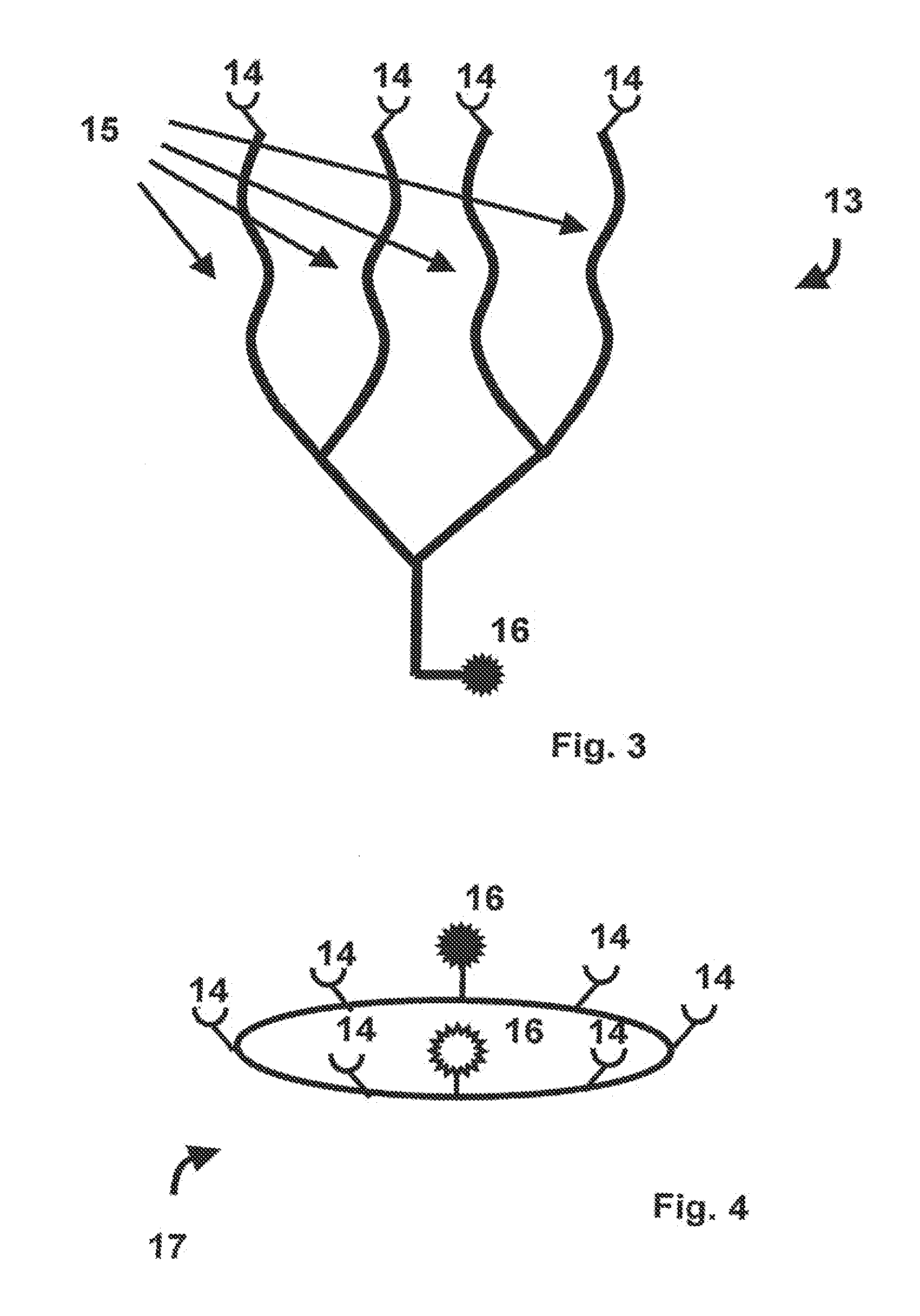
The present invention relates to an MHC binding polymer suitable for the oligomerisation of individual MHC monomers. The MHC binding polymer comprises a first segment and a second segment, wherein the first segment comprises a peptide capable of binding in a binding groove of an MHC molecule, and wherein the second segment comprises a linking segment and a recognition site for coupling the MHC binding polymer with a specific partner. The linking segment is a polymer with a length of at least 10 Angstrom in its native conformation. Further it relates to an MHC oligomer containing such MHC binding polymers. Individual functional MHC complex monomers are oligomerised via their peptides bound in the peptide binding groove of the complex. Moreover, it relates to a method of making such MHC binding polymer and oligomer and various methods using the same.

Description

[0001]The present invention relates to an MHC binding polymer suitable for the oligomerisation of individual MHC monomers. Further it relates to an MHC oligomer containing such MHC binding polymers. Individual functional MHC complex monomers are oligomerised via their peptides bound in the peptide binding groove of the complex. Finally, it relates to a method of making such MHC binding polymer and oligomer and various methods using the same.BACKGROUND OF THE INVENTION[0002]Major Histocompatibility Complex (MHC) molecules, which are found on the cell surface in tissues, play an important role in presenting cellular antigens in the form of short linear peptides to T cells by interacting with T cell receptors (TCRs) present on the surface of T cells. They consist of alpha and beta chains, and a peptide bound in a groove formed by these chains when properly folded.[0003]It has been established that isolated or recombinant forms of MHC peptide molecules are useful for detecting, separati...

Claims

the structure of the environmentally friendly knitted fabric provided by the present invention; figure 2 Flow chart of the yarn wrapping machine for environmentally friendly knitted fabrics and storage devices; image 3 Is the parameter map of the yarn covering machine
Login to View More

Application Information

Patent Timeline
no application Login to View More
Patent Type & Authority Applications(United States)
IPC IPC(8): C07K19/00
CPCC07K14/70539A61K38/177C07K14/00C07K19/00
Inventor SCHWABE, NIKOLAI FRANZ GREGORTAN, LINDA CHENG-CHOOGOUVEIA, CATHERINE ELIZABETHCOX, JOANNA
Owner PROIMMUNE
Features
  • R&D
  • Intellectual Property
  • Life Sciences
  • Materials
  • Tech Scout
Why Patsnap Eureka
  • Unparalleled Data Quality
  • Higher Quality Content
  • 60% Fewer Hallucinations
Social media
Patsnap Eureka Blog
Learn More