
Semiconductor device having calibration circuit that adjusts impedance of output buffer
a technology of output buffer and calibration circuit, which is applied in the direction of logic circuits, reliability increasing modifications, coupling arrangements of logic circuits, etc., can solve the problems of taking a long time to perform calibration operations, and not being able to complete calibration operations in a predetermined time period. , to achieve the effect of shortening the time of calibration operation
- Summary
- Abstract
- Description
- Claims
- Application Information
AI Technical Summary
Benefits of technology
Problems solved by technology
Method used
Image

Examples
first embodiment
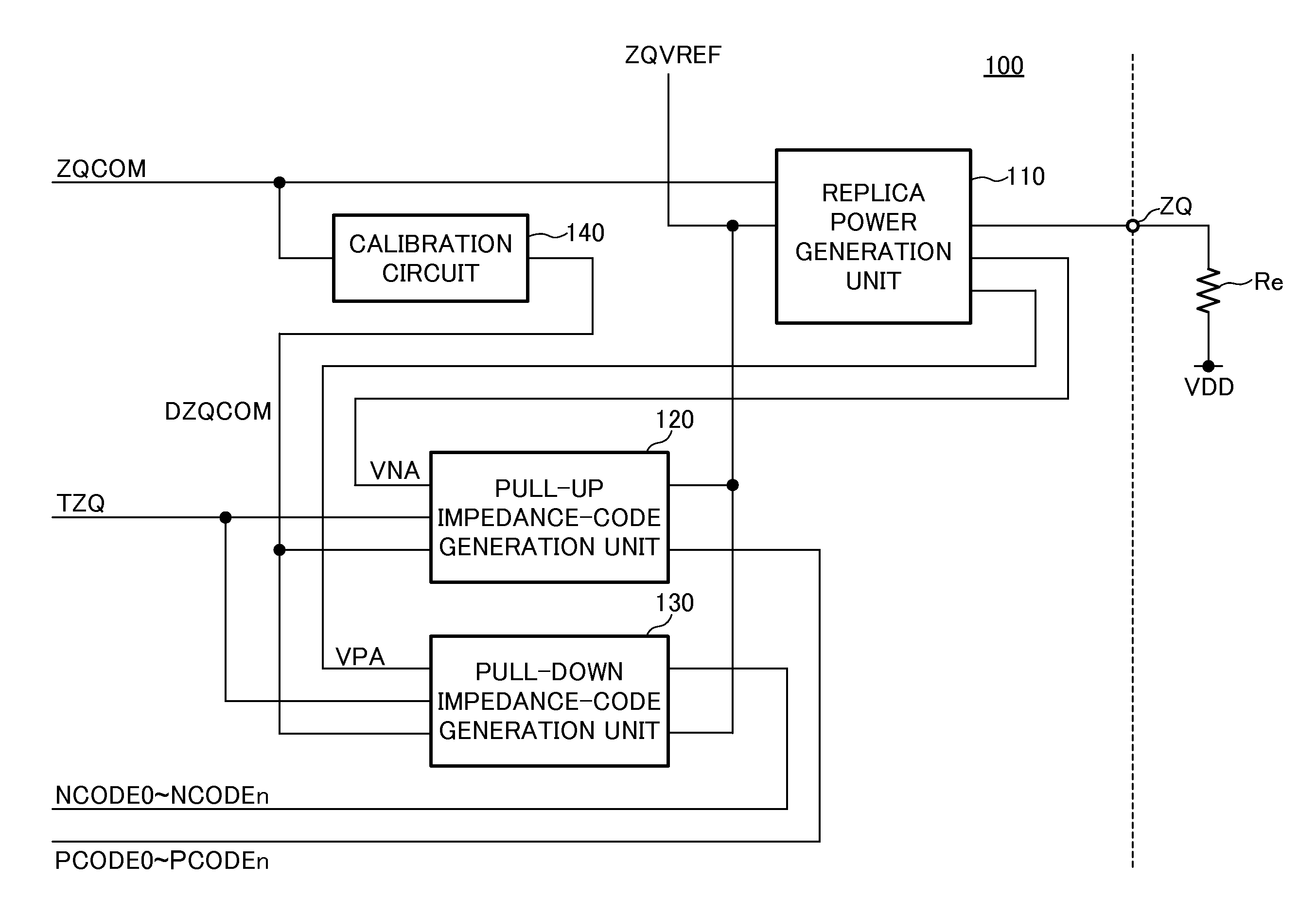
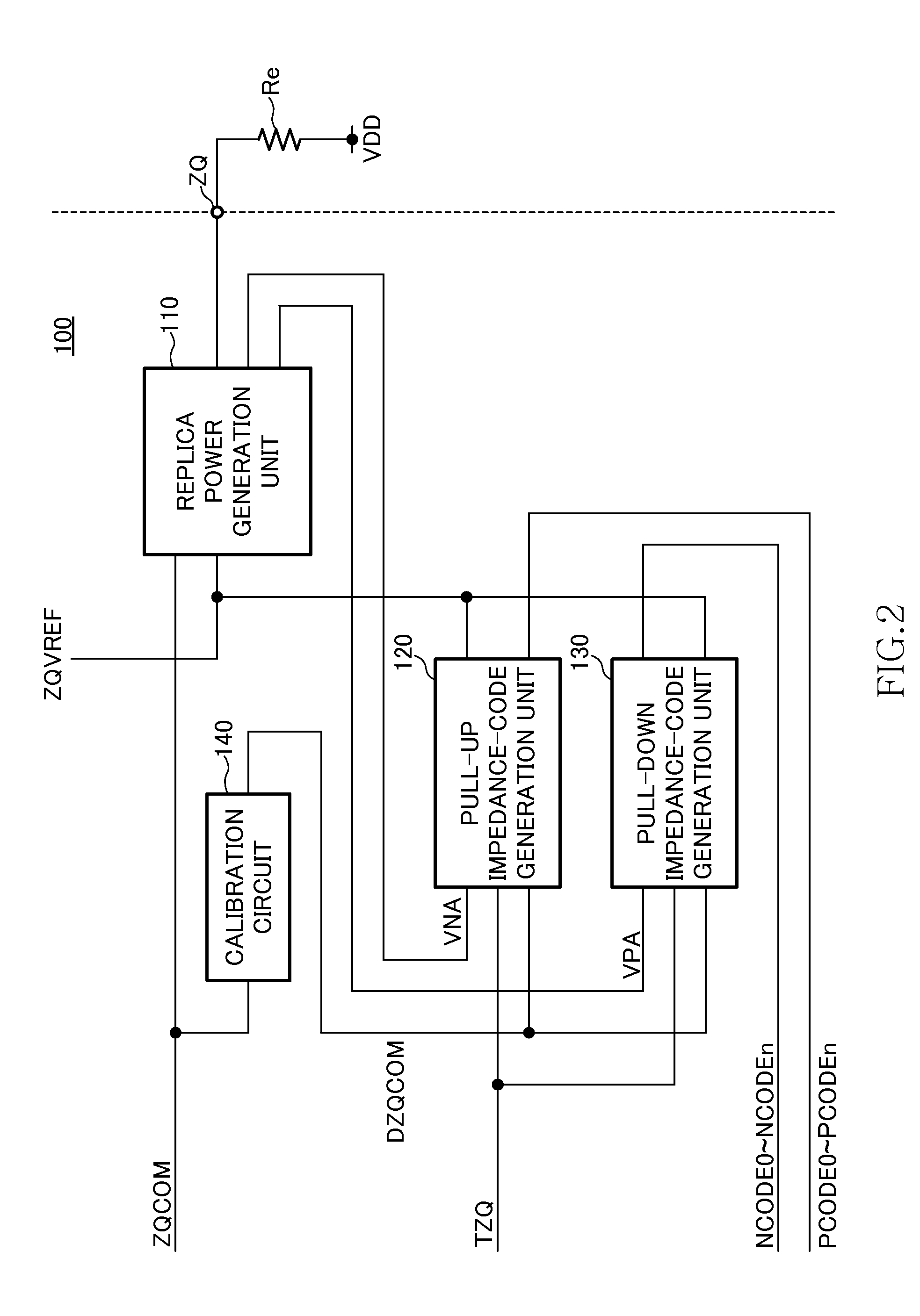
[0042]Turning to FIG. 2, the calibration circuit 100 according to the present invention includes a replica power generation unit 110, a pull-up impedance-code generation unit 120, and a pull-down impedance-code generation unit 130. The replica power generation unit 110 is a circuit that generates bias potentials VNA and VPA, which are control signals, based on the reference potential ZQVREF. The bias potential VNA is supplied to the pull-up impedance-code generation unit 120, and the bias potential VPA is supplied to the pull-down impedance-code generation unit 130. Although these units 110, 120, and 130 are activated based on the calibration signal ZQCOM, in order to secure a time for the bias potentials VNA and VPA to be stabilized, the pull-up impedance-code generation unit 120 and the pull-down impedance-code generation unit 130 are activated in response to the calibration signal ZQCOM that is delayed by a delay circuit 140.
[0043]Turning to FIG. 3, the replica power generation u...
second embodiment
[0064]the present invention is explained next with reference to FIGS. 8 to 12.
[0065]As shown in FIG. 9, the calibration circuit 100 according to the second embodiment includes a pull-up impedance-code generation unit 160 and a pull-down impedance-code generation unit 170. In the second embodiment, the delay circuit 140 and the replica power generation unit 110 shown in FIG. 2 are not included in the calibration circuit 100. Therefore, the calibration circuit 100 according to the second embodiment has characteristics such that its circuit size is smaller and the current consumption is also smaller as compared to the calibration circuit 100 according to the first embodiment.
[0066]Turning to FIG. 10, the pull-up impedance-code generation unit 160 has a circuit configuration similar to that of the pull-up impedance-code generation unit 120 shown in FIG. 5, including an impedance adjustment unit 161 that is connected between the power supply line to which the power supply potential VDD i...
PUM
 Login to View More
 Abstract
Description
Claims
Application Information
 Login to View More