
Synthetic data collection method for full matrix capture using an ultrasound array
- Summary
- Abstract
- Description
- Claims
- Application Information
AI Technical Summary
Benefits of technology
Problems solved by technology
Method used
Image

Examples
Embodiment Construction
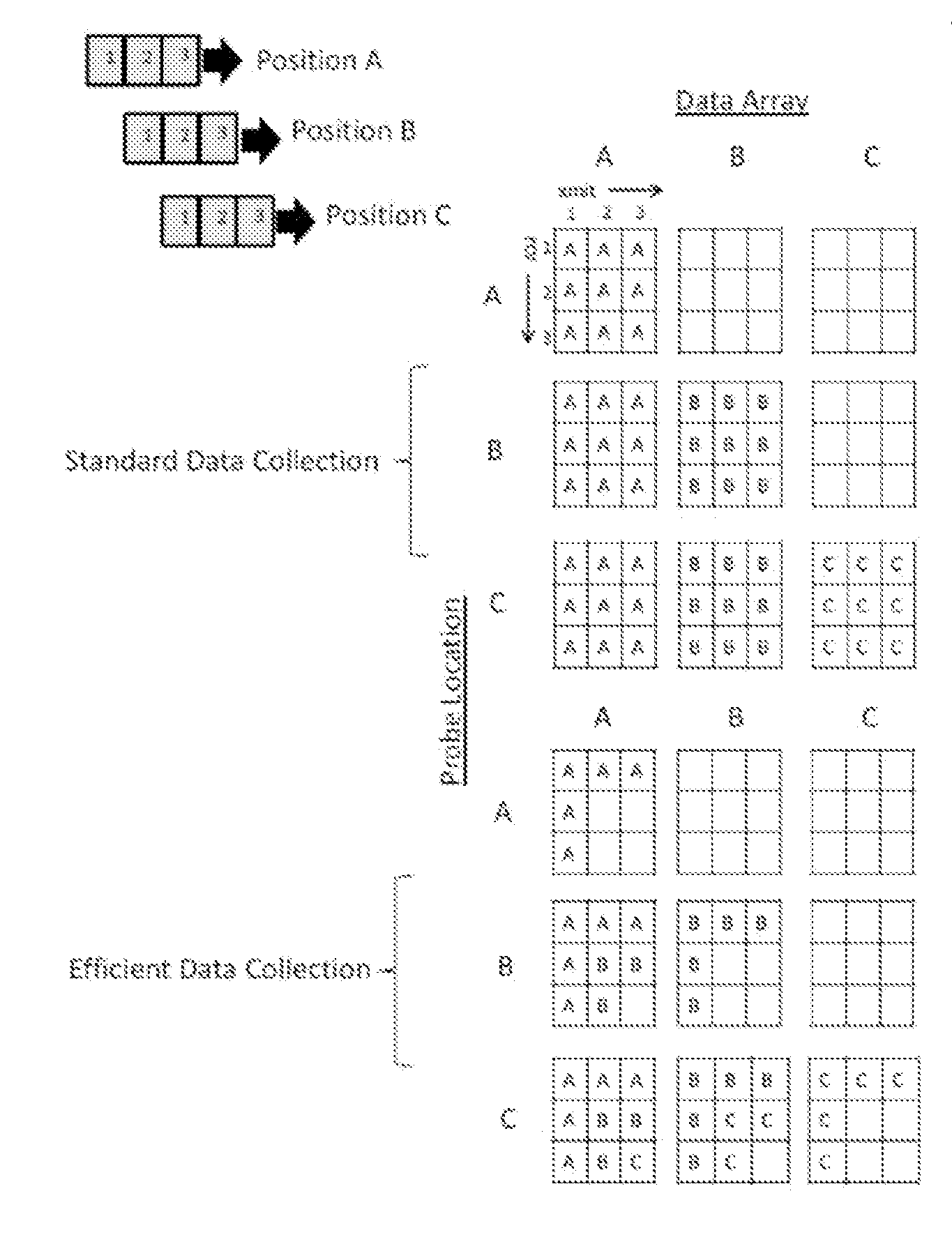
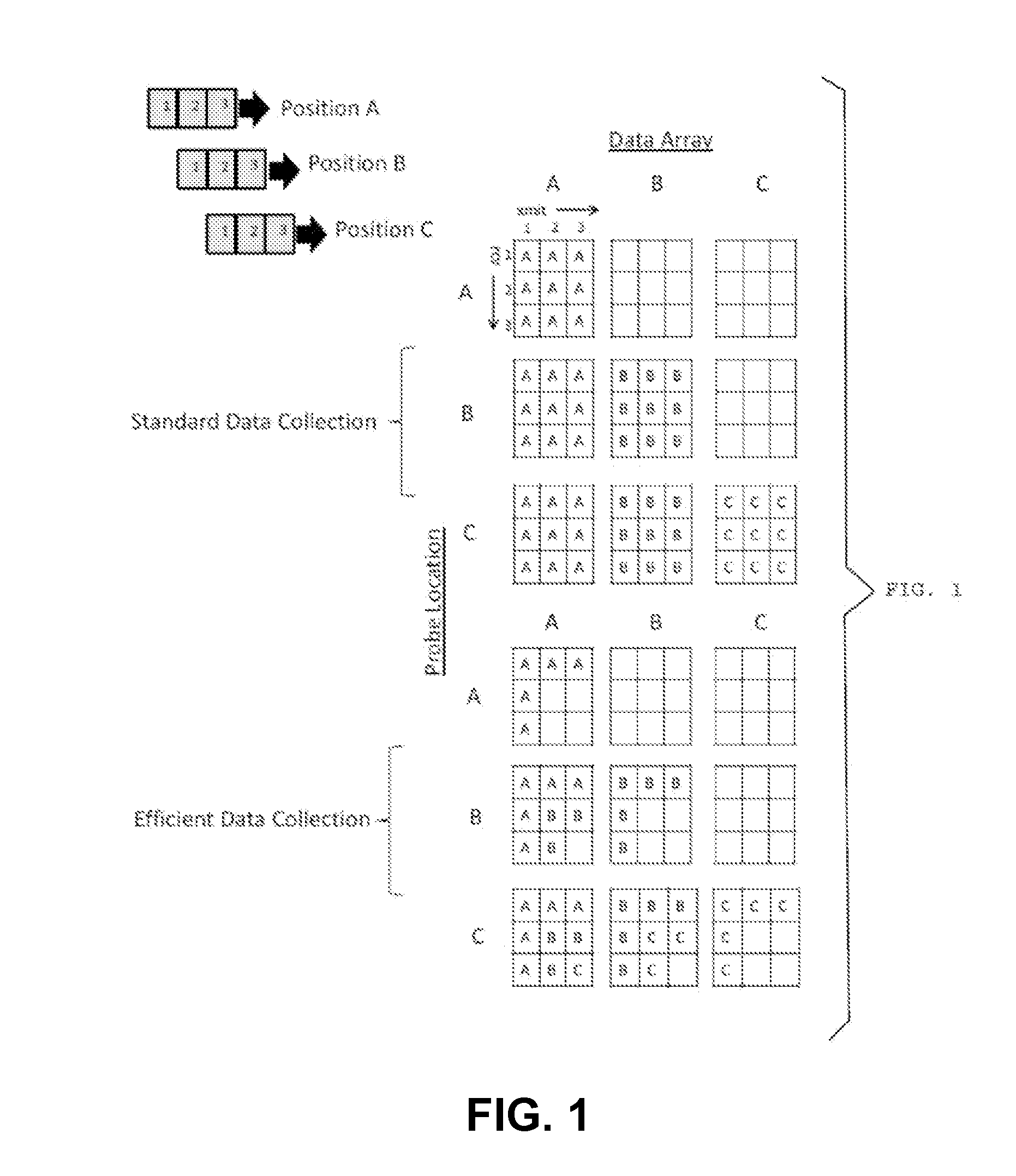
[0028]Referring now to the drawings, FIG. 1 illustrates, in the section identified as “Efficient Data Collection,” the present, novel ultrasound data collection method. Following the “Standard Data Collection” method, in order to collect all data for the three probe positions a total of 9 element firings would be needed and 18 waveforms must be collected. According to the present “Efficient Data Collection” method only 5 element firings and 12 waveforms need to be collected in order to have all waveform data at all positions. In order for this particular implementation to be possible the probe increment must be equal to element pitch. Also, this particular implementation relies on the reciprocity principle (i.e. a signal transmitted by element x and received by element y is in principle the same as a signal transmitted by element y and received by element x). In the case of pulse-echo operation the consequence of the reciprocity principle is that the matrix is symmetrical about its ...
PUM
 Login to View More
 Abstract
Description
Claims
Application Information
 Login to View More