Method and devices for securing bidirectional suture loops using coaxial mechanical fasteners

a technology of mechanical fasteners and bidirectional sutures, which is applied in the field of methods and devices for securing bidirectional sutures using coaxial mechanical fasteners, can solve the problems of complicated and challenging tie-dock technique, and the approach is generally limited, so as to reduce the risk of damaging adjacent structures and minimize the profile of the fastener

US20140276979A1Inactive Publication Date: 2014-09-18LSI SOLUTIONS
0 Cites 38 Cited by

Patent Information

Authority / Receiving Office
US · United States
Current Assignee / Owner
Publication Date
2014-09-18
Estimated Expiration
Not applicable · inactive patent

Smart Images

  • Figure 1
    Figure 1
  • Figure 2
    Figure 2
  • Figure 3
    Figure 3
Patent Text Reader

Abstract

A method and apparatus for securing separate loops of suture with a coaxial mechanical fastener. Separate loops of suture extend from opposite ends of the mechanical fastener. A wire snare facilitates pulling the suture through the fastener. A suturing instrument provides for the infusion of pressurized physiologic solutions into the left ventricle so that the proper replacement suture length can be demonstrated real time prior to crimping the fastener. The instrument incorporates a slotted release site so that the fastener and suture can be released from the device tip once the fastener is secured. A method of securing suture coming from cardiac valve leaflets and or other structures like papillary muscles permits a more atraumatic orientation of the fastener coaxial with the suture strands.
Need to check novelty before this filing date? Find Prior Art

Description

CROSS-REFERENCE TO RELATED APPLICATIONS

[0001] Not ApplicableSTATEMENT REGARDING FEDERALLY SPONSORED RESEARCH OR DEVELOPMENT

[0002] Not applicable.REFERENCE TO A “SEQUENCE LISTING”

[0003] Not applicable.BACKGROUND OF THE INVENTION

[0004] 1. Field of the Invention

[0005] The use of a mechanical fastener or “knot” to secure or connect together a loop of surgical suture can provide an accepted alternative to the hand tying of a manual knot. Unlike a hand-tied manual knot, which is composed only of multiple throws of the suture itself, a mechanical suture fastener leaves behind inside of the patient another structural element in addition to the suture. Therefore, to be useful a mechanical fastener must be safe and ergonomic to deploy on the suture and present minimal risk to the patient's long-term clinical outcome. Inadvertent damage by the mechanical fastener to the placed suture or injury to the tissue or surrounding tissue structures is unacceptable.

[0006] Alternative knot replacement techniqu...

Examples

Embodiment Construction

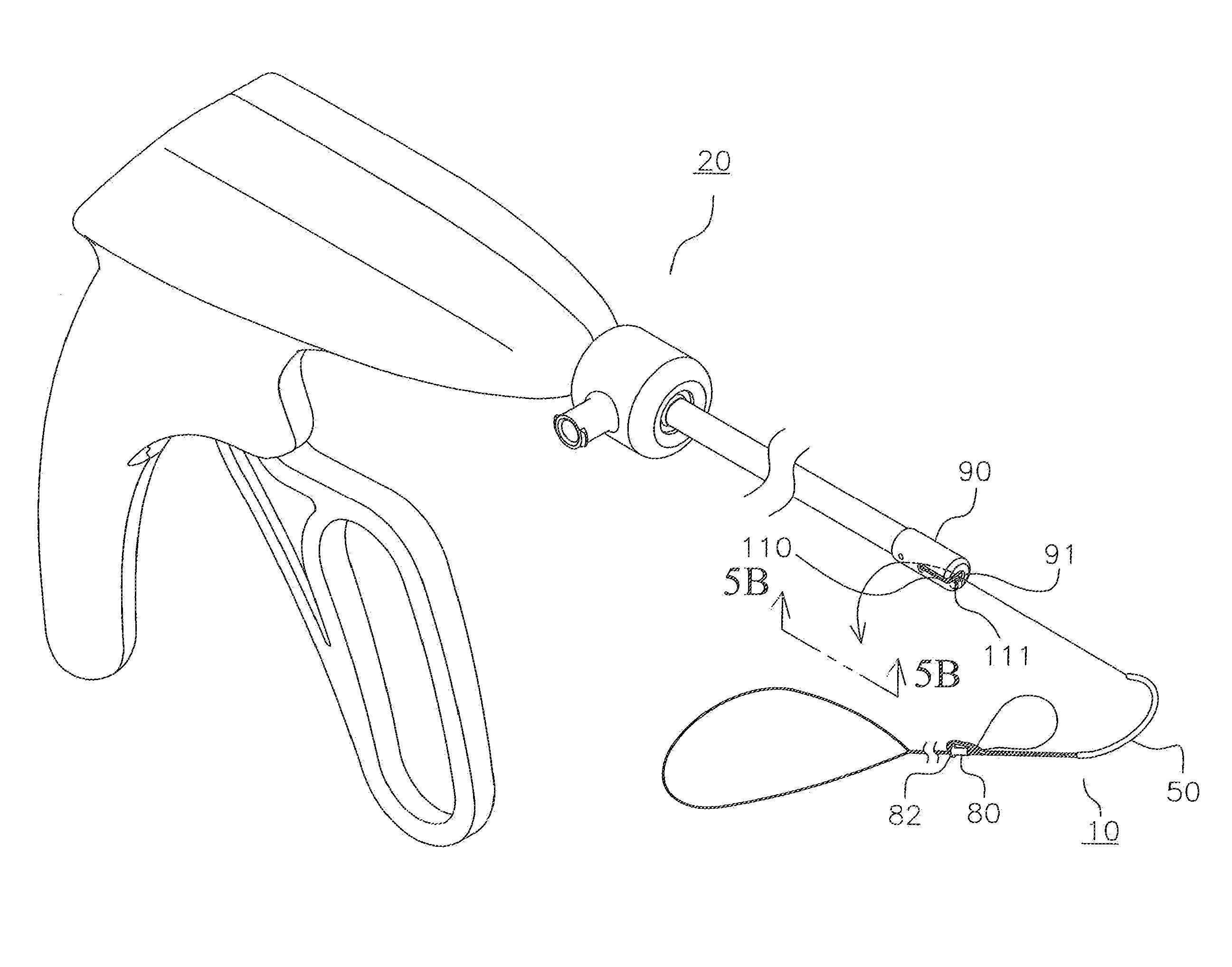
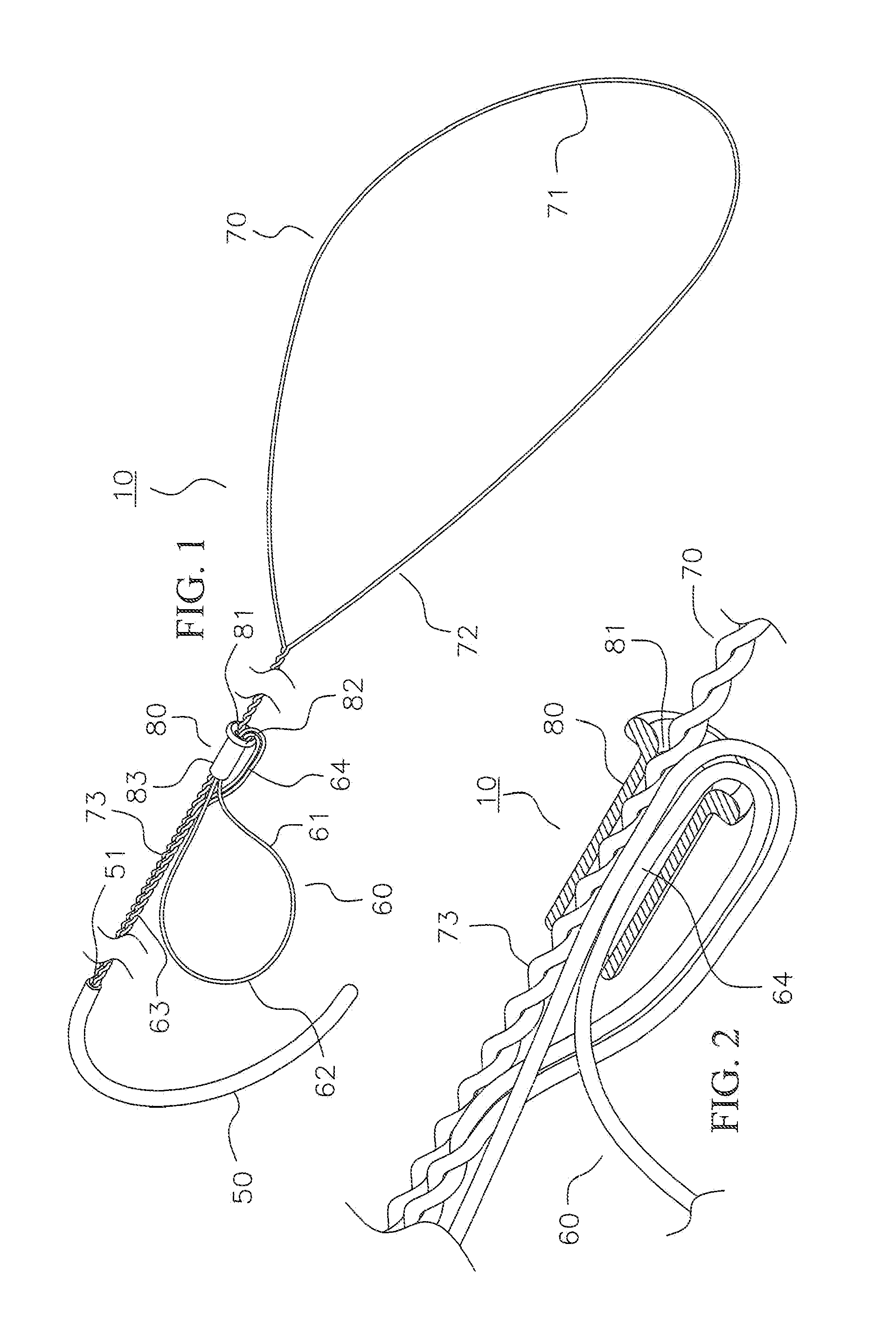
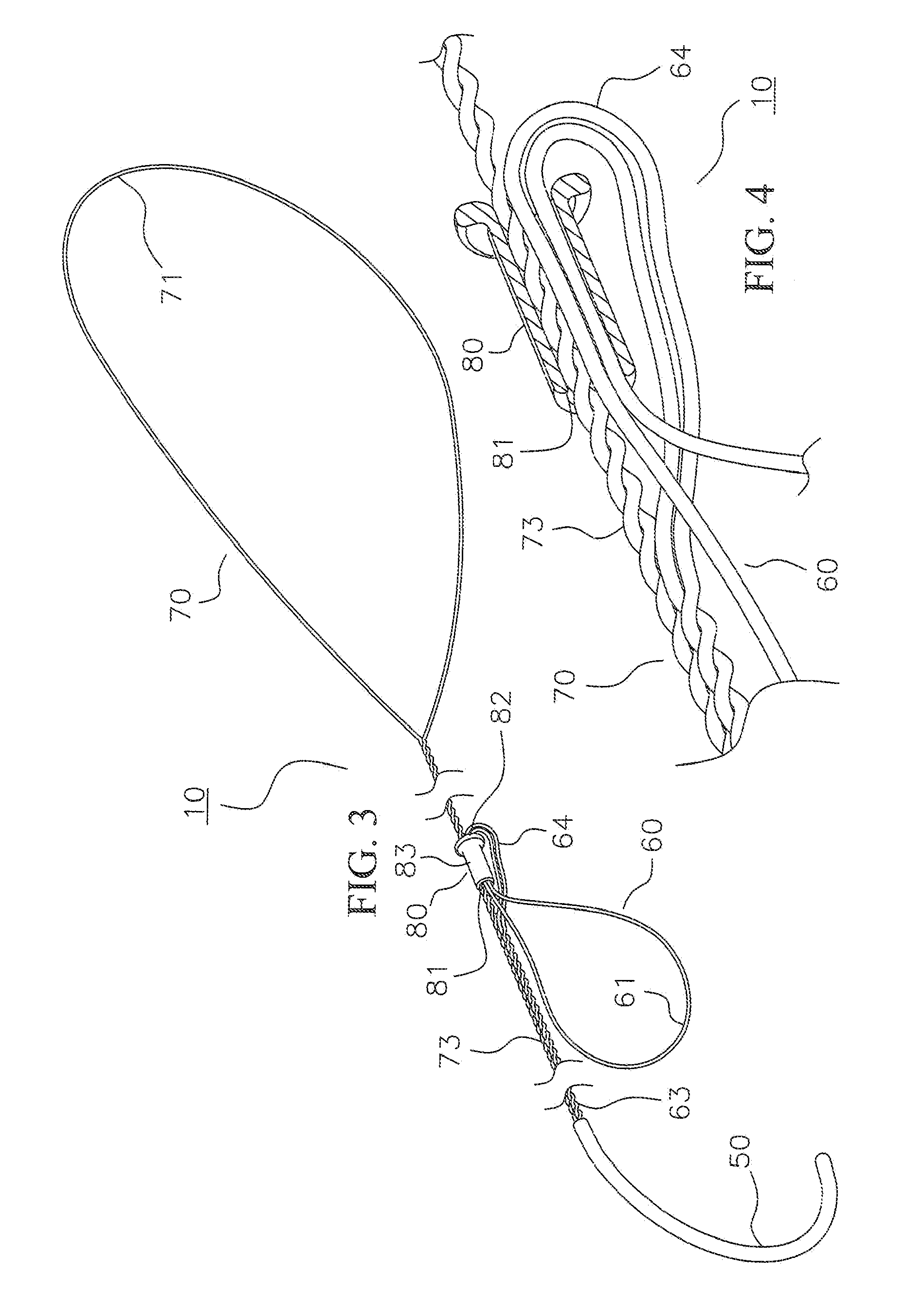
[0084]Referring to FIGS. 1 through 4, a bidirectional snare device 10 is shown. FIG. 1 is a distally oriented perspective view of the bidirectional snare device 10. The bidirectional snare device 10 consists of a curved handle 50 which fixedly holds a short wire snare 60 and a long wire snare 70 within a receiving bore 51. The curved handle 50 is typically comprised of a medical-grade stainless steel and formed in such a manner to allow for manipulation by the user. The short wire snare 60 and long wire snare 70 are also made from medical-grade stainless steel, but in small diameter wire form. The short wire snare 60 and long wire snare 70 pass through a wire bore 81 of a malleable sleeve 80. The sleeve is typically manufactured form a nonreactive, biocompatible material such as titanium and is fashioned that the distal end has an enlarged flange 82 connected to a body 83 of a slightly smaller diameter. The long wire snare 70 is formed by bending a length of wire 72 into a loop 71 w...