
Method and device for utilizing qualitative ratings to evaluate meetings
a qualitative rating and meeting technology, applied in the field of meeting productivity analytics, can solve the problems of not teaching an effective way of integrating objective (quantitative) data criteria with subjective (qualitative) criteria derived from users of the system, and not enough to determine whether the meeting was a success or no
- Summary
- Abstract
- Description
- Claims
- Application Information
AI Technical Summary
Benefits of technology
Problems solved by technology
Method used
Image

Examples
example 1
Use by a Meeting Participant
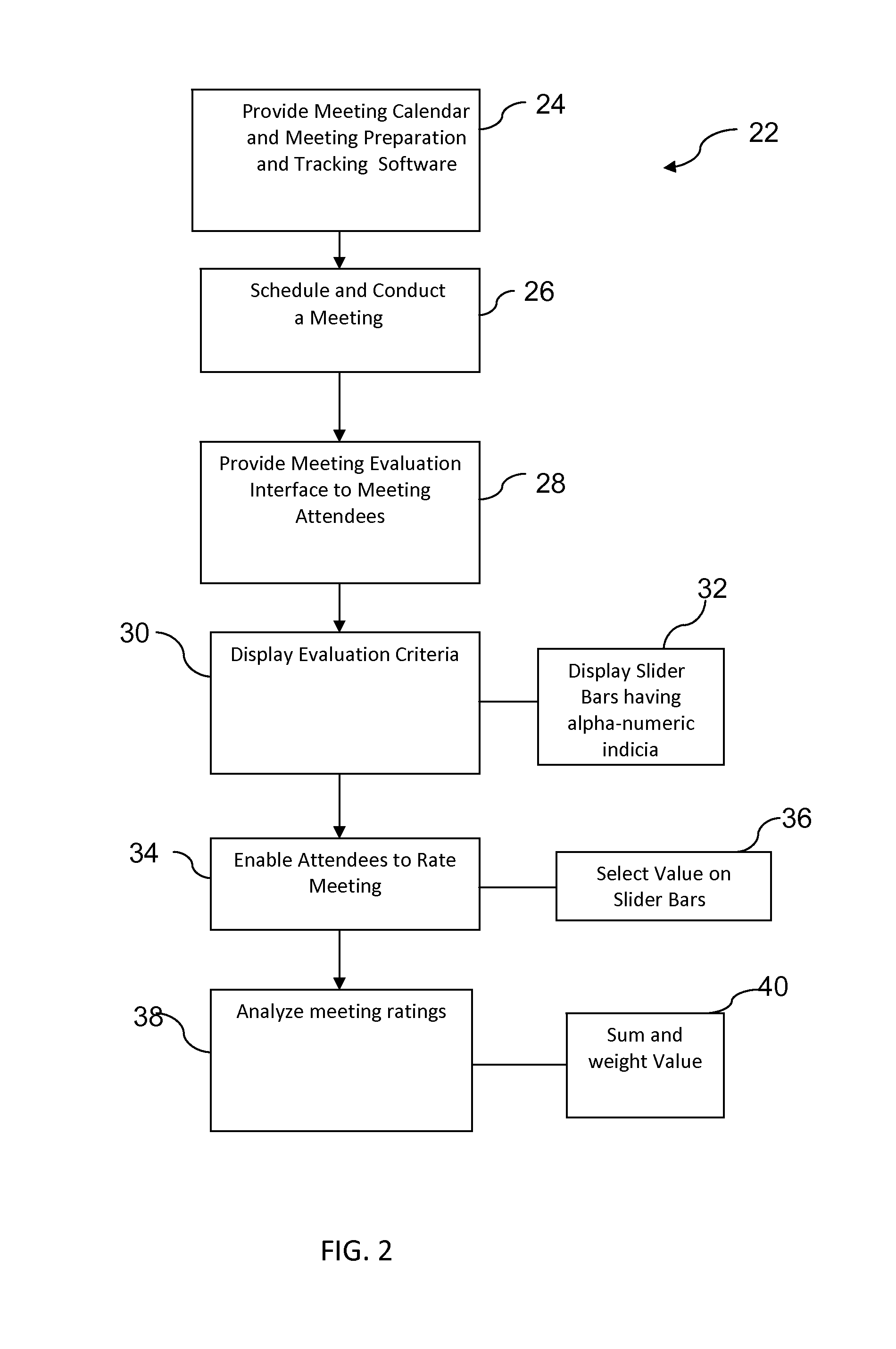
[0066]At the end of a meeting, a participant can use the Ratings feature of the application to provide a qualitative rating of how they felt the meeting went. In as little as 10 seconds, they can provide feedback on four key factors—the Goal & Agenda, the Preparations, the Process of the meeting itself, and the Outcomes generated from the meeting.
[0067]The rating derived, from a range of 0 to 10 (with 10 being highest), gives that individual's ranking, as well as indicating how the person felt about each of the elements, either positive or negative. It's not required, but a user can also provide specific comments about any or all of the four factors. The comments can be read mechanically by the client workstation and qualitative criteria can be derived from the comments. Appropriate algorithms for extracting data from free text are commonly known.
[0068]The ratings by each participant are averaged to provide an overall score for the meeting, along with ind...
example 2
Use by a Meeting Leader
[0069]The aggregate score gives an immediate indication of what went well in the meeting and what could have been better. Due to the timeliness of the feedback, it's even possible to correct issues or errors before everyone leaves the room, thus improving the effectiveness of the meeting.
[0070]Ratings for a given meeting are qualitative data that can be combined with other qualitative data, as well as quantitative data associated with the meeting leader to enable assessment of the meeting leader's overall performance. The ratings for a given meeting can also help assess the performance and skill of a team, department, or any other entity of which the meeting leader is a part.
[0071]These aggregated ratings, as displayed in a ratings dashboard, become incredibly useful tools for managers, teams, and senior management to assess the on-going effectiveness of an individual, a team, or even the company as a whole. Due to the frequency with which new ratings are gene...
example 3
Use by a Manager
[0072]The ratings provide a tool with which a manager can quickly and regularly track the quality of effort of staff. Exceptional results can be acknowledged promptly, and mediocre-to-negative results can be addressed immediately. Being able to adjust efforts so quickly provides a significant boost to the effectiveness of a team, since it helps keep everyone working toward the same objective in the most effective and supportive way possible.
[0073]As well, the ratings provide important trend data for a manager when it's time to conduct performance reviews. Areas of strength are quickly apparent, and aspects that need further work are also very obvious. Beyond the ratings themselves and one's skills at planning and conducting meetings, the ratings reveal skills of communication, planning, interpersonal skills, capacity to produce desired work, and more.
PUM
 Login to View More
 Abstract
Description
Claims
Application Information
 Login to View More