Information processing terminal, control method therefor, and non-transitory computer-readable medium
a technology of information processing terminal and control method, which is applied in the direction of digital transmission, instruments, data switching networks, etc., can solve the problems of imposing a load on the user of functions, and the display of the display order or display position of the selection target services displayed to the user is not always user-friendly, so as to improve usability
- Summary
- Abstract
- Description
- Claims
- Application Information
AI Technical Summary
Benefits of technology
Problems solved by technology
Method used
Image



Examples
first embodiment
[0040]An embodiment of the present invention will be described below with reference to the accompanying drawings.
[0041][Overview of Web Intents Mechanism]
[0042]A basic mechanism related to Web Intents as an example of a mechanism of cooperating with an arbitrary Web service (or Web application) without using a dedicated API will first be explained with reference to the accompanying drawings. Note that Web Intents will be described as a practical example in the present invention. It is, however, possible to apply another similar mechanism as a technique of service cooperation including an arbitrary Web service (or Web application).
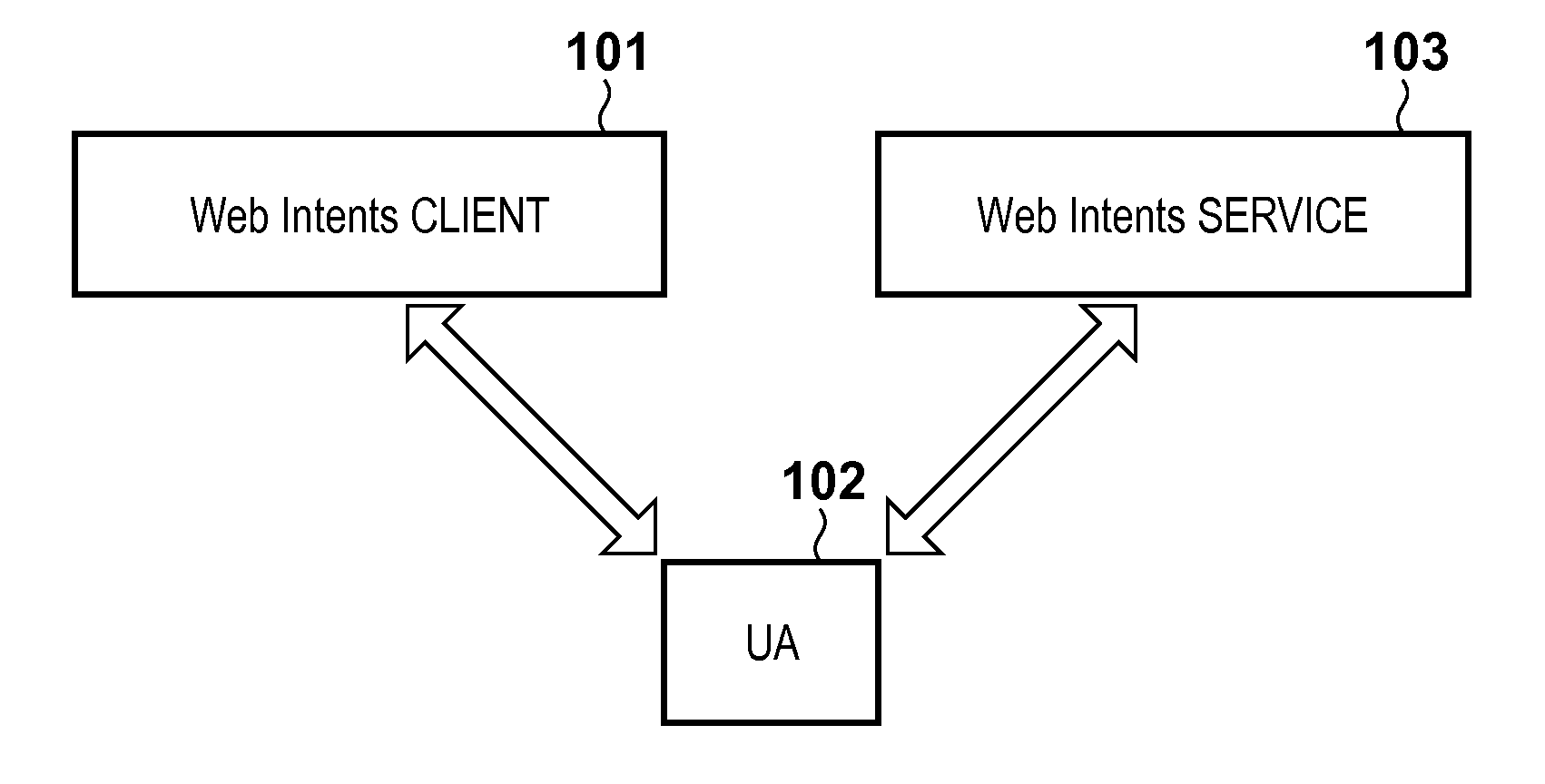
[0043]FIG. 1 is a view showing the overall arrangement of Web Intents. A Web Intents service 103 provides a service or function using the Intents technique. A Web Intents client 101 uses the service provided by the Web Intents service 103. A UA (User Agent) 102 transfers a request from the Web Intents client 101 to the Web Intents service 103. The UA 102 fu...
second embodiment
[0105]In the second embodiment, a method of deciding the display order of Web Intents services 103 depending on the login state of each Web Intents service account in a mobile terminal will be described.
[0106][System Configuration]
[0107]FIG. 14 is a view showing the relationship between a Web Intents client 101, a UA 102, and the Web Intents service 103 which are connected via the Internet according to this embodiment. In FIG. 14, a mobile terminal 1401 includes the Web Intents client 101 and UA 102 as in the first embodiment. In this embodiment as well, assume that the Web Intents client 101 corresponds to an application portion of the mobile terminal 1401, and the UA 102 corresponds to an OS portion. A Web Intents service 1402 corresponds to the above-described Web Intents service 103. In this example, the Web Intents service 1402 is a general-purpose computer representing a Web site (Web application) for providing a function or a service of, for example, editing or saving an imag...
third embodiment
[0134]In the third embodiment, a method of deciding a display order depending on whether a Web Intents service 103 is local application / service or a Web application / service to be used via a network will be described.
[0135]The relationship between a Web Intents client 101, a UA 102, and the Web Intents service 103 according to this embodiment is the same as that shown in FIG. 14 described in the second embodiment and a description thereof will be omitted. In this embodiment as well, assume that the Web Intents client 101 corresponds to an application portion of a mobile terminal 1401 and the UA 102 corresponds to an OS portion. The hardware arrangements and software arrangements of the mobile terminal 1401 and a Web Intents service 1402 are the same as those shown in FIGS. 6A, 15, 7A, and 16, respectively, and a description thereof will be omitted.
[0136][Table Structure]
[0137]FIG. 22 shows an example of a registered Web Intents service table held for an OS unit 710 of the mobile term...
PUM
 Login to View More
 Abstract
Description
Claims
Application Information
 Login to View More