
Microbial production of branched medium chain alcohols, such as 4-methylpentanol
- Summary
- Abstract
- Description
- Claims
- Application Information
AI Technical Summary
Benefits of technology
Problems solved by technology
Method used
Image

Examples
example 1
Production of 4-methyl-1-pentanol in E. coli
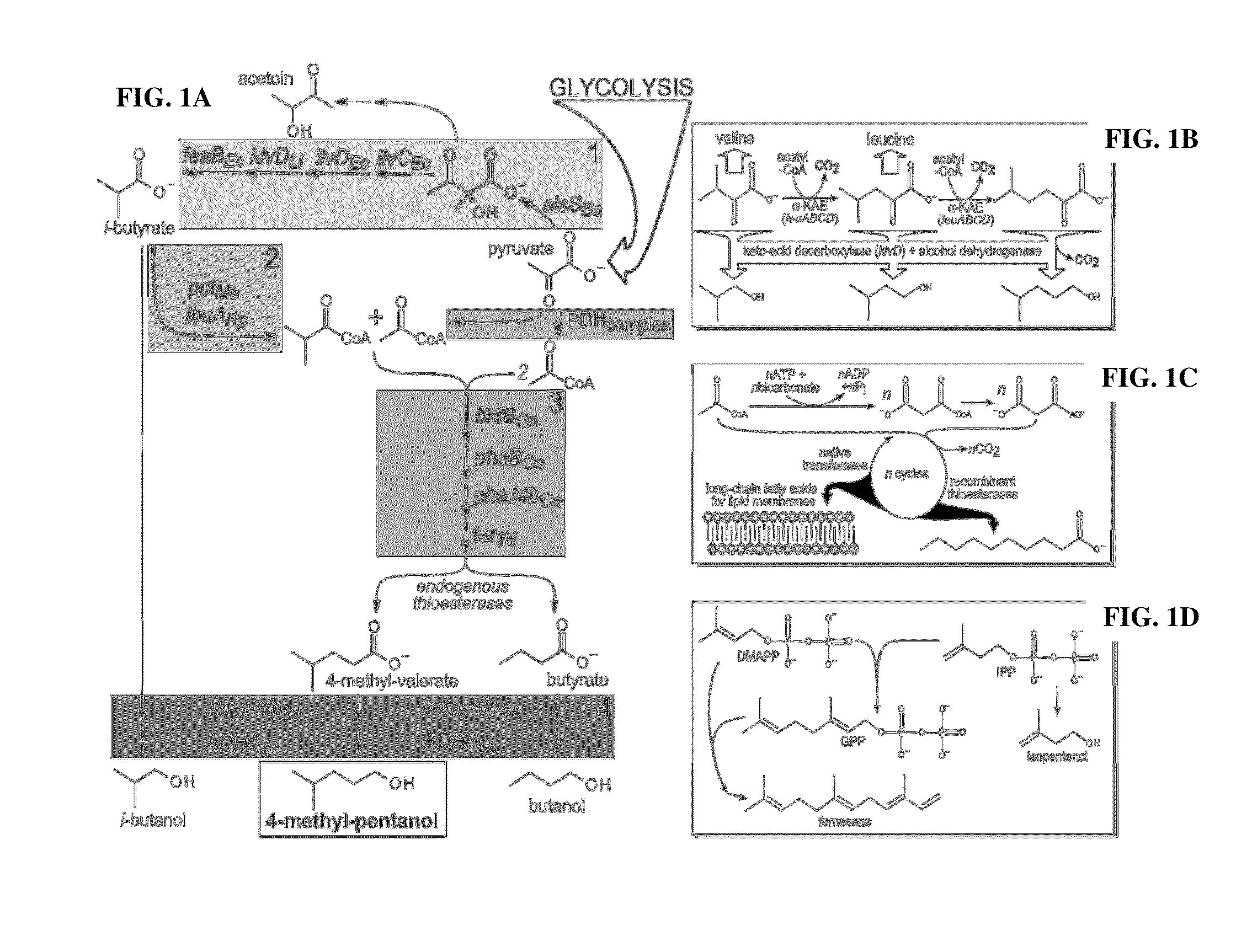
[0108]Production of C4 and C5 straight- and branched-chain alcohols via the Ehrlich pathway utilizes the α-keto acids tailored for synthesis of specific amino acids. The valine intermediate, α-ketoisovalerate (α-KIV), is extended by one carbon using the α-keto-acid-elongation pathway (αKAE) to generate α-ketoisocaproate, a precursor of leucine. Further extension of α-ketoacids to make longer chain alcohols is rare in nature. αKAE has also been implicated as the pathway to medium-chain acids and alcohols in certain plant species (van der Hoeven 2000). Recently Zhang et al. used protein engineering to identify αKAE enzymes for the synthesis of medium-chain alcohols (Zhang 2008). However, the described αKAE pathway maintains preference for the synthesis of shorter intermediates and the overall pathway chemistry is inefficient, releasing one CO2 for every carbon added during elongation (FIG. 1B).
[0109]Contrarily, fatty acid synthases (FASs) p...
PUM
| Property | Measurement | Unit |
|---|---|---|
| Density | aaaaa | aaaaa |
Abstract
Description
Claims
Application Information
 Login to View More