Simplified inverted v-tail stabilizer for aircraft

a stabilizer and aircraft technology, applied in the direction of aircrafts, fuselages, transportation and packaging, etc., can solve the problems of limiting the wing portion of the aircraft and achieve the effect of reducing the number of control surfaces, reducing construction costs, and simplifying design

US20160052619A1Inactive Publication Date: 2016-02-25GAGLIANO CHRISTOPHER
10 Cites 5 Cited by

Patent Information

Authority / Receiving Office
US · United States
Patent Type
Applications(United States)
Current Assignee / Owner
Publication Date
2016-02-25
Estimated Expiration
Not applicable · inactive patent

Smart Images

  • Figure 1
    Figure 1
  • Figure 2
    Figure 2
  • Figure 3
    Figure 3
Patent Text Reader

Abstract

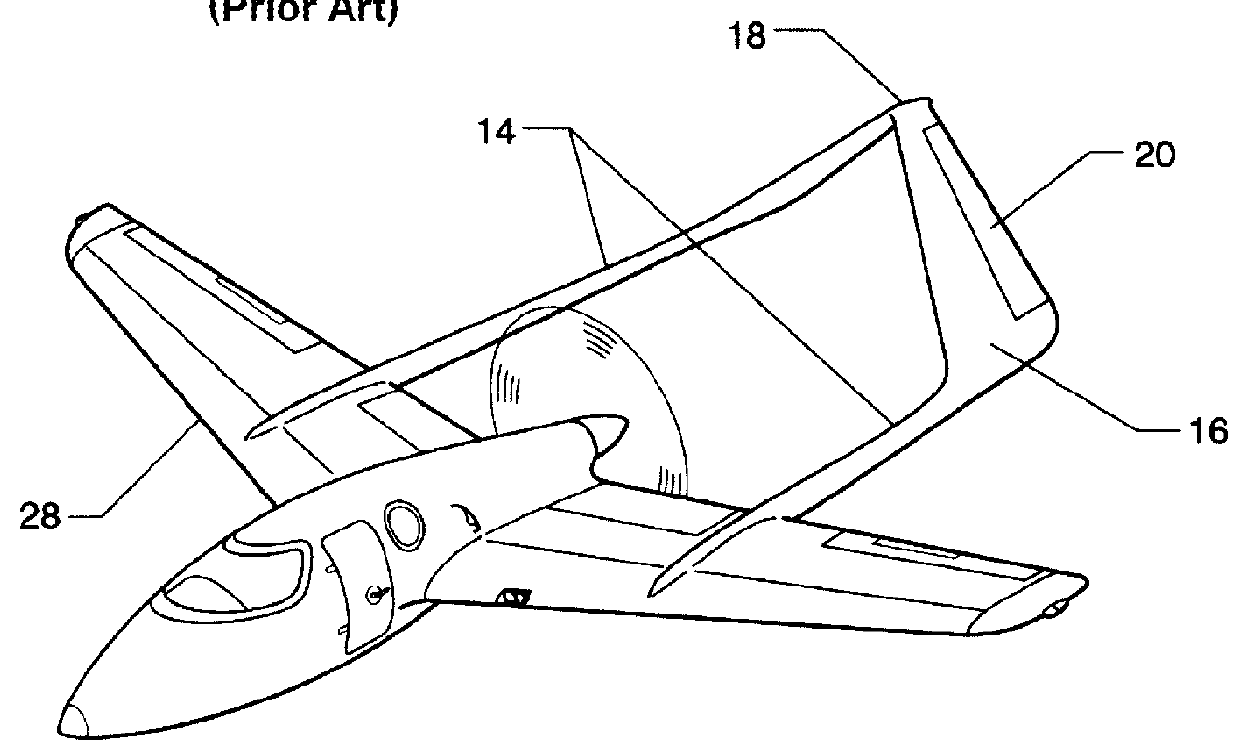
The simplified inverted V-tail aircraft comprise of fixed inverted V-tail stabilizers, wing mounted elevons, with no moving control surfaces attached to the fixed inverted V-tail stabilizers. Elevons act as elevators as well as aileron elements and rudders and the design is simplified, making construction far less costly. No control cables or other control devices are required to be routed to the inverted V-tail. Moreover, the number of control surfaces is reduced and limited to the wing portion of the aircraft. The inverted V-tail may thus be made in one piece, for example, using composites, thus simplifying construction considerably.
Need to check novelty before this filing date? Find Prior Art

Description

CROSS-REFERENCE TO RELATED APPLICATIONS

[0001] The present application claims priority from Provisional U.S. Patent Application No. 61 / 908,064 filed on Dec. 19, 2013, and incorporated herein by reference.FIELD OF THE INVENTION

[0002] The present invention relates to stabilizing an aircraft in flight, specifically an improved structure over conventional and non-conventional aircraft designs to include flying wing type aircraft.BACKGROUND OF THE INVENTION

[0003] Applicant's previous U.S. Pat. No. 5,979,824, issued Nov. 9, 1999, is incorporated herein by reference. In that patent, it was noted that aircraft have been flown with various tail arrangements, or no tail arrangement, also known as a flying wing since the original Wright Brothers aircraft of 1903.

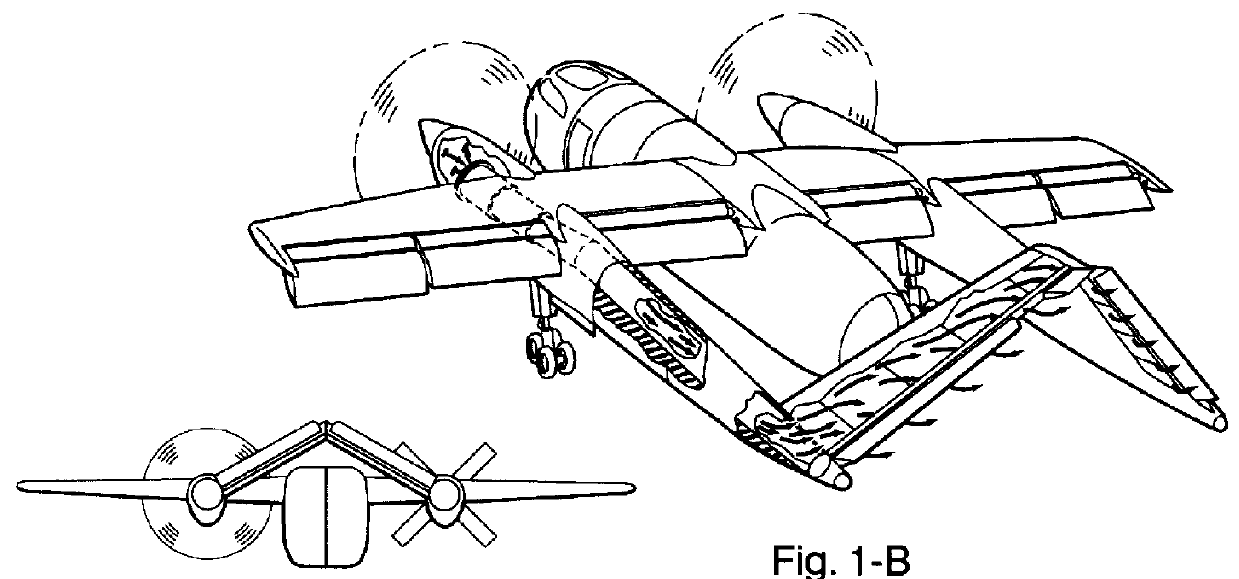
[0004] FIG. 1-A and FIG. 1-B illustrate a prior art conventional inverted “V” tail. One type of aircraft (FIG. 1-A) known as the conventional inverted “V” tail has been flown and tested showing evidence of improved performance but the overa...

Examples

Embodiment Construction

[0044]The innovative design as described below yields a number of unique and sustaining advantages that are currently not found in the most advanced, state of the art aircraft.

[0045]This invention referred to in this Provisional Patent Application is called a “Simplified Inverted V-Tail Stabilizer for Aircraft” and was discovered while working on a new aviation product as defined by Gagliano, U.S. Pat. No. 5,979,824, entitled “Stabilizer Fins-Inverted for Aircraft,” issued Nov. 9, 1999 and incorporated by reference. Extensive research regarding the best, most reliable way to control an aircraft lead the inventor to combine superior features of both Inverted V-Tail stabilizers and new elevon controls used on the Northrop YB-35 and the Northrop Grumman B2 aircraft.

[0046]Simplified Inverted V-Tail Stabilizers can be used in various types of aircraft, such as small general aviation aircraft, unmanned air vehicles (UAV) and military or commercial aircraft. The superior simplicity of a Si...