
Flip-flops with low clock power
a flip-flop and clock power technology, applied in the direction of pulse generators, pulse techniques, electrical apparatus, etc., can solve the problems of clock power consumption and critical clock power in flip-flops to the overall digital power consumption
- Summary
- Abstract
- Description
- Claims
- Application Information
AI Technical Summary
Benefits of technology
Problems solved by technology
Method used
Image

Examples
Embodiment Construction
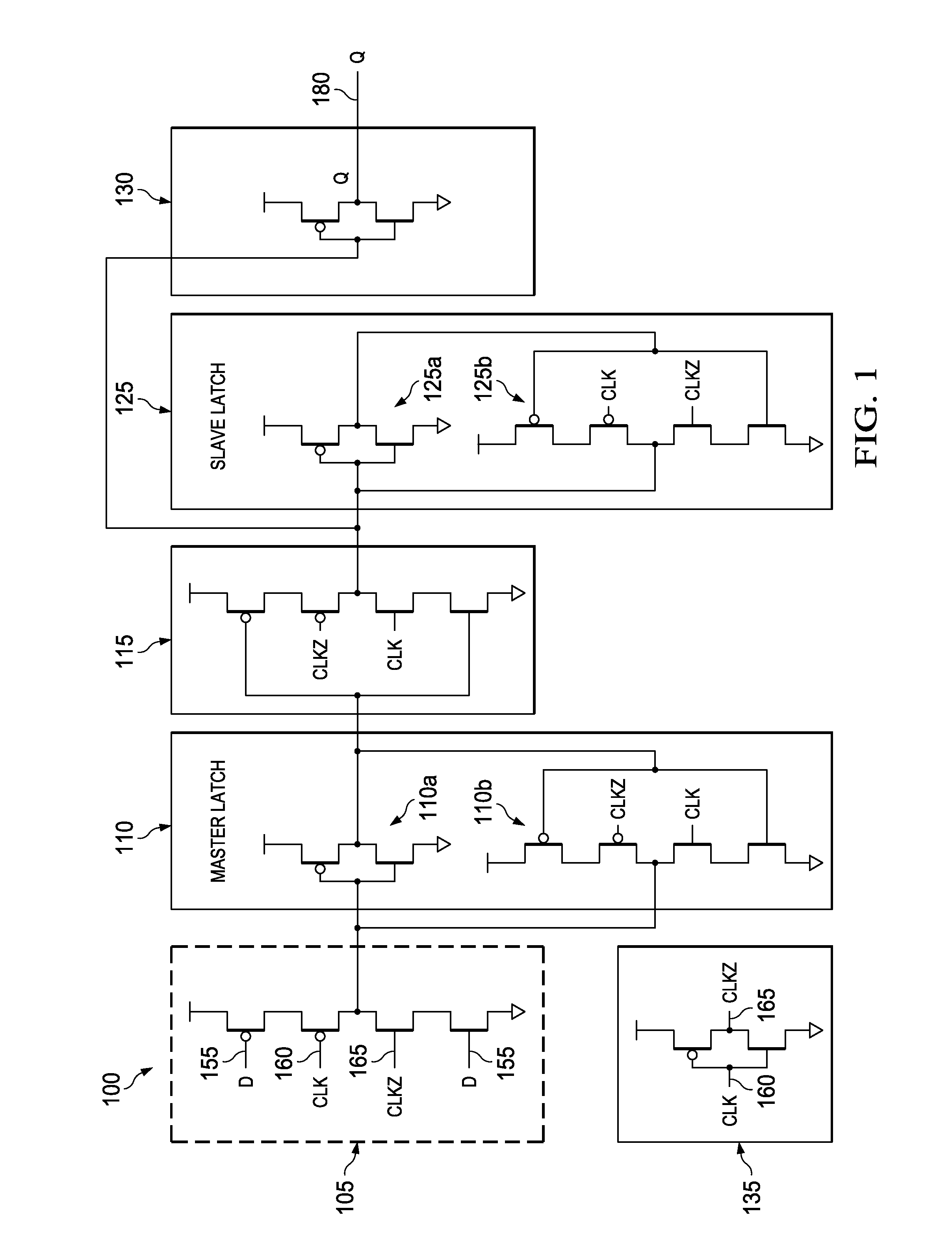
[0014]FIG. 1 illustrates a schematic of a flip-flop 100. The flip-flop 100 receives a flip-flop input D 155, a clock input CLK 160 and an inverted clock input CLKZ 165. A tri-state inverter 105 is coupled to a master latch 110. The output of the master latch 110 is received at a tri-state inverter 115. A slave latch 125 is coupled to the tri-state inverter 115. The master latch 110 and the slave latch 125 are implemented using two back-to-back inverters.
[0015]The back-to-back inverters include an inverter 110a and a tri-state inverter 110b in the master latch 110 and an inverter 125a and a tri-state inverter 125b in the slave latch 125. An output of the slave latch 125 is equal to an output of tri-state inverter 115. The output of the slave latch 125 is received at a data inverter 130. The data inverter 130 generates a flip-flop output Q 180. An inverter 135 receives the clock input CLK 160 to generate the inverted clock input CLKZ 165.
[0016]The operation of the flip-flop illustrate...
PUM
 Login to View More
 Abstract
Description
Claims
Application Information
 Login to View More