
Low reflective and superhydrophobic or super water-repellent glasses and method of fabricating the same
- Summary
- Abstract
- Description
- Claims
- Application Information
AI Technical Summary
Benefits of technology
Problems solved by technology
Method used
Image

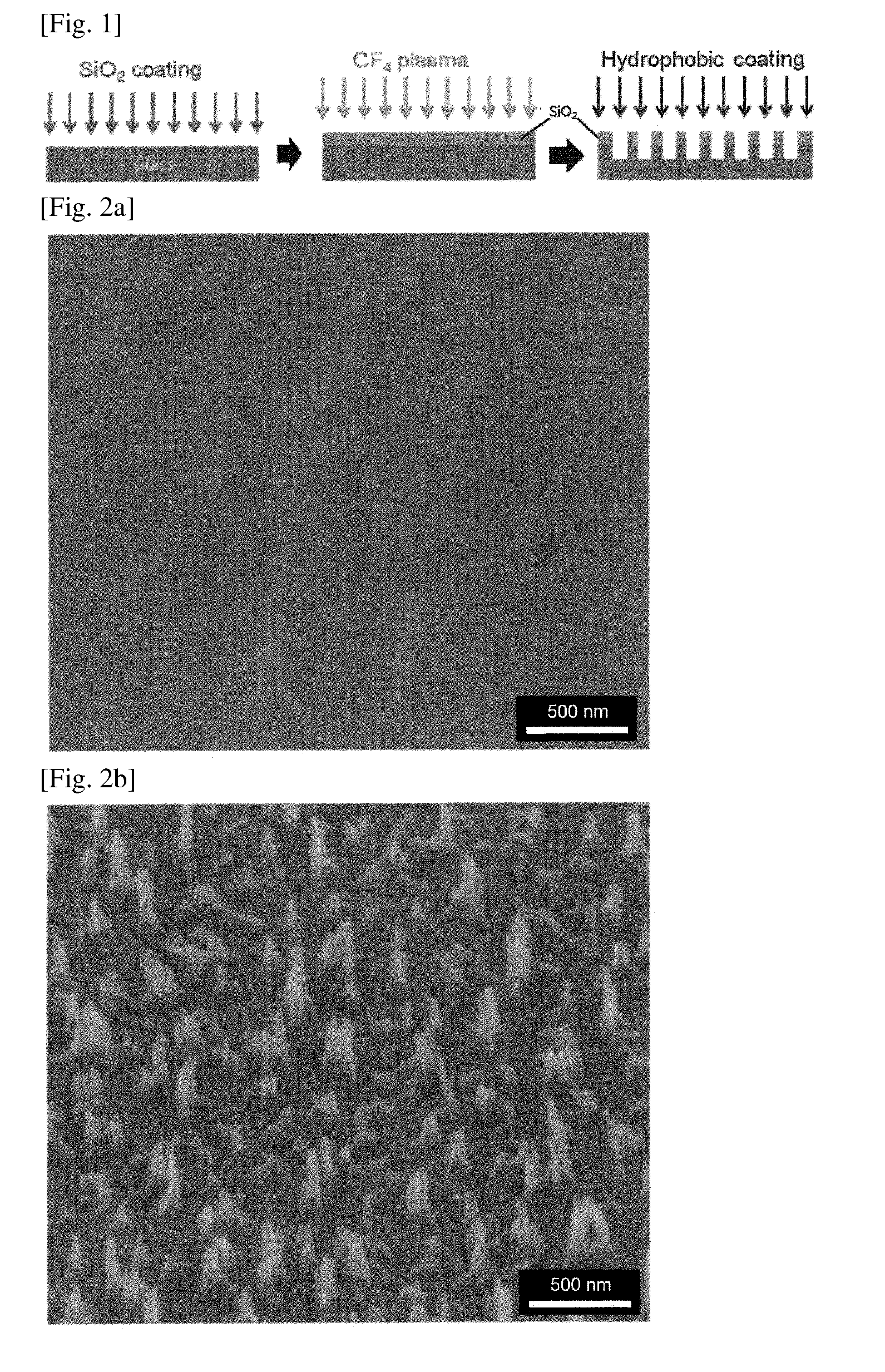
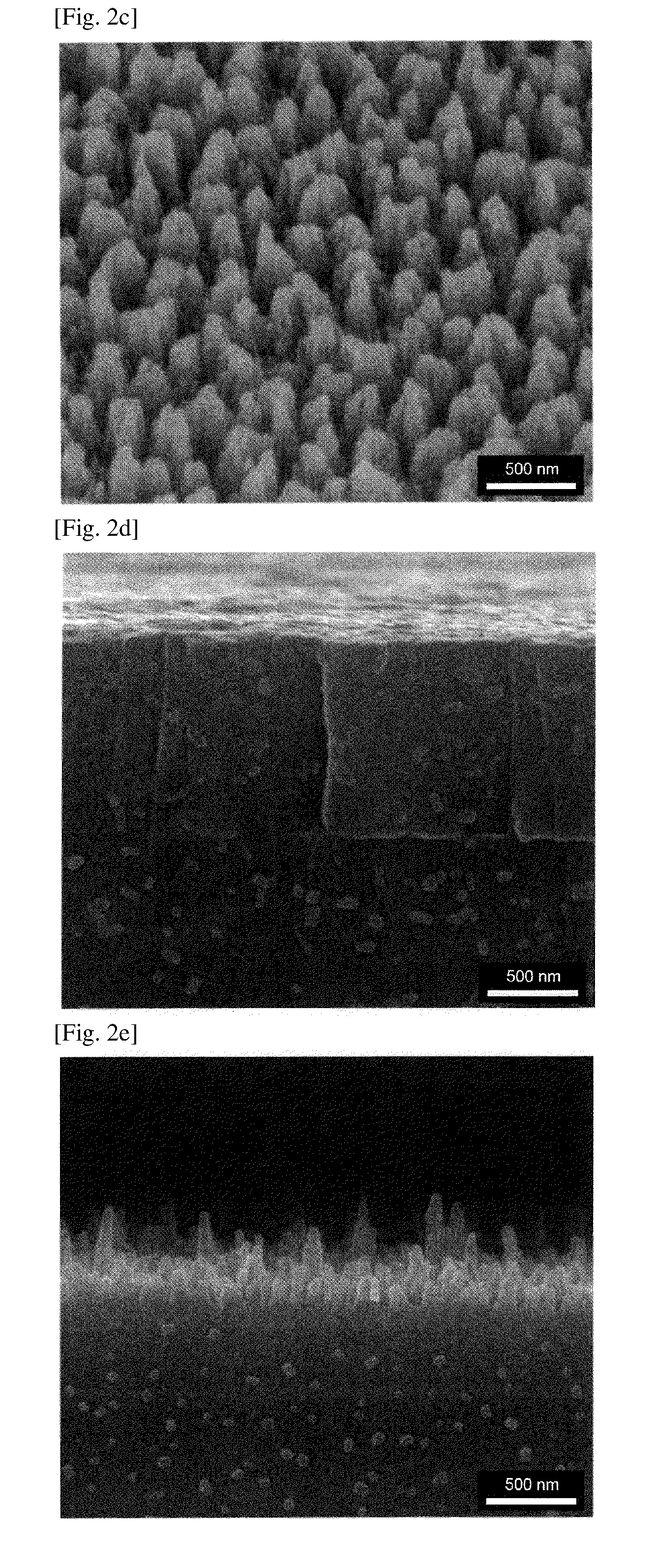
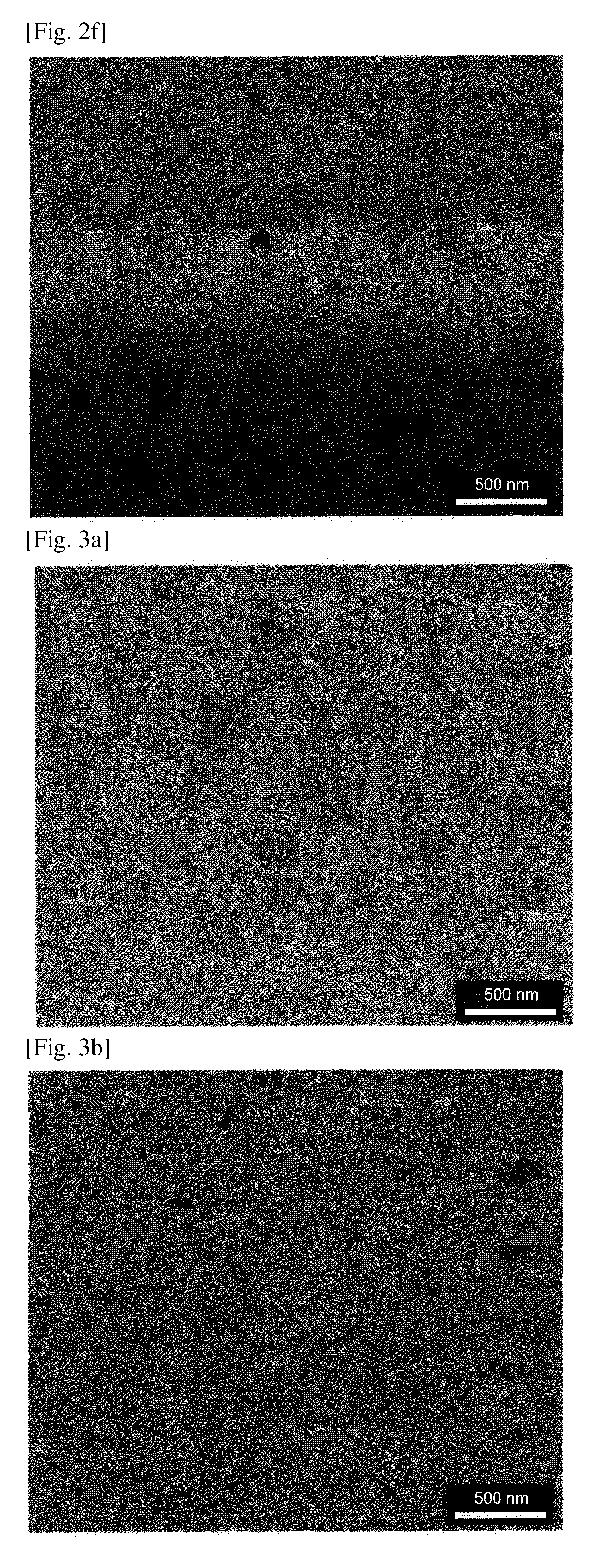
Examples
Example
Comparative Example 1
[0078]Characteristic evaluation was carried out for a sample as a glass of Comparative Example 1, which was obtained without SiO2 thin film deposition or CF4 plasma treatment with respect to the glass which was the same as the general glass (soda lime glass) used in Example 1.
[0079]Fabrication of the Glass of Comparative Examples 2-1 to 2-6
[0080]Each glass of Comparative Examples 2-1 to 2-6 was produced by CF4 plasma treatment without a SiO2 thin film deposition on the glass which was the same as the general glass (soda lime glass) used in Example 1. The CF4 plasma treatment was the same as that carried out in each of Examples 1-1 to 1-6. The etched glass of each of Comparative Examples 2-1 to 2-6, which was the glass whose surface was etched by the CF4 plasma treatment, was coated with a hydrophobic thin film, equally as done in Examples 1-1 to 1-6, thereby fabricating samples of Comparative Examples 2-1 to 2-6.
[0081]To correspond to Examples 1-1 to 1-6 describ...
PUM
| Property | Measurement | Unit |
|---|---|---|
| Time | aaaaa | aaaaa |
| Time | aaaaa | aaaaa |
| Thickness | aaaaa | aaaaa |
Abstract
Description
Claims
Application Information
 Login to View More