

Encoding device, decoding device, encoding method, decoding method, and non-transitory computer-readable recording medium
a computer-readable recording medium and encoding device technology, applied in the field of encoding device, decoding device, encoding method, decoding method, etc., can solve the problems of reducing subjective quality, generating noise that sounds like a ringing bell, and contradicting the efficient use of radio waves or frequency bands, so as to reduce the overall bit rate and improve the quality
- Summary
- Abstract
- Description
- Claims
- Application Information
AI Technical Summary
Benefits of technology
Problems solved by technology
Method used
Image



Examples
first embodiment
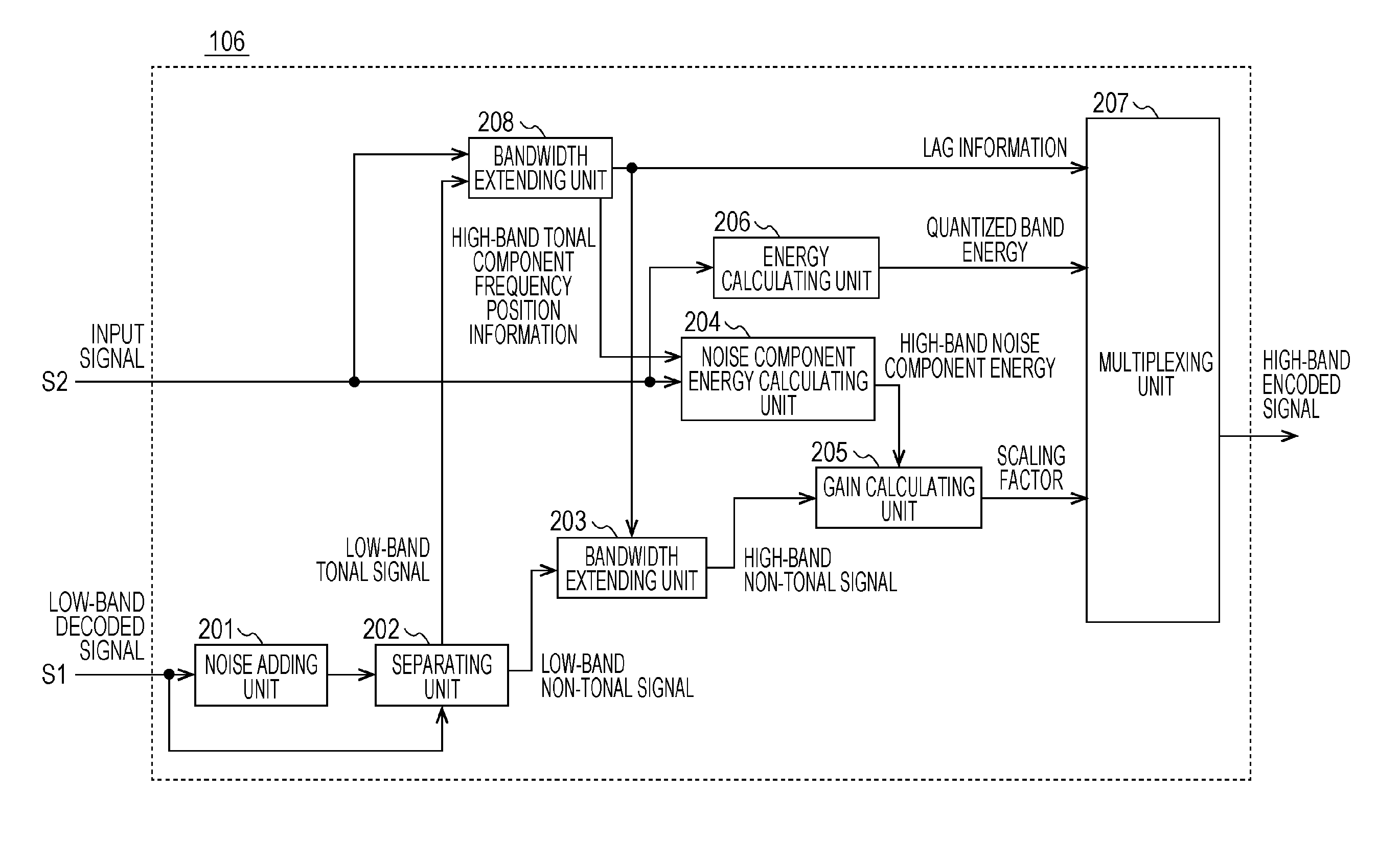
[0024]FIG. 1 is a block diagram illustrating a configuration of an encoding device for a voice signal and the like according to a first embodiment. An exemplary case will be described in which an encoded signal has a layered configuration including a plurality of layers; that is, a case of performing hierarchical coding (scalable encoding) will be described. An example that encompasses encoding other than scalable encoding will be described later with reference to FIG. 4. An encoder 100 illustrated in FIG. 1 includes a downsampling unit 101, a first layer encoding unit 102, a multiplexing unit 103, a first layer decoding unit 104, a delaying unit 105, and a second layer encoding unit 106. In addition, an antenna, which is not illustrated, is connected to the multiplexing unit 103.
[0025]The downsampling unit 101 generates a signal having a low sampling rate from an input signal and outputs the generated signal to the first layer encoding unit 102 as a low-band signal having a frequen...
second embodiment
[0050]Next, a configuration of an encoding device according to a second embodiment of the present disclosure will be described with reference to FIG. 3. Note that the overall configuration of an encoding device 100 according to this embodiment has the configuration illustrated in FIG. 1, as in the first embodiment.
[0051]FIG. 3 is a block diagram illustrating a configuration of a second layer encoding unit 106 in this embodiment, differing from the second layer encoding unit 106 in the first embodiment in that the position relationship of the noise adding unit and the separating unit is inverted and that a separating unit 302 and a noise adding unit 301 are included.
[0052]From a low-band decoded signal S1, the separating unit 302 separates a low-band non-tonal signal, which is a non-tonal component, and a low-band tonal signal, which is a tonal component. The separation method used is the same as that in the description of the first embodiment, and the separation is performed accordi...
third embodiment
[0064]FIG. 5 is a block diagram illustrating a configuration of a voice signal decoding device according to a third embodiment. As an example, in the following description, an encoded signal is a signal that has a layered configuration including a plurality of layers and that is transmitted from an encoding device, and the decoding device decodes this encoded signal. Note that an example in which an encoded signal does not have a layered configuration will be described with reference to FIG. 8.
[0065]A decoder 400 illustrated in FIG. 5 includes a demultiplexing unit 401, a first layer decoding unit 402, and a second layer decoding unit 403. An antenna, which is not illustrated, is connected to the demultiplexing unit 401.
[0066]From an encoded signal input through the antenna, which is not illustrated, the demultiplexing unit 401 demultiplexes a low-band encoded signal, which is a first encoded signal, and a high-band encoded signal. The demultiplexing unit 401 outputs the low-band en...
PUM
 Login to View More
 Abstract
Description
Claims
Application Information
 Login to View More