

Method and device for HTTP streaming over unreliable transport protocol
a technology of unreliable transport protocol and method, applied in the field of data transmission, can solve problems such as delays, and achieve the effect of reducing transmission latencies and sufficient reliability
- Summary
- Abstract
- Description
- Claims
- Application Information
AI Technical Summary
Benefits of technology
Problems solved by technology
Method used
Image



Examples
first embodiments
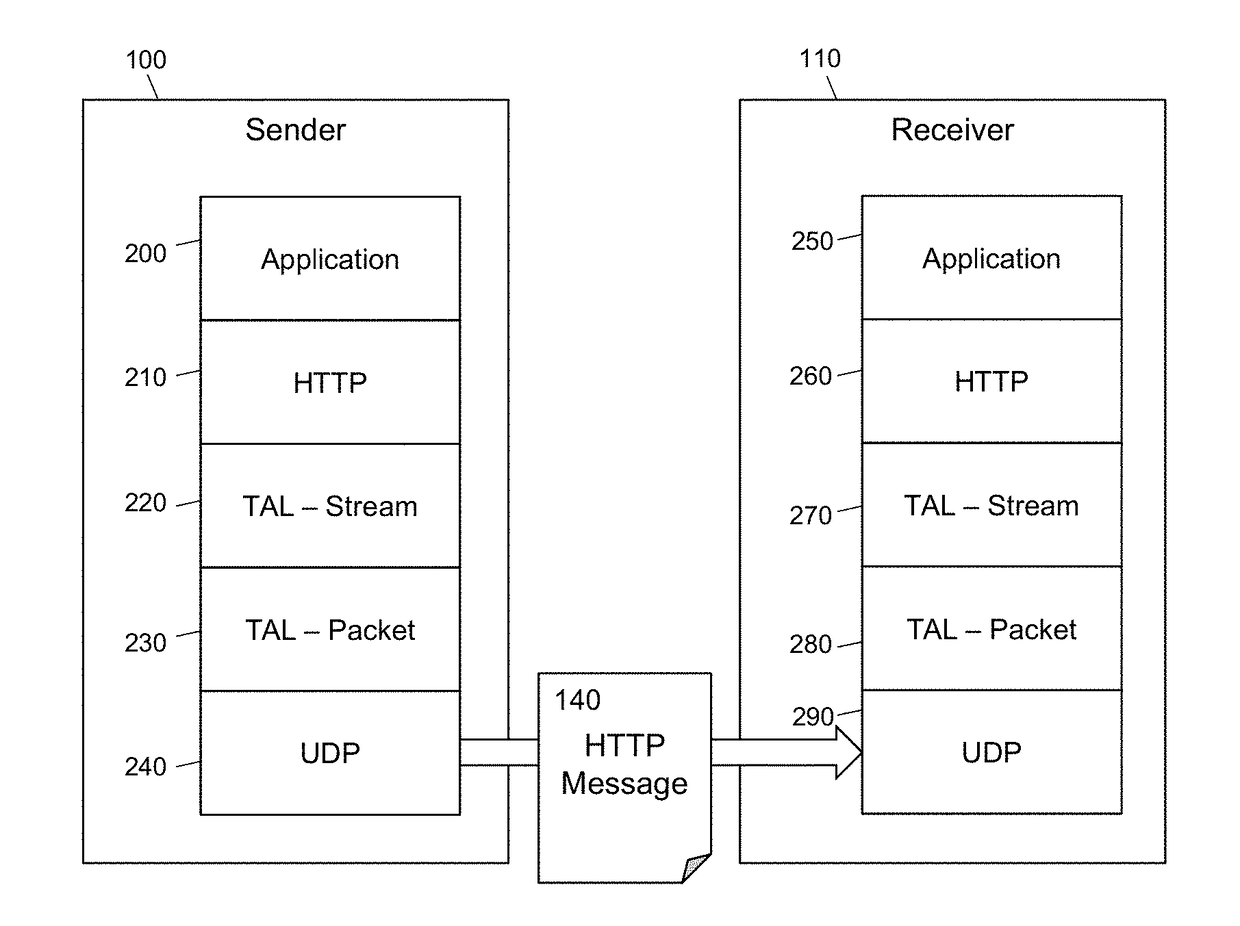
[0072]The first problem to solve for enabling the unreliable transmission of HTTP messages is to be able to signal that a message is sent in an unreliable way.
[0073]Indeed, there is a need for the sender to inform the receiver that a HTTP message is transferred unreliably. Second, at both the sender and receiver sides, all the layers processing the HTTP message need to be informed that the message is transferred unreliably.
[0074]Sender Side-Signalling
[0075]FIGS. 3a and 3b describes the signalling on the sender side (either at a client or at a server). FIG. 3a illustrates the flowchart and FIG. 3b gives a representation of the inter-layer signalling based on the architecture of FIG. 2.
[0076]First (300), the application determines that a HTTP message will be transferred unreliably. It may rely on different mechanisms for doing this. For example a server may be configured to return a set of HTTP responses in an unreliable way. It may also be configured to return a type of HTTP response...
second embodiments
on
[0200]The second problem to solve for enabling the unreliable transmission of TA packets is to be able to inform the receiver, in case a TA packet containing only unreliable TA frames is lost, that the TA packet was sent unreliably and it will not be retransmitted.
[0201]Delayed Unreliability Transmission
[0202]FIG. 8 describes an algorithm used by the sender to inform the receiver that a missing TA packet was sent unreliably.
[0203]First (800), the sender detects that the receiver has not received a previously sent TA packet. This detection is realized through the normal TAL processing for loss detection (may be similar to TCP). For example, the sender receives a NACK (Non-Acknowledgement) for the TA packet, or it doesn't receives an acknowledgement in a predetermined timeframe for the TA packet after the sending of the packet.
[0204]Then, the sender checks (810) whether the TA packet was reliable or not. As described previously a TA packet is unreliable only if all the TA frames it ...
third embodiments
cessing
[0325]The third problem to solve is on the receiver side to transmit in a timely manner the received data, even when part of it is lost. In particular, the TA layers should detect that some data belonging to a HTTP message transmitted unreliably has been lost and inform in a timely manner the HTTP layer and indirectly the application layer.
[0326]This problem can be split into three sub-problems, the first one being the detection of a TA packet loss in relation with a TA stream. The second problem is the evaluation of the size of the data contained in the lost packet. The third problem is deciding upon the replacement content to transmit to the HTTP layer.
[0327]Solution Overview:
[0328]Determining Some Data is Lost
[0329]Receiver[0330]Upon receiving one (or more) data frame after one (or more) non received frame[0331]Decide the one (or more) non received frame are lost[0332]After receiving a frame for a stream[0333]Compute an expected delay between two frames for the stream[0334...
PUM
 Login to View More
 Abstract
Description
Claims
Application Information
 Login to View More