Method and System for Image Registrations

a technology of image registration and image, applied in the field of computer vision, can solve problems such as poor matching accuracy, and achieve the effects of improving image registration accuracy, maintaining efficiency, and improving registration

US20180053293A1Active Publication Date: 2018-02-22MITSUBISHI ELECTRIC RES LAB INC
2 Cites 23 Cited by

Patent Information

Authority / Receiving Office
US · United States
Current Assignee / Owner
Publication Date
2018-02-22

Smart Images

  • Figure 1
    Figure 1
  • Figure 2
    Figure 2
  • Figure 3
    Figure 3
Patent Text Reader

Abstract

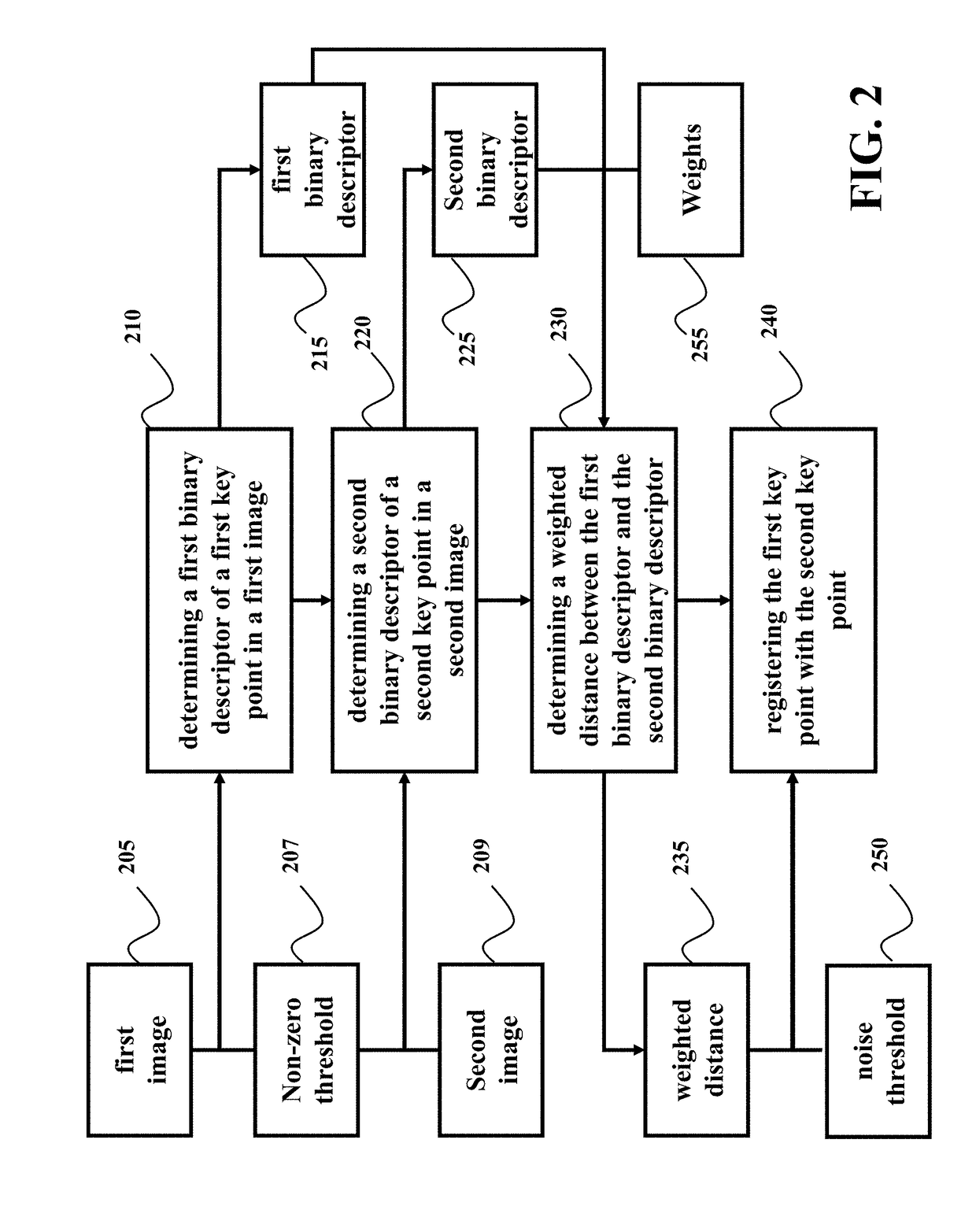
An image registrations includes determining a first binary descriptor of a first key point in a first image, determining a second binary descriptor of a second key point in a second image, determining a weighted Hamming distance between the first binary descriptor and the second binary descriptor, and registering the first key point with the second key point when the weighted Hamming distance is below a noise threshold. At least one element in the first or the second binary descriptor is a result of a comparison of a difference between intensities of at least two pixels of the first or the second image with a threshold. At least two weights of the weighted Hamming distance for comparing at least two elements of the first or the second binary descriptors are different.
Need to check novelty before this filing date? Find Prior Art

Description

FIELD OF THE INVENTION

[0001] This invention relates generally to computer vision, and more particularly to registration of different images.BACKGROUND OF THE INVENTION

[0002] Image registration is the process of transforming different sets of data of different images into one coordinate system. Data may be multiple photographs, data from different sensors, times, depths, or viewpoints. The image registration is used in computer vision, medical imaging, biological imaging and brain mapping, and compiling and analyzing images and data from satellites. Registration is necessary in order to be able to compare or integrate the data obtained from these different measurements and to perform various computer vision actions.

[0003] Image registration or image alignment algorithms can be classified into intensity-based and feature-based. One of the images is referred to as the reference or source and the others are respectively referred to as the target, sensed or subject images. Image registratio...

Examples

example embodiments

[0060]FIG. 6 shows a schematic of a system according to one embodiment of the invention. The system includes a first sensor 601 to measure a scene to produce a first set of measurements 603 of the scene and a second sensor 602 to measure the scene to produce a second set measurements 604 of the scene. For example, the first sensor 601 is a LIDAR and the second sensor 602 is a camera. The system extracts

[0061]keypoints and descriptors 605 from the LIDAR image. Similarly, the system extracts keypoints and descriptors 606 from the intensity image. The system uses weighted hamming distance 607 to match the LIDAR and intensity image. Using the matches, the system can obtain sensor fusion 608.

[0062]FIG. 6B shows a schematic of a system according to another embodiment of the invention. The system acquires a day time image 621 and a night time image 622. The system extracts keypoints and descriptors 623 from the day time image and extracts keypoints and descriptors 624 from the night time i...