

RF heat dissipation plastic, method for manufacturing RF heat dissipation plastic, and repeater cabinet using same
a heat dissipation plastic and repeater cabinet technology, applied in the field of rf heat dissipation plastic, can solve the problems of increasing the loss of heat dissipation, expressing and the inability to uniformly express characteristics in the entire area, so as to achieve excellent mechanical strength and excellent heat dissipation performance. , excellent heat dissipation performan
- Summary
- Abstract
- Description
- Claims
- Application Information
AI Technical Summary
Benefits of technology
Problems solved by technology
Method used
Image



Examples
preparation example 1
Filler
[0096]First, in order to prepare a first filler, cellulose nanofibrils as a high-strength filler and tetrahydroxysilane (TEOS) as an inorganic coating precursor were treated at a weight ratio of 1:30 and reacted for 8 hours, and by aging the reacted high-strength filler for 1.5 hours, first fillers as shown in in FIGS. 3 and 4 in which an inorganic coating layer was formed on the surface of the high-strength filler were prepared. In this case, in the prepared first filler, the average cross-sectional diameter of the high-strength filler was 10 μm and the average thickness of the inorganic coating layer was 15 nm, and the prepared first filler had 150 parts by weight of the inorganic coating layer based on 100 parts by weight of the high-strength filler.
preparation example 2
Filler
[0097]First, in order to prepare a second filler, graphite with nickel (Ni) nanoparticles formed on the surface at 23° C. and in an atmospheric state was immersed in a coating composition in which dopamine at a concentration of 2 mM, 13 parts by weight of sodium periodate (Na2S2O8) as an oxidizing agent and 20 parts by weigh of a buffer solution (Tris-base, Fisher) based on 100 parts by weight of dopamine were mixed in a solvent containing 65% by weight of pure water (DI water) and 35% by weight of methanol, and after stirring for 2.5 hours, it was filtered and washed with DI water and dried at 23° C. to form a catecholamine layer on the surface of graphite to prepare a second filler, which was a graphite composite. In this case, the average particle diameter of the second filler was 150 μm.
example 1
re of RF Heat Dissipation Plastic
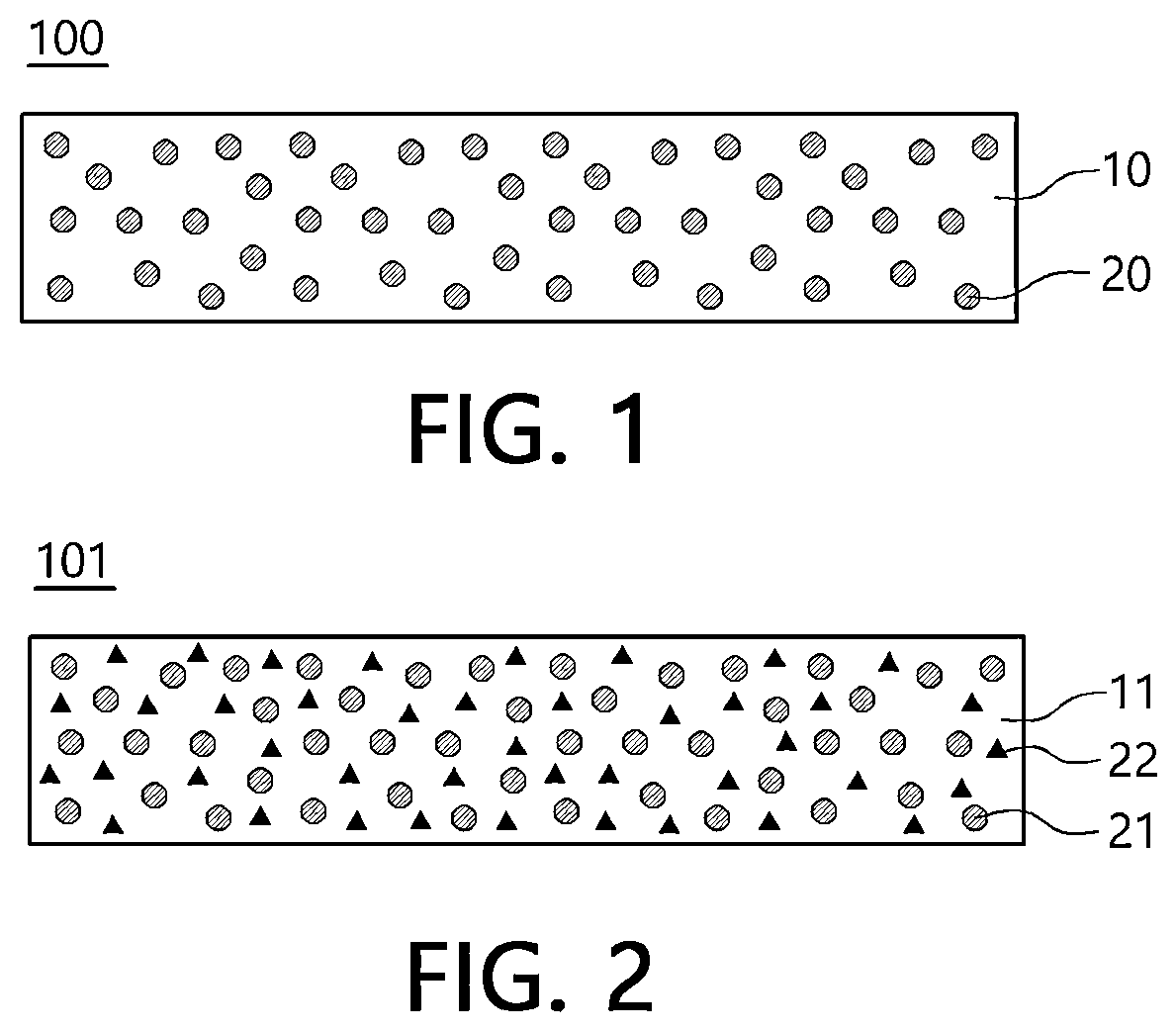
[0098]Based on 100 parts by weight of polypropylene (PP) as a base resin, 7 parts by weight of the first filler prepared according to Preparation Example 1 and 100 parts by weight of the second filler prepared according to Preparation Example 2 were mixed, and by compounding through a 15-pi twin-screw extruder, an RF heat dissipation plastic as shown in FIG. 2 was manufactured.
PUM
 Login to View More
 Abstract
Description
Claims
Application Information
 Login to View More