Procedure for generating operational ballistic capture transfer using a computer implemented process

a technology of computer implementation and ballistic capture, applied in the field of space travel, can solve the problems of invalidating the original eigenfunction used to generate the long range behavior of these systems cannot be predicted, and the drawback of the set of perturbed eigenfunctions, so as to reduce the propellant requirements of lunar missions, reduce the requirement of cislunar travel, and reduce the requirement of propellant requirements

a technology of computer implementation and ballistic capture, applied in the field of space travel, can solve the problems of invalidating the original eigenfunction used to generate the long range behavior of these systems cannot be predicted, and the drawback of the set of perturbed eigenfunctions, so as to reduce the propellant requirements of lunar missions, reduce the requirement of cislunar travel, and reduce the requirement of propellant requirements

US6442482B1Inactive Publication Date: 2002-08-27GALAXY DEVMENT

Image

Smart Image Click on the blue labels to locate them in the text.
Viewing Examples
Smart Image
  • Procedure for generating operational ballistic capture transfer using a computer implemented process
  • Procedure for generating operational ballistic capture transfer using a computer implemented process
  • Procedure for generating operational ballistic capture transfer using a computer implemented process

Examples

Experimental program
Comparison scheme
Effect test

Embodiment Construction

When a rocket travels from the earth to the moon on a classical direct route taking only three days called a Hohmann transfer, it must fire its engines in order to slow down to achieve lunar orbit. Otherwise, the rocket will overfly the moon at about 1 km / s. A typical lunar mission comprises the following steps. Initially, a spacecraft is launched from earth or low earth orbit with sufficient impulse per unit mass, or change in velocity, to place the spacecraft into an earth-to-moon orbit. Generally, this orbit is a substantially elliptic earth-relative orbit having an apogee selected to nearly match the radius of the moon's earth-relative orbit.

As the spacecraft approaches the moon, a change in velocity is provided to transfer the spacecraft from the earth-to-moon orbit to a moon-relative orbit. An additional change in velocity may then be provided to transfer the spacecraft from the moon-relative orbit to the moon's surface if a moon landing is planned. When a return trip to the e...

the structure of the environmentally friendly knitted fabric provided by the present invention; figure 2 Flow chart of the yarn wrapping machine for environmentally friendly knitted fabrics and storage devices; image 3 Is the parameter map of the yarn covering machine
Login to View More

PUM

No PUM Login to View More

Abstract

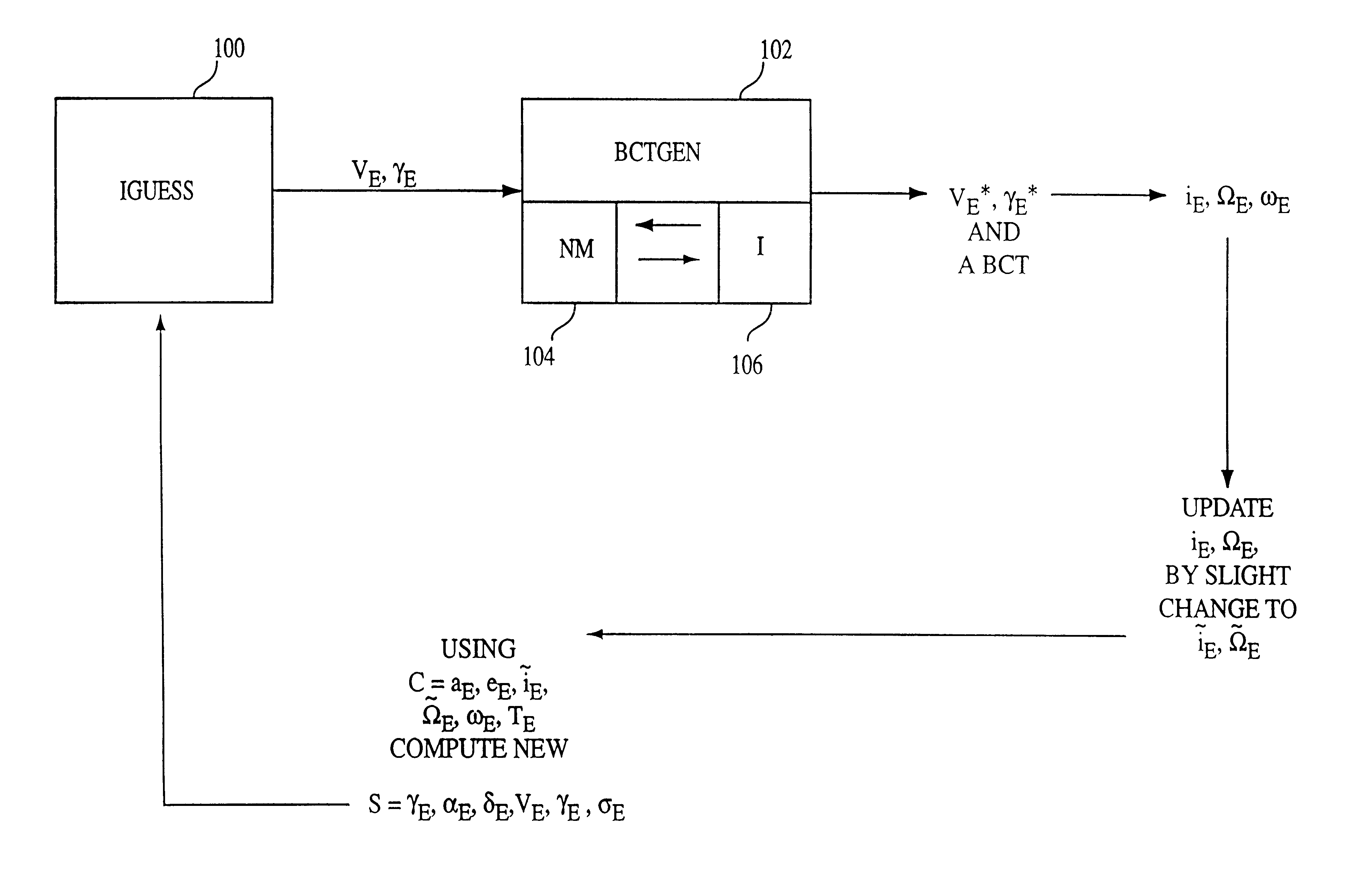
A method generates an operational ballistic capture transfer for an object emanating substantially at earth or earth orbit to arrive at the moon or moon orbit using a computer implemented process. The method includes the steps of entering parameters including velocity magnitude VE, flight path angle gammaE, and implementing a forward targeting process by varying the velocity magnitude VE, and the flight path angle gammaE for convergence of target variables at the moon. The target variables include radial distance, rM, and inclination iM. The method also includes the step of iterating the forward targeting process until sufficient convergence to obtain the operational ballistic capture transfer from the earth or the earth orbit to the moon or the moon orbit.

Description

1. Field of the InventionThis invention relates in general to methods for space travel, and in particular, to methods for an object, such as a satellite, space craft, and the like, to be placed in lunar orbit around the moon, and / or orbit around other planets including earth.2. Background of the Related ArtThe study of motion of objects, including celestial objects, originated, in part, with Newtonian mechanics. During the eighteenth and nineteenth centuries, Newtonian mechanics, using a law of motion described by acceleration provided an orderly and useful framework to solve most of the celestial mechanical problems of interest for that time. In order to specify the initial state of a Newtonian system, the velocities and positions of each particle must be specified.However, in the mid-nineteenth century, Hamilton recast the formulation of dynamical systems by introducing the so-called Hamiltonian function, H, which represents the total energy of the system expressed in terms of the...

Claims

the structure of the environmentally friendly knitted fabric provided by the present invention; figure 2 Flow chart of the yarn wrapping machine for environmentally friendly knitted fabrics and storage devices; image 3 Is the parameter map of the yarn covering machine
Login to View More

Application Information

Patent Timeline
27 Aug 2002
Publication
US6442482B1
IPC
B64G1/00; B64G1/24
CPC
B64G1/007; B64G1/242; B64G2001/1064; B64G1/1064; B64G1/2427; B64G1/244
Inventors
BELBRUNO, EDWARD A.