Method, apparatus and system for use in determining pilot-to-data power ratio in wireless communication

a technology wireless communication, applied in the field of pilot-to-data power ratio determination, can solve problems such as loss of information and incorrect utilization of ratios

US6859505B2Inactive Publication Date: 2005-02-22MOTOROLA INC
3 Cites 15 Cited by

Patent Information

Authority / Receiving Office
US · United States
Patent Type
Patents(United States)
Current Assignee / Owner
Publication Date
2005-02-22
Estimated Expiration
Not applicable · inactive patent

Smart Images

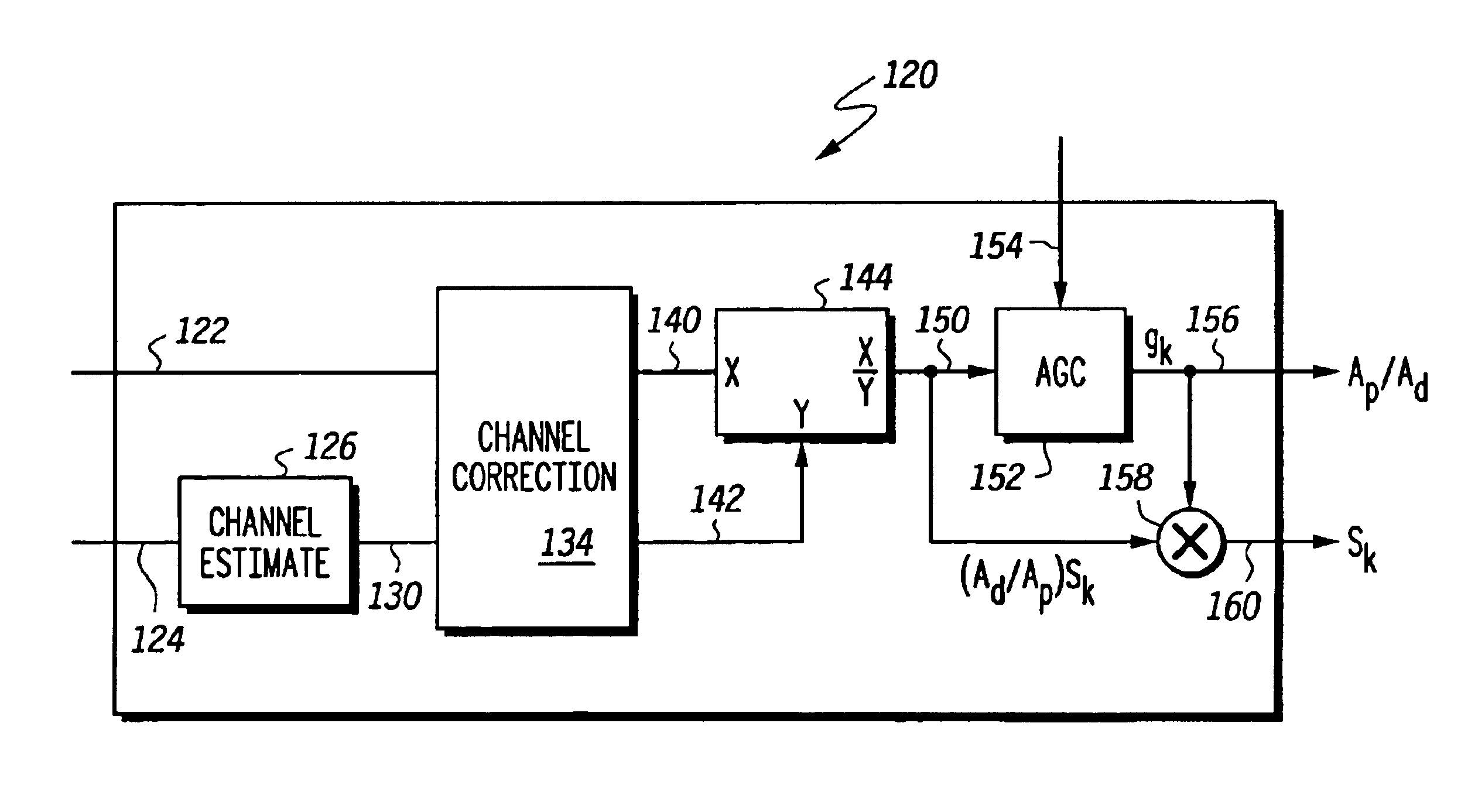
  • Figure 1
    Figure 1
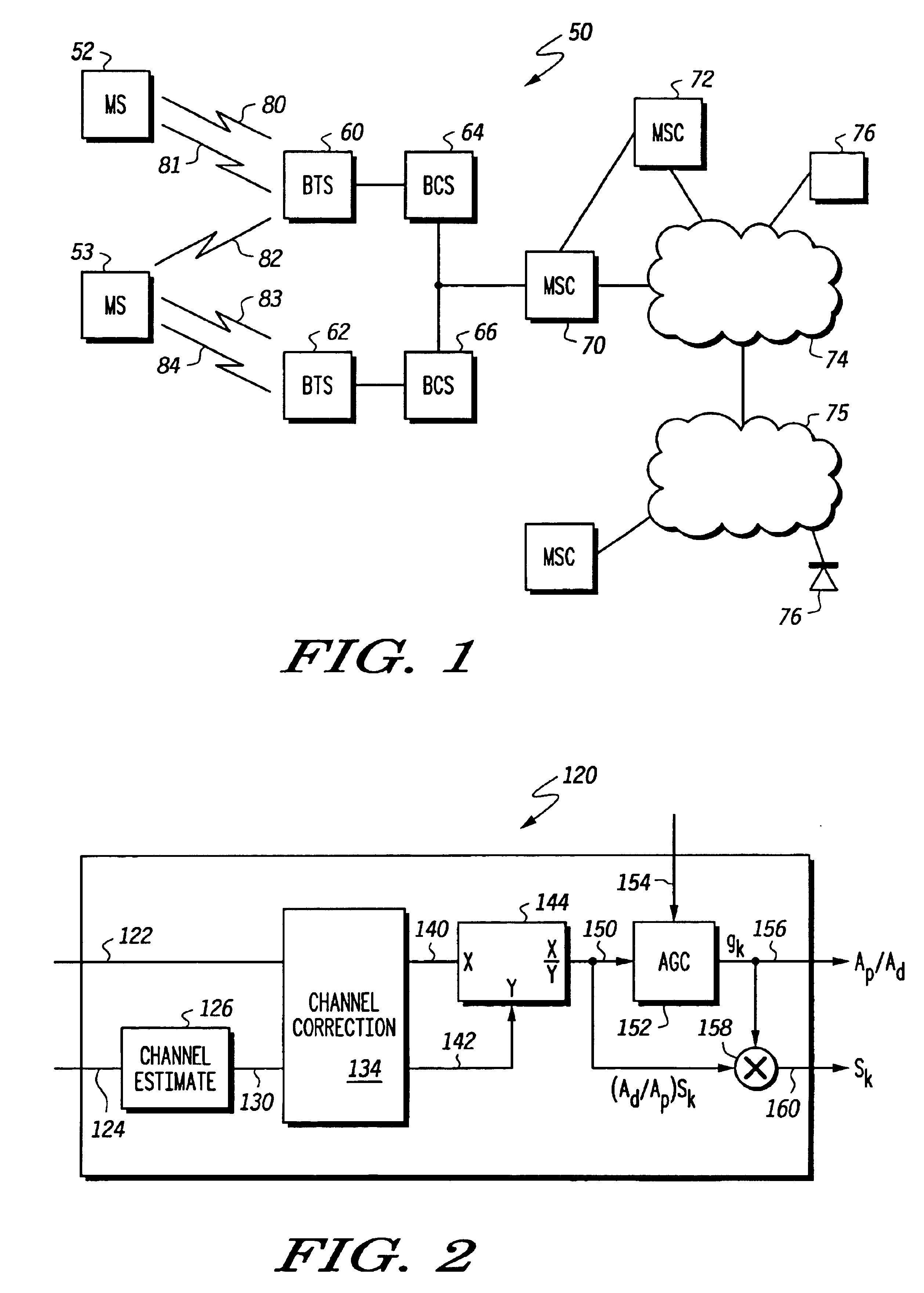
  • Figure 2
    Figure 2
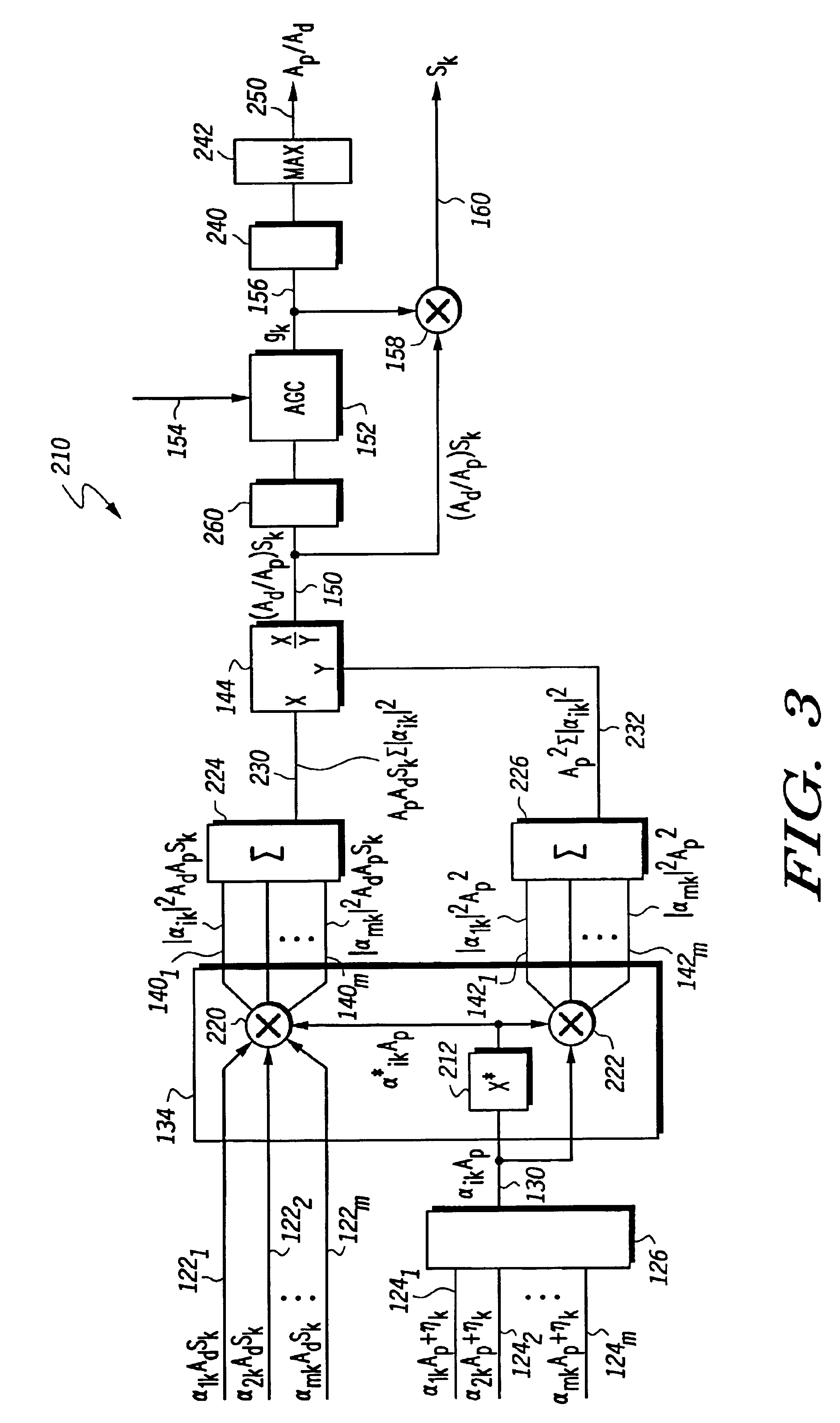
  • Figure 3
    Figure 3
Patent Text Reader

Abstract

A method, apparatus and system for use in determining a pilot-to-data power ratio by receiving a data symbol (122) having a data amplitude, receiving a pilot signal (124) having a pilot amplitude, reverse training (350) an automatic gain (154) based on the data amplitude and the pilot amplitude, and determining a pilot-to-data power ratio (250) according to the reverse training of the automatic gain. In some embodiments the method further compensates for channel fading in the data symbol by providing for channel correction (340) on the data symbol, providing for channel correction (344) on the pilot signal and dividing the channel corrected data symbol by the channel corrected pilot signal providing a fading compensated data symbol, where the fading compensated data symbol (150) is provided prior to reverse training such that the reverse training is based at least in part on the fading compensated data symbol.
Need to check novelty before this filing date? Find Prior Art

Description

FIELD OF THE INVENTIONThe present invention relates generally to wireless communication, and more particularly to determining a pilot-to-data power ratio for quadrature amplitude modulation (QAM) signals.BACKGROUND OF THE INVENTIONCommunication systems that use a pilot signal are known. A pilot signal typically comprises a signal of known character that a receiving device can utilize to better interpret and decode other signals as are transmitted in conjunction with the pilot signal. As such, the pilot signal in particular can be utilized to facilitate adjustment of various reception processing parameters to compensate, at least in part, for channel conditions.In some wireless communication systems, a power ratio between a wirelessly communicated data signal and a wirelessly communicated pilot signal is needed to accurately scale received wirelessly communicated signals. Typically, the pilot-to-data power ratio is also wirelessly communicated by previous systems over an additional c...

Examples

Embodiment Construction

These various embodiments provide for methods, systems and equipment or apparatuses that can be used to determine a pilot power versus data power ratio of wirelessly communicated data and pilot signals without an additional communication of the ratio from a transmitting device. The ratio of pilot to data power is useful for properly scaling received amplitude modulated signals and / or symbols. For example, the power to data ratio is utilized within a wireless system to properly scale quadrature amplitude modulated (QAM) symbols in order to forward the symbols onto a QAM decision grid and to optimally support Hybrid-Automatic Repeat Request (HARQ) systems. These embodiments can be utilized in substantially any wireless communication system (IS-95 based or otherwise) using amplitude modulation and / or QAM, such as CDMA2000 C (EVDV), HSDPA, 3G products and other similar communication systems.

Previous wireless systems usually communicate the pilot-to-data power ratio over a control sub-ch...