Unlock instant, AI-driven research and patent intelligence for your innovation.

System boot time reduction method

a system and boot time technology, applied in the field of operating systems, can solve the problems of limited memory size of a cache, affecting the availability of data, and unable to make data available when

Inactive Publication Date: 2005-07-19
INTEL CORP
View PDF27 Cites 48 Cited by
  • Summary
  • Abstract
  • Description
  • Claims
  • Application Information

AI Technical Summary

Problems solved by technology

However, the memory size of a cache is limited and is generally used to store the most recently used data.
Although the replacement process generally does not cause problems, replacement of certain types of data can be detrimental.
However, for the type of the data necessary during a system initialization, locking the initialization data into a volatile cache memory would not make the data available when required as the information would be lost between system boots or power cycling of the system.

Method used

the structure of the environmentally friendly knitted fabric provided by the present invention; figure 2 Flow chart of the yarn wrapping machine for environmentally friendly knitted fabrics and storage devices; image 3 Is the parameter map of the yarn covering machine
View more

Image

Smart Image Click on the blue labels to locate them in the text.
Viewing Examples
Smart Image
  • System boot time reduction method
  • System boot time reduction method
  • System boot time reduction method

Examples

Experimental program
Comparison scheme
Effect test

second embodiment

[0022]FIG. 3 shows another pinning procedure 300 in accordance with the invention allowing a maximum amount of data to be pinned. Upon system initialization, a determination is made whether a maximum amount of data have been pinned (block 320). Until the maximum amount is exceeded, the memory control hub 140 causes the pinned bit(s) corresponding to accessed line(s) of data to be set (blocks 320 and 330). Access here also includes both reading and writing to the cache 150. The maximum amount that can be pinned is given based on the needs of the system. Generally, the majority of lines of data in the cache 150 should be left “not pinned” for normal operation. For example, in mass storage caches with N cache associativity sets, the maximum amount may be set to one line per cache associativity set.

third embodiment

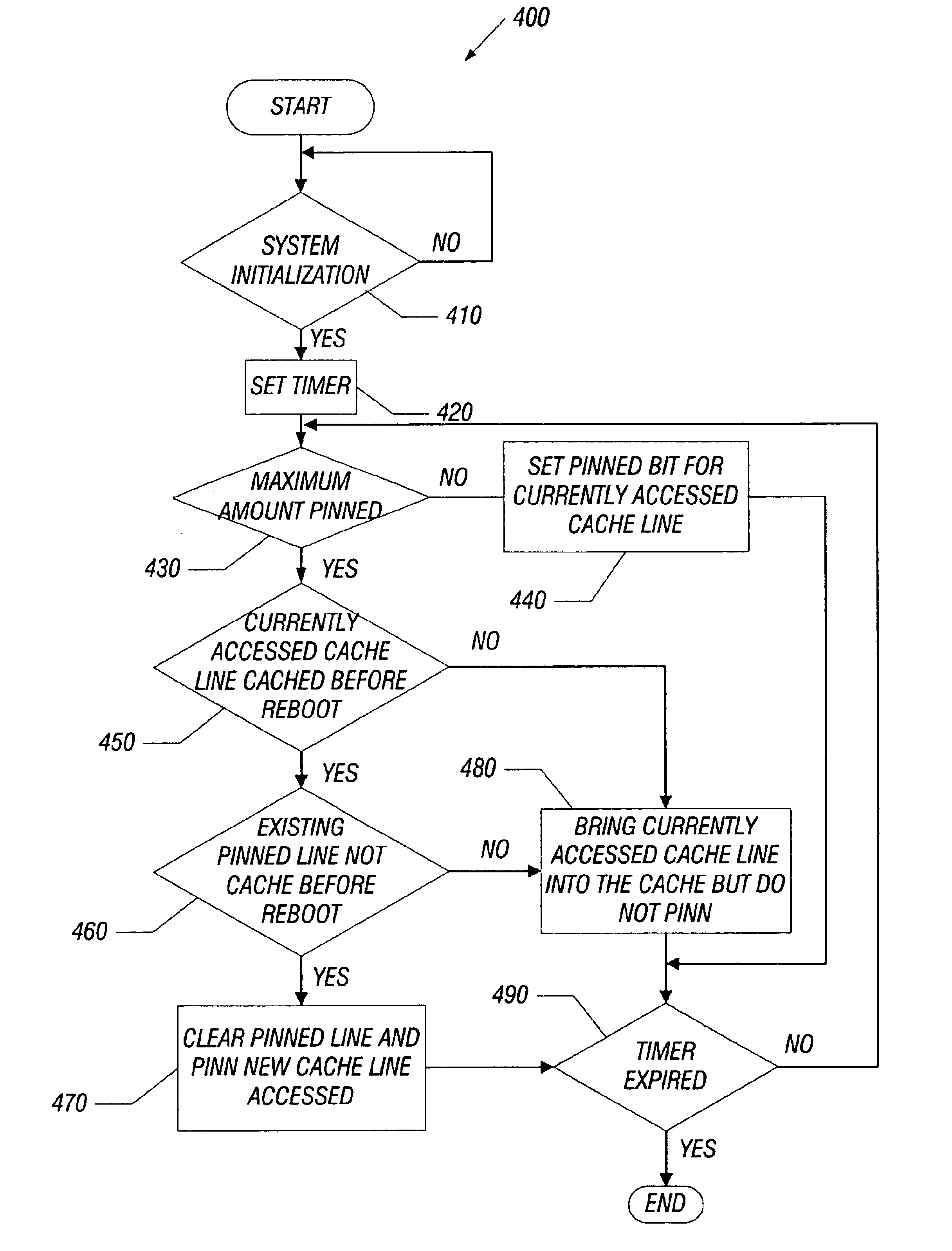
[0023]FIG. 4 shows another pinning procedure 400 in accordance with the invention using both a timer and a maximum amount of data to pin. In the pinning procedure 400, a “cacheBeforeReboot bit” is also added to the non-persistent metadata. The cacheBeforeReboot bit is set for any cache line that was present in the cache 150 before a system initialization. For example, these bits may be set as the persistent metadata is paged in from the cache 150 when a system is restarted.

[0024]Referring to FIG. 4, a timer is set upon a system initialization (block 420) and if the maximum amount has not been exceeded, the memory control hub 140 causes the pinned bit(s) corresponding to accessed cache line(s) to be set (blocks 430 and 440). Access here includes both reading and writing to the cache 150. If the maximum amount is exceeded, a determination is made whether a currently accessed cache line was cached before reboot (block 450) by checking the cacheBeforeReboot bit information. If the cache...

the structure of the environmentally friendly knitted fabric provided by the present invention; figure 2 Flow chart of the yarn wrapping machine for environmentally friendly knitted fabrics and storage devices; image 3 Is the parameter map of the yarn covering machine
Login to View More

PUM

No PUM Login to View More

Abstract

A system and method to reduce the time for system initializations is disclosed. In accordance with the invention, data accessed during a system initialization is loaded into a non-volatile cache and is pinned to prevent eviction. By pinning data into the cache, the data required for system initialization is pre-loaded into the cache on a system reboot, thereby eliminating the need to access a disk.

Description

FIELD[0001]The invention relates to operating systems, and more particularly, to a non-volatile cache used in a system.BACKGROUND DESCRIPTION[0002]The use of a cache with a processor reduces memory access time and increases the overall speed of a device. Typically, a cache is an area of memory which serves as a temporary storage area for a device. Data frequently accessed by the processor remain in the cache after an initial access and subsequent accesses to the same data may be made to the cache.[0003]Two types of caching are commonly used, memory caching and disk caching. A memory cache, sometimes known as cache store, is typically a high-speed memory device such as a static random access memory (SRAM). Memory caching is effective because most programs access the same data or instructions repeatedly.[0004]Disk caching works under the same principle as the memory caching but uses a conventional memory device such as a dynamic random access memory (DRAM). The most recently accessed ...

Claims

the structure of the environmentally friendly knitted fabric provided by the present invention; figure 2 Flow chart of the yarn wrapping machine for environmentally friendly knitted fabrics and storage devices; image 3 Is the parameter map of the yarn covering machine
Login to View More

Application Information

Patent Timeline
no application Login to View More
IPC IPC(8): G06F12/12G06F9/445G06F12/08
CPCG06F9/4401G06F12/126G06F12/0866
Inventor COULSON, RICHARD L.GARNEY, JOHN I.MATTHEWS, JEANNA N.ROYER, ROBERT J.
Owner INTEL CORP
Features
  • R&D
  • Intellectual Property
  • Life Sciences
  • Materials
  • Tech Scout
Why Patsnap Eureka
  • Unparalleled Data Quality
  • Higher Quality Content
  • 60% Fewer Hallucinations
Social media
Patsnap Eureka Blog
Learn More