Land mine overpass tread design

a technology of overpass tread and foam rubber, which is applied in the direction of shields, non-skid devices, offensive equipment, etc., can solve the problems of claiming the lives of thousands of soldiers or innocent civilians, and the danger of land mines, so as to minimize the pressure on the fusing mechanism of land mines, minimize the pressure exerted, and maximize the contact of foam rubber with the ground

US6952990B1Inactive Publication Date: 2005-10-11NIITEK
58 Cites 20 Cited by

Patent Information

Authority / Receiving Office
US · United States
Patent Type
Patents(United States)
Current Assignee / Owner
Publication Date
2005-10-11
Estimated Expiration
Not applicable · inactive patent

Smart Images

  • Figure 1
    Figure 1
  • Figure 2
    Figure 2
  • Figure 3
    Figure 3
Patent Text Reader

Abstract

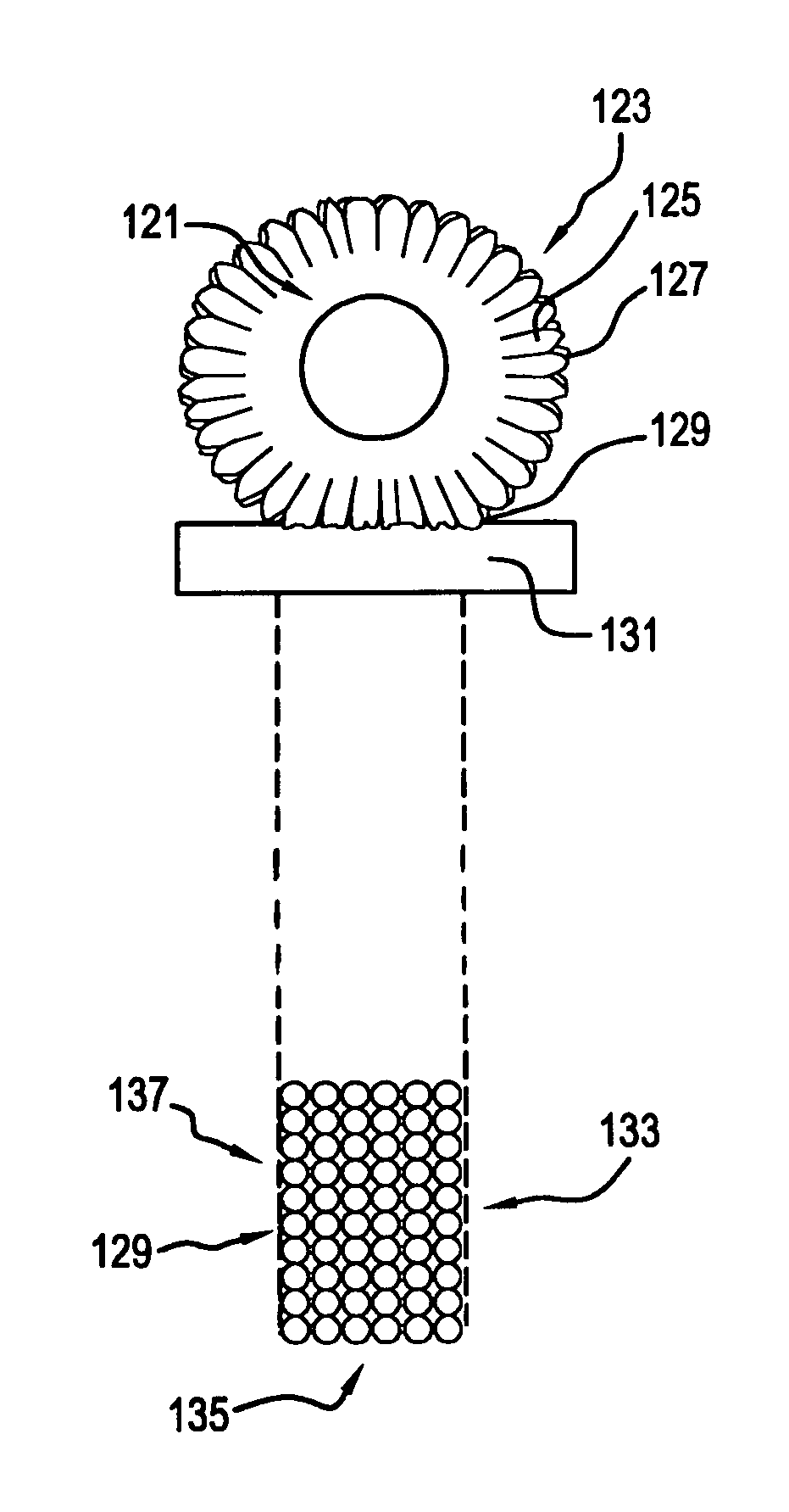
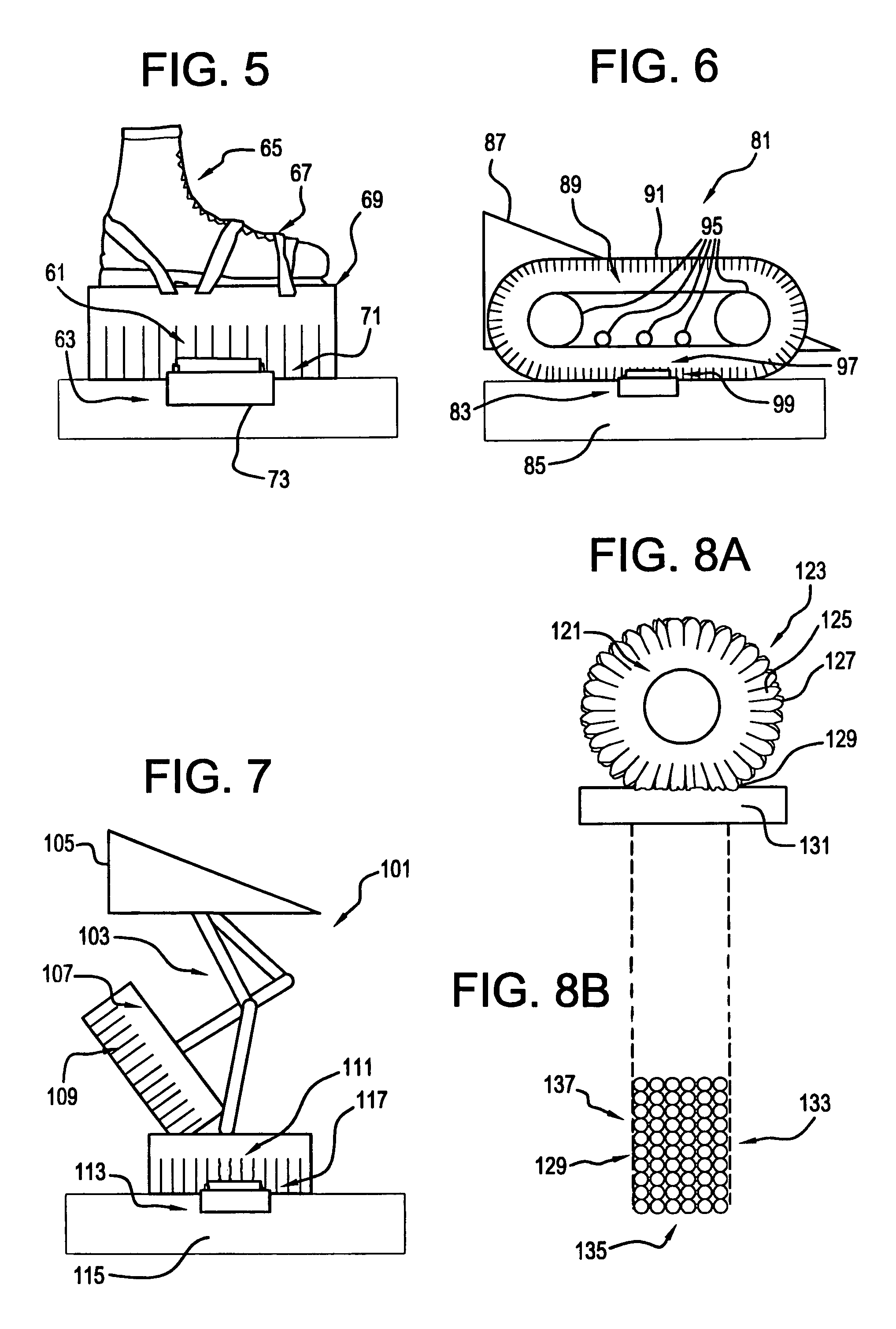
A land mine pressure fuse avoidance system has a base. A tread on the base contacts the ground around a land mine and independently distributes pressures around the ground. The tread has plural independent closed cell foam rubber elements. Each element is separated from adjacent elements for independently supporting only a portion of a load on the base, while other similarly independent elements support remaining portion of the load. The base is a cylindrical tire, a continuous track, a shoe sole attachment or a robotic foot, and the tread is conformed to and extends outward from the base. The independent elements of the tread are made of closed cell foam rubber formed as a tread on the base with notches between adjacent elements of the tread. Notches extend longitudinally along the tread, and notches extend across the tread, forming block shaped elements extending from the base. The notches extend into the tread for distances greater than heights above ground of clutter and of partially buried mines or fuses. In one form the tread has independent radially extending elements constructed of closed cell foam.
Need to check novelty before this filing date? Find Prior Art

Description

BACKGROUND OF THE INVENTION

[0001] Land mines are dangerous and claim the lives of thousands of soldiers or innocent civilians every year. Most land mines are detonated by a pressure-activated fuse. The pressure required to activate those fuses range from ounces to many pounds. Anti-personnel mines typically require one or so pounds to detonate. The overwhelming majority of anti-tank mines require several pounds of pressure to detonate.

[0002] A large worldwide community is dedicated to ridding the world of future and already emplaced land mines. Various governments and humanitarian efforts are developing land mine detection systems to pinpoint the locations of land mines so personnel and equipment can avoid the mines that might detonate and cause damage. All efforts including the day-to-day civilian activities in mined countries could benefit from mine-overpass-capabilities.

[0003] The countermine community typically assumes that low ground pressure vehicles automatically create a mine o...

Examples

Embodiment Construction

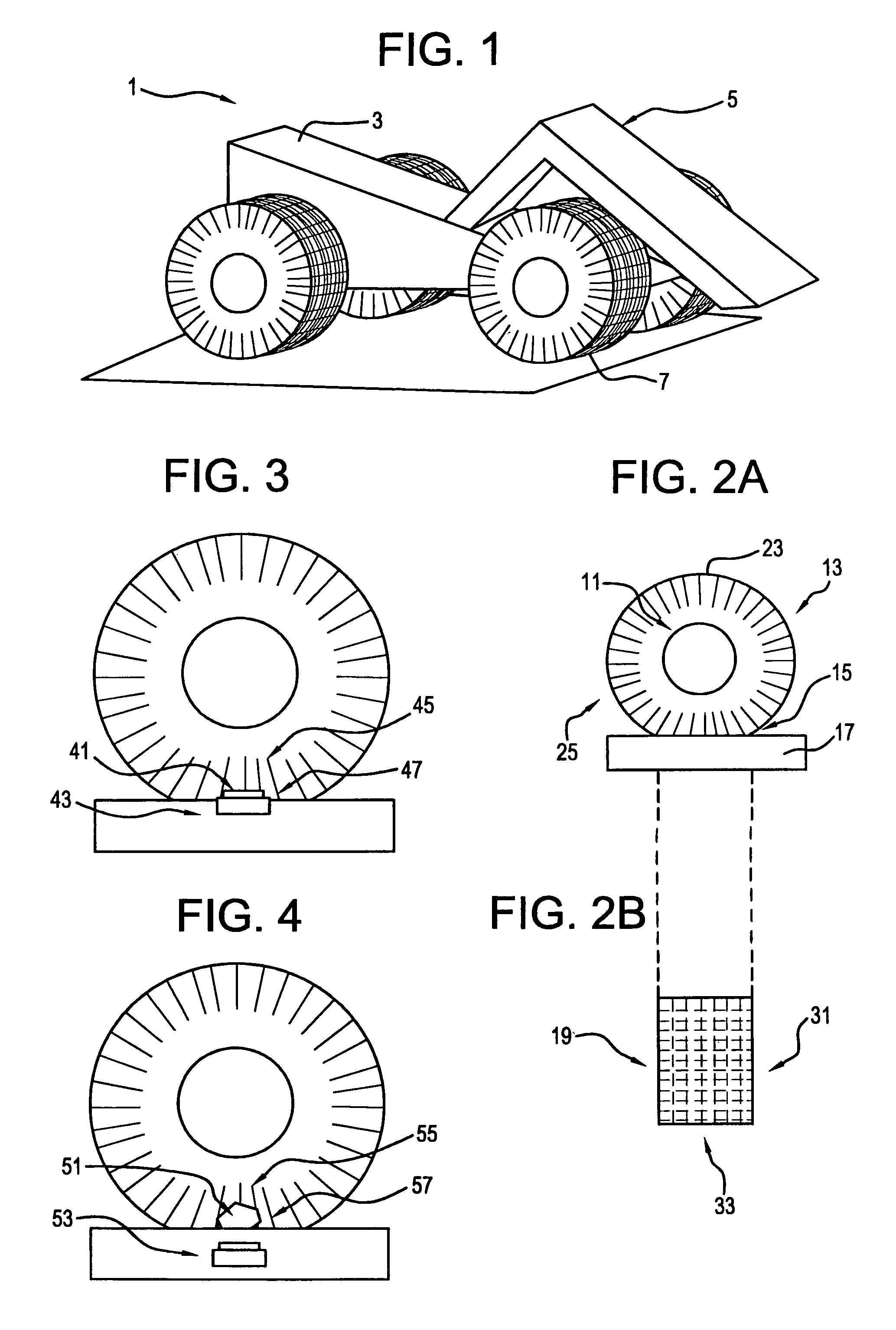
[0031]Referring to FIG. 1, a land mine detection vehicle system is generally indicated by the numeral 1. The system includes a remotely controlled cart 3 and a land mine detection sensor 5. The vehicle 1 is supported on notched closed cell foam rubber tire 7 and tread material used to minimize land mine detonations while passing over land mines.

[0032]Referring to FIG. 2A, a notched closed cell foam rubber tire rests on the ground 17. A part 11 of the closed-cell foam rubber is not notched and stretch-fits over a rim 21. Many notches 13 are cut into the foam rubber. The notches 13 extend from the perimeter 23 of the tire 25 to some depth that is greater than the height of most clutter objects and mines that it must pass over without detonating a mine. The notches 13 are an important part of the invention, as they prevent nearby notched foam elements from exerting pressure on the mine's fusing mechanism. Equally important is the down-track contact length 15 that the tire 25 makes with...