Unlock instant, AI-driven research and patent intelligence for your innovation.

System and method for autonomically reallocating memory among buffer pools

a buffer pool and autonomous reallocation technology, applied in the field of computer memory management, can solve the problems of secondary storage i/o delay associated physical i/o delay, difficulty in achieving the goal, and inability to use a large buffer pool, and achieve the effect of less efficacy

Inactive Publication Date: 2005-11-01
IBM CORP
View PDF14 Cites 25 Cited by
  • Summary
  • Abstract
  • Description
  • Claims
  • Application Information

AI Technical Summary

Benefits of technology

The present invention is a system, computer program product, and method for automatically optimizing memory distribution among buffer pools in a data processing system. The system uses a simulated buffer pool extension (SBPX) to represent data stored in a buffer pool and to estimate the efficiency of extending the pool by different amounts of memory. The system calculates the expected efficiency benefit of extending each buffer pool and uses a primary victimization scheme to select the least recently used data for victimization. The system also tallies the requests for data that is not resident in the buffer pool but is represented in the associated SBPX and uses a greedy memory reallocation algorithm to allocate memory among buffer pools. The system can adapt to unforeseen or unanthipticipated system events and improves system efficiency without requiring user intervention.

Problems solved by technology

There is a disadvantage for incurring associated physical I / O delays of secondary storage.
This goal is, of course, difficult to achieve as it entails some degree of prediction of future events that may or may not prove to be accurate.
Alternatively, if the application scans large data sets in a single pass, the use of a large buffer pool may not be warranted as even a large size may not preclude a significant number of memory page misses.
An intrinsic flaw of such known methods of buffer pool memory allocation is the fact that actual application behavior may differ from projected behavior due to unforeseen events, such as variable system loads, network delays, unanticipated user behavior or changes in the workload behavior.
When unforeseen events occur, the assumptions underlying a particular buffer pool memory allocation may be invalidated.
In addition, the performance of the data processing system may disadvantageously suffer because the chosen buffer pool sizes may prove to be ill suited for the data access patterns that actually occur.
Moreover, adjustment of buffer pool sizes may necessitate suspension or termination of the executing application.
Disadvantageously, this approach still requires the user to “set” the desired response times prior to run time.
If unforeseen system events occur during operation that cause the system's processor to be loaded in an unanticipated way, the response times set by the user may not actually be representative of desirable or achievable thresholds and system efficiency may suffer.
The need for such a system has heretofore remained unsatisfied.

Method used

the structure of the environmentally friendly knitted fabric provided by the present invention; figure 2 Flow chart of the yarn wrapping machine for environmentally friendly knitted fabrics and storage devices; image 3 Is the parameter map of the yarn covering machine
View more

Image

Smart Image Click on the blue labels to locate them in the text.
Viewing Examples
Smart Image
  • System and method for autonomically reallocating memory among buffer pools
  • System and method for autonomically reallocating memory among buffer pools
  • System and method for autonomically reallocating memory among buffer pools

Examples

Experimental program
Comparison scheme
Effect test

Embodiment Construction

[0048]The following definitions and explanations provide background information pertaining to the technical field of the present invention, and are intended to facilitate the understanding of the present invention without limiting its scope:

[0049]API: Application Program Interface, a language and message format used by an application program to communicate with the operating system or some other control program such as a database management system (DBMS) or communications protocol.

[0050]SQL: Structured Query Language, a standardized query language for requesting information from a database.

[0051]An embodiment of the present invention provides an autonomic method for directing a data processing system to autonomically optimize memory distribution between data caches (also known as buffer pools). For example, the method may be used in a database system stored in the memory of the data processing system. This database system may include a Database Management System (DBMS) and a databas...

the structure of the environmentally friendly knitted fabric provided by the present invention; figure 2 Flow chart of the yarn wrapping machine for environmentally friendly knitted fabrics and storage devices; image 3 Is the parameter map of the yarn covering machine
Login to View More

PUM

No PUM Login to View More

Abstract

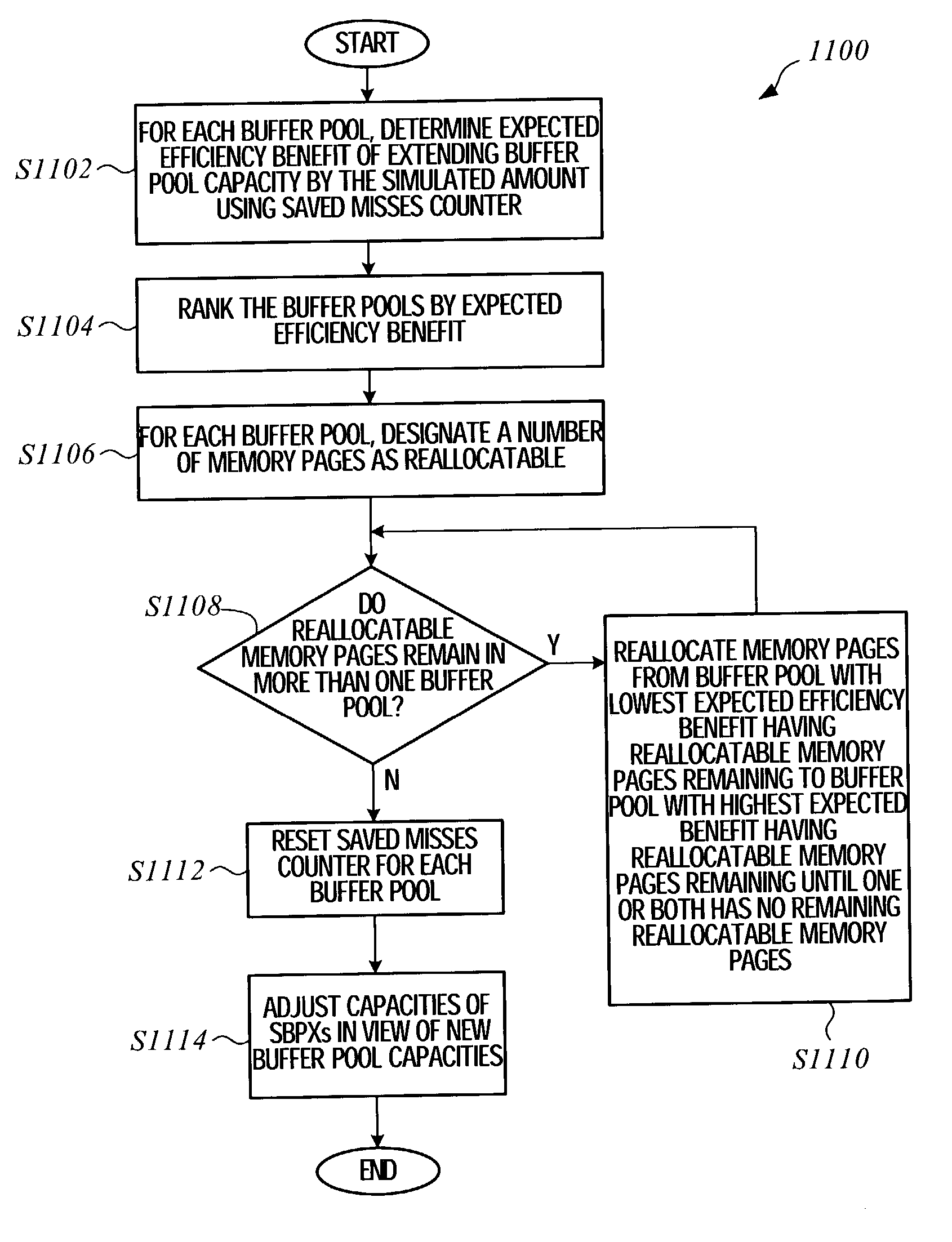
A system and method autonomically reallocate memory among buffer pools to permit quick access to data. A simulated buffer pool extension (SBPX) is created for each buffer pool in a set of buffer pools. Data victimized from a buffer pool is represented in the associated SBPX. Requests for data that is not resident in a buffer pool but is represented in the associated SBPX are tallied. Periodically, an expected efficiency benefit of increasing the capacity of each buffer pool is determined from the tallies. Memory is reallocated from the buffer pool with the lowest expected efficiency benefit having remaining reallocatable memory to the buffer pool with the highest expected efficiency benefit having remaining reallocatable memory, until either one or both of the buffer pools exhausts its reallocatable memory. This process is repeated until all reallocatable memory has been reallocated, until only one buffer pool with reallocatable memory remains, or until all buffer pools with remaining reallocatable memory have substantially the same expected efficiency benefit.

Description

PRIORITY CLAIM[0001]The present application claims the priority of Canadian patent application, Ser. No. 2,408,481, titled “Autonomic Reallocation of Memory Among Buffer Pools,” filed on Oct. 17, 2002, and which is incorporated herein by reference.FIELD OF THE INVENTION[0002]The present invention generally relates to computer memory management, and it more specifically relates to a system and associated method for autonomically reallocating computer memory among buffer pools.BACKGROUND OF THE INVENTION[0003]Data processing systems, such as database management systems (DBMSs) commonly operate with multiple buffer pools. Buffer pools are data caches located in volatile memory that are primarily used to store recently accessed data. The purpose of a buffer pool is to permit application data of immediate importance to be quickly accessed by an application from volatile memory, and thereby limit the need to load such data from secondary storage (e.g., a disk or tape drive). There is a di...

Claims

the structure of the environmentally friendly knitted fabric provided by the present invention; figure 2 Flow chart of the yarn wrapping machine for environmentally friendly knitted fabrics and storage devices; image 3 Is the parameter map of the yarn covering machine
Login to View More

Application Information

Patent Timeline
no application Login to View More
Patent Type & Authority Patents(United States)
IPC IPC(8): G06F9/50G06F12/02G06F12/0866
CPCG06F9/5016G06F12/0866G06F12/12G06F12/123
Inventor LIGHTSTONE, SAM S.STORM, ADAM J.VALENTIN, GARYZILIO, DANIEL C.
Owner IBM CORP