AI technical title is built by PatSnap AI team. It summarizes the technical point description of the patent document.
a cross-point memory and access time technology, applied in the field of memory, can solve the problems of limiting the total size and applications of the memory, requiring a complex refresh algorithm, and non-volatile memory such as flash memory is slower to program, so as to achieve the effect of fast access tim
Inactive Publication Date: 2006-06-06
UNITY SEMICON
View PDF12 Cites 71 Cited by
Summary
Abstract
Description
Claims
Application Information
AI Technical Summary
This helps you quickly interpret patents by identifying the three key elements:
Problems solved by technology
Method used
Benefits of technology
Problems solved by technology
Although SRAM is the memory of choice for computer applications, with very fast access times, its volatility, large size and stand-by current limit the total size and applications of the memory.
Nonvolatile memories such as Flash memory are slower to program, and in some case must be erased a large block at a time before being reprogrammed.
DRAM has the smallest cell size, but necessitates a complex refresh algorithm, and is volatile.
For new applications, away from PC applications and into portable applications such as cell phones, personal digital assistants (PDA), digital cameras, camcorders, removable “key-chain” or “USB” disks, the key issues are nonvolatility and low power consumption.
Both types of memory can be relatively fast or relatively slow.
The ROMs that are capable of modifying their data typically require long write cycles that erase entire blocks of data prior to new data being written.
The layout of such devices are not ideal, usually requiring feature sizes of at least 8 f2 for each memory cell, where f is the minimum feature size.
However, mere recognition that a two terminal memory element is theoretically capable of being placed in a cross point array does not solve many of the non-trivial problems associated with actually creating such a device.
Method used
the structure of the environmentally friendly knitted fabric provided by the present invention; figure 2 Flow chart of the yarn wrapping machine for environmentally friendly knitted fabrics and storage devices; image 3 Is the parameter map of the yarn covering machine
View more
Image
Smart Image Click on the blue labels to locate them in the text.
Viewing Examples
Smart Image
Click on the blue label to locate the original text in one second.
Reading with bidirectional positioning of images and text.
Smart Image
Examples
Experimental program
Comparison scheme
Effect test
Embodiment Construction
[0057]In the following description, numerous specific details are set forth to provide a thorough understanding of the present invention. It will be apparent, however, to one skilled in the art that the present invention may be practiced without some or all of these specific details. In other instances, well known process steps have not been described in detail in order to avoid unnecessarily obscuring the present invention.
Overview
[0058]The random access reads and writes that are required for RAM devices typically require that a particular memory cell be capable of being selected out of an entire memory block. For a two terminal memory cell in a cross point structure, that usually means that both terminals are used for selection. Since one of the terminals is common to an entire row of memory cells and another terminal is common to an entire column of memory cells in a cross point array, writing with a single terminal would result in writing to either an entire row or an entire col...
the structure of the environmentally friendly knitted fabric provided by the present invention; figure 2 Flow chart of the yarn wrapping machine for environmentally friendly knitted fabrics and storage devices; image 3 Is the parameter map of the yarn covering machine
Login to View More
PUM
Login to View More
Abstract
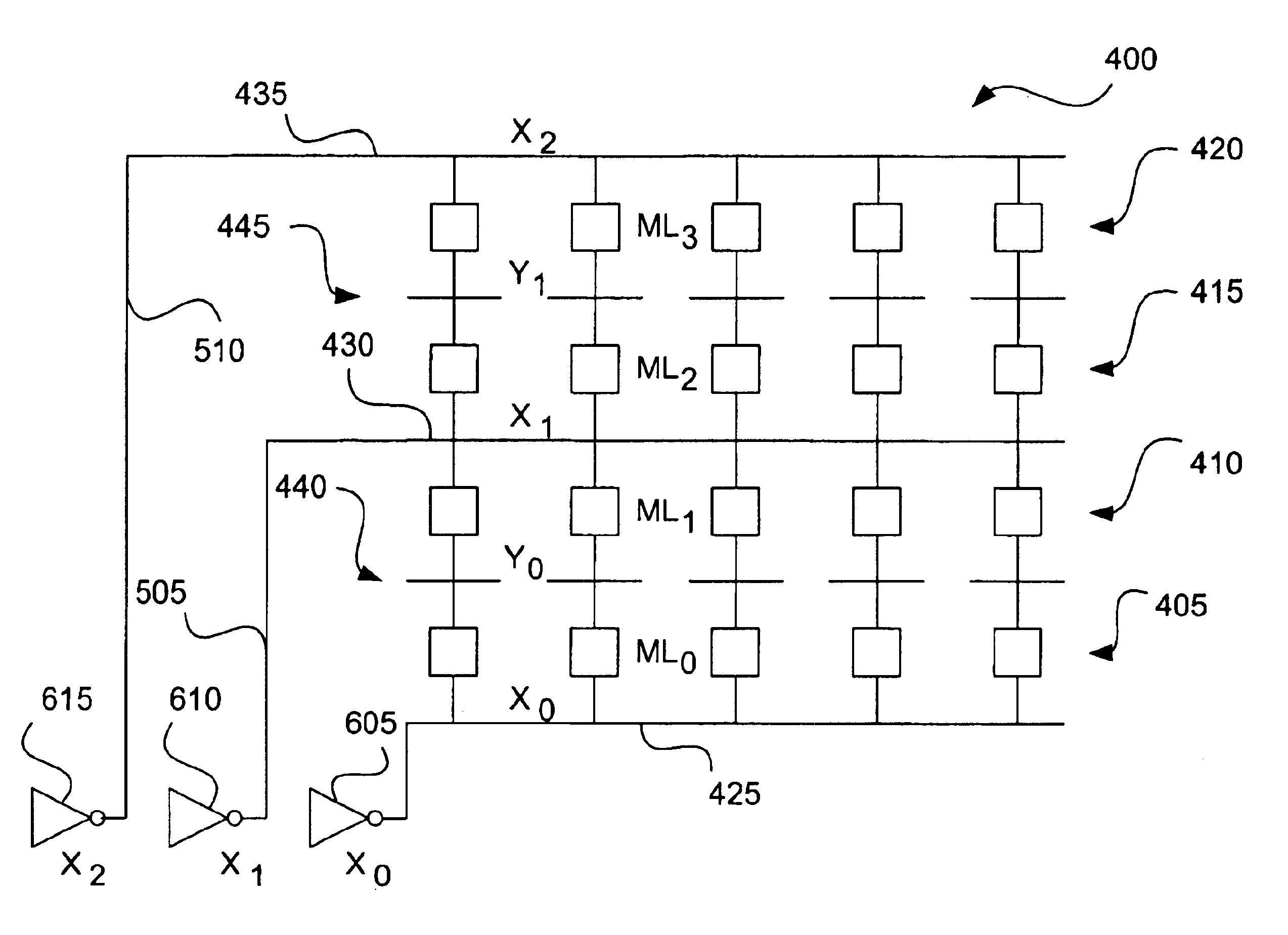
Cross point array with fast access time. A cross point array is driven by drivers on a semiconductor substrate. The drivers for either a single-layer cross point array or for the bottom layer of a stacked cross point array can be positioned to improve access time. Specifically, if the x-direction drivers are positioned in the middle of the x-direction conductive array lines and the y-direction drivers are positioned in the middle of the y-direction conductive array lines, the access time will be improved.
Description
CROSS-REFERENCE TO RELATED APPLICATIONS[0001]This application claims the benefit of U.S. Provisional Application No. 60 / 400,849, filed Aug. 2, 2002, the U.S. Provisional Application No. 60 / 422,922, filed Oct. 31, 2002, and the U.S. Provisional Application 60 / 424,083, filed Nov. 5, 2002, all of which are incorporated herein by reference in their entireties and for all purposes. This application is related to the following U.S. Pat. Applications: U.S. application Ser. No. 10 / 360,005, filed Feb. 7, 2003, now U.S. Pat. No. 6,917,539; U.S. application Ser. No. 10 / 330,512, filed Dec. 26, 2002, now U.S. Pat. No. 6,753,561; application Ser. No. 10 / 330,153, filed Dec. 26, 2002, now U.S. Pat. No. 6,834,008; application Ser. No. 10 / 330,964, filed Dec. 26, 2002, now U.S. Pat. No. 6,831,854; application Ser. No. 10 / 330,170, filed Dec. 26, 2002; application Ser. No. 10 / 330,900, filed Dec. 26, 2002, now U.S. Pat. No. 6,850,429; application Ser. No. 10 / 330,150, filed Dec. 26, 2002, now U.S. Pat. No...
Claims
the structure of the environmentally friendly knitted fabric provided by the present invention; figure 2 Flow chart of the yarn wrapping machine for environmentally friendly knitted fabrics and storage devices; image 3 Is the parameter map of the yarn covering machine
Login to View More
Application Information
Patent Timeline
Application Date:The date an application was filed.
Publication Date:The date a patent or application was officially published.
First Publication Date:The earliest publication date of a patent with the same application number.
Issue Date:Publication date of the patent grant document.
PCT Entry Date:The Entry date of PCT National Phase.
Estimated Expiry Date:The statutory expiry date of a patent right according to the Patent Law, and it is the longest term of protection that the patent right can achieve without the termination of the patent right due to other reasons(Term extension factor has been taken into account ).
Invalid Date:Actual expiry date is based on effective date or publication date of legal transaction data of invalid patent.
Login to View More
Patent Type & AuthorityPatents(United States)
IPC IPC(8): G11C7/00G11C11/56G11C13/00H10N80/00
CPCG11C11/5685G11C13/0007G11C2213/77G11C2213/31
InventorRINERSON, DARRELLCHEVALLIER, CHRISTOPHE J.LONGCOR, STEVEN W.KINNEY, WAYNEWARD, EDMOND R.HSIA, STEVE KUO-REN



 Login to View More
  Login to View More