
Method and system for link fabric error detection and message flow control
- Summary
- Abstract
- Description
- Claims
- Application Information
AI Technical Summary
Benefits of technology
Problems solved by technology
Method used
Image

Examples
Embodiment Construction
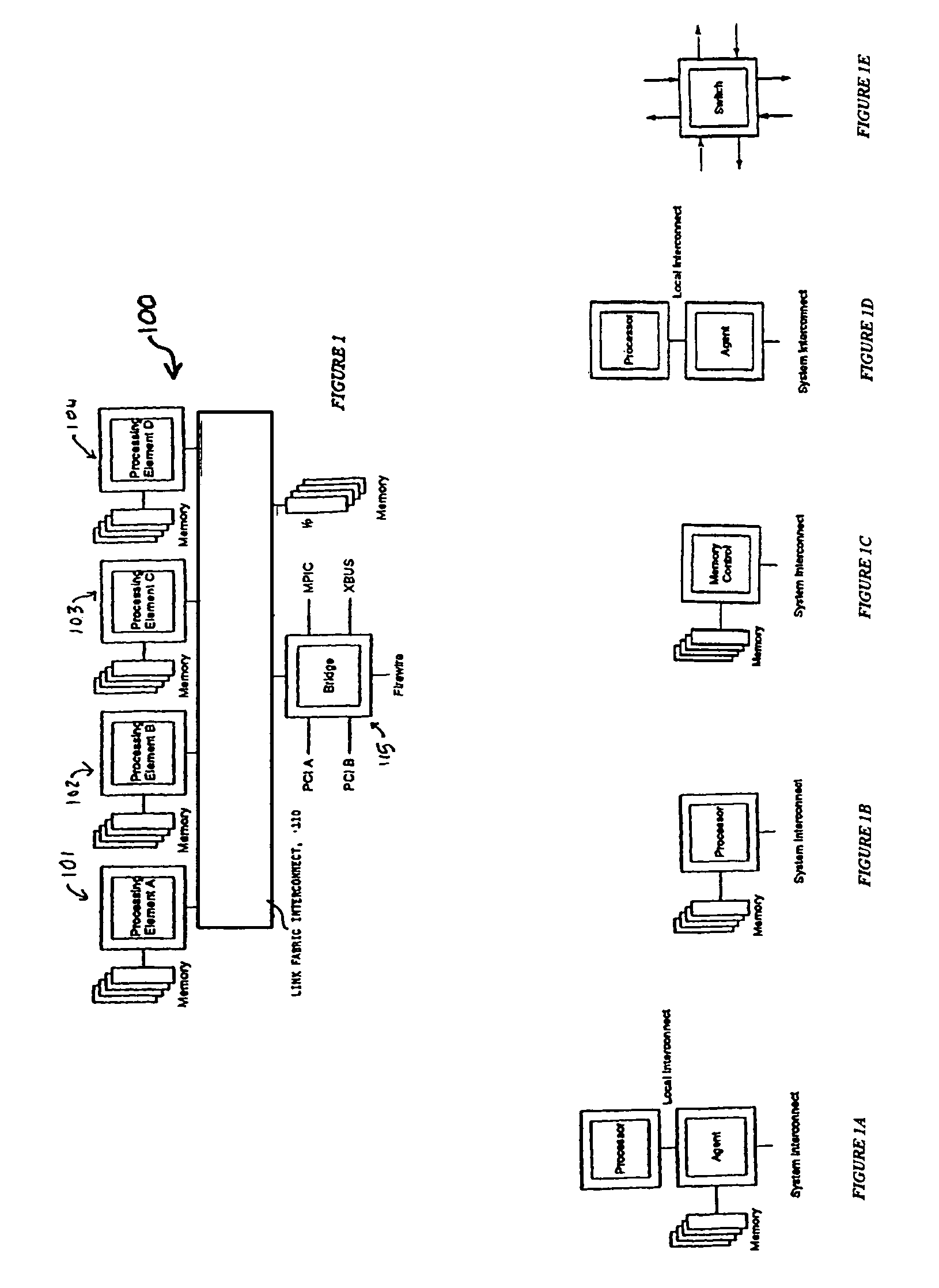
[0045]Architecture and Interconnect Fabric FIG. 1 illustrates generally an embodiment of a digital data system 100 employing link interconnect message communication in accordance with the present invention. The system includes a plurality of nodes, some of which are shown as digital devices 101, 102, 103, 104, . . . In the illustrated embodiment, these are processors with associated memories, though, they may also comprise other digital devices capable of generating, handling and / or passing message packets.
[0046]In this regard, it will be understood that messaging over interconnected links as described herein has wide application, e.g., to systems that implement direct memory access, to systems that provide communications between processors in a domain, as well as to systems that provide such communications between lower-level digital devices or components. Examples of the former are provided by FIGS. 1 and 1A. Examples of the latter are provided by FIGS. 1B and 1D (a stand-alone pr...
PUM
 Login to View More
 Abstract
Description
Claims
Application Information
 Login to View More