
Method for controlling static magnetic field and MRI apparatus
a static magnetic field and control method technology, applied in the direction of instruments, magnetic bodies, using reradiation, etc., can solve the problem that the effect of preventing leakage flux cannot be sufficiently obtained, and achieve the effect of preventing leakage flux
- Summary
- Abstract
- Description
- Claims
- Application Information
AI Technical Summary
Benefits of technology
Problems solved by technology
Method used
Image

Examples
embodiment 1
[0053][Embodiment 1]
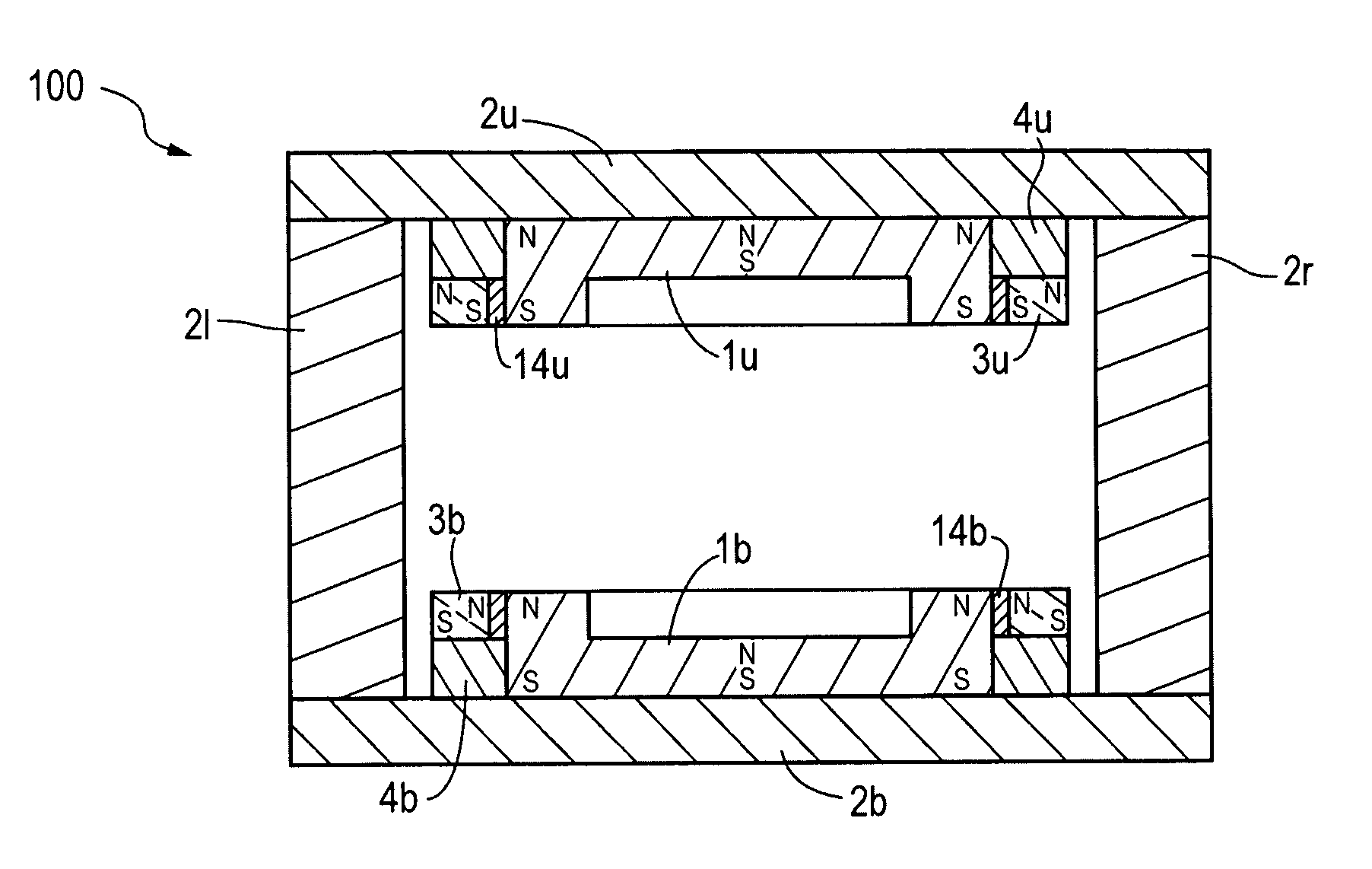
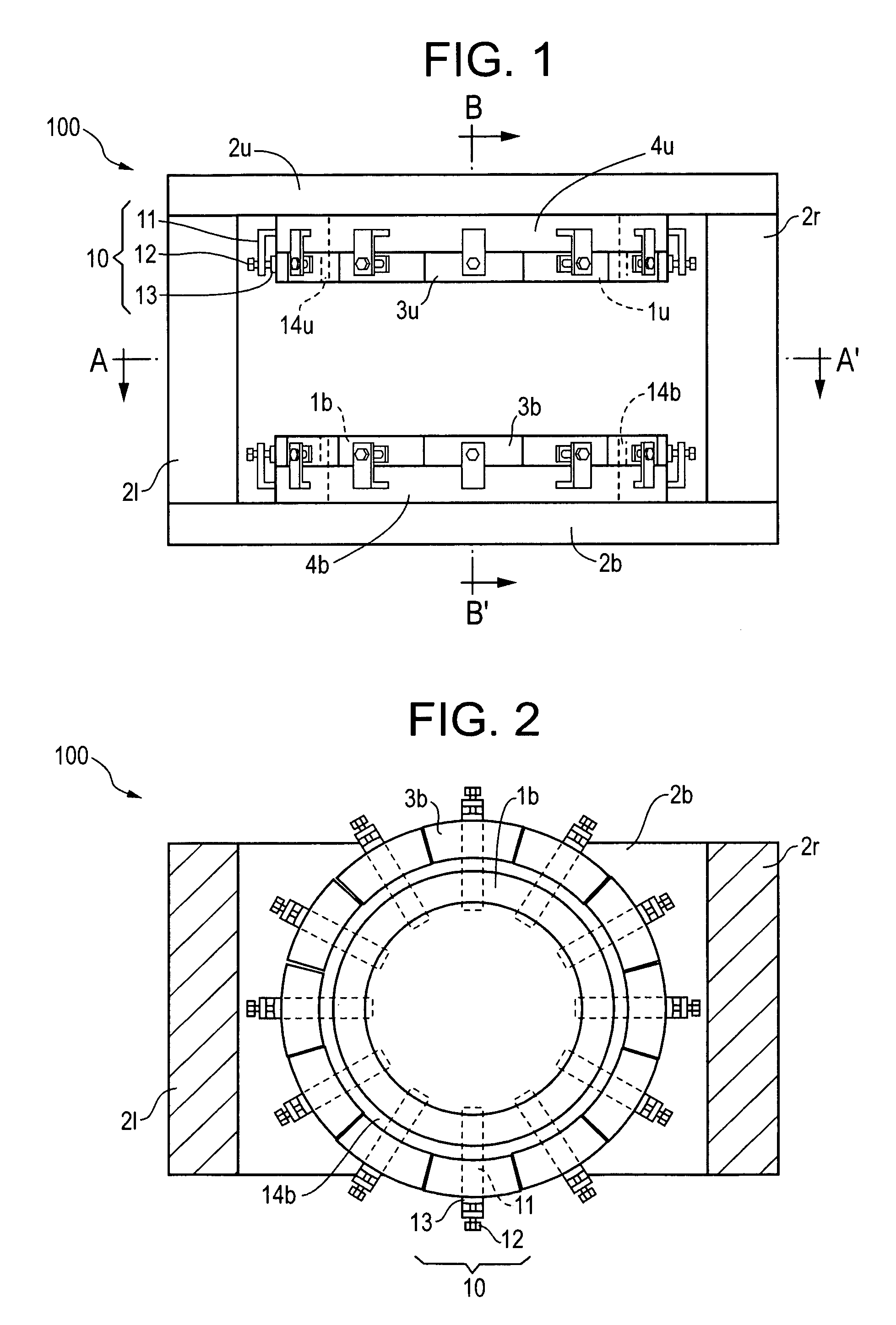
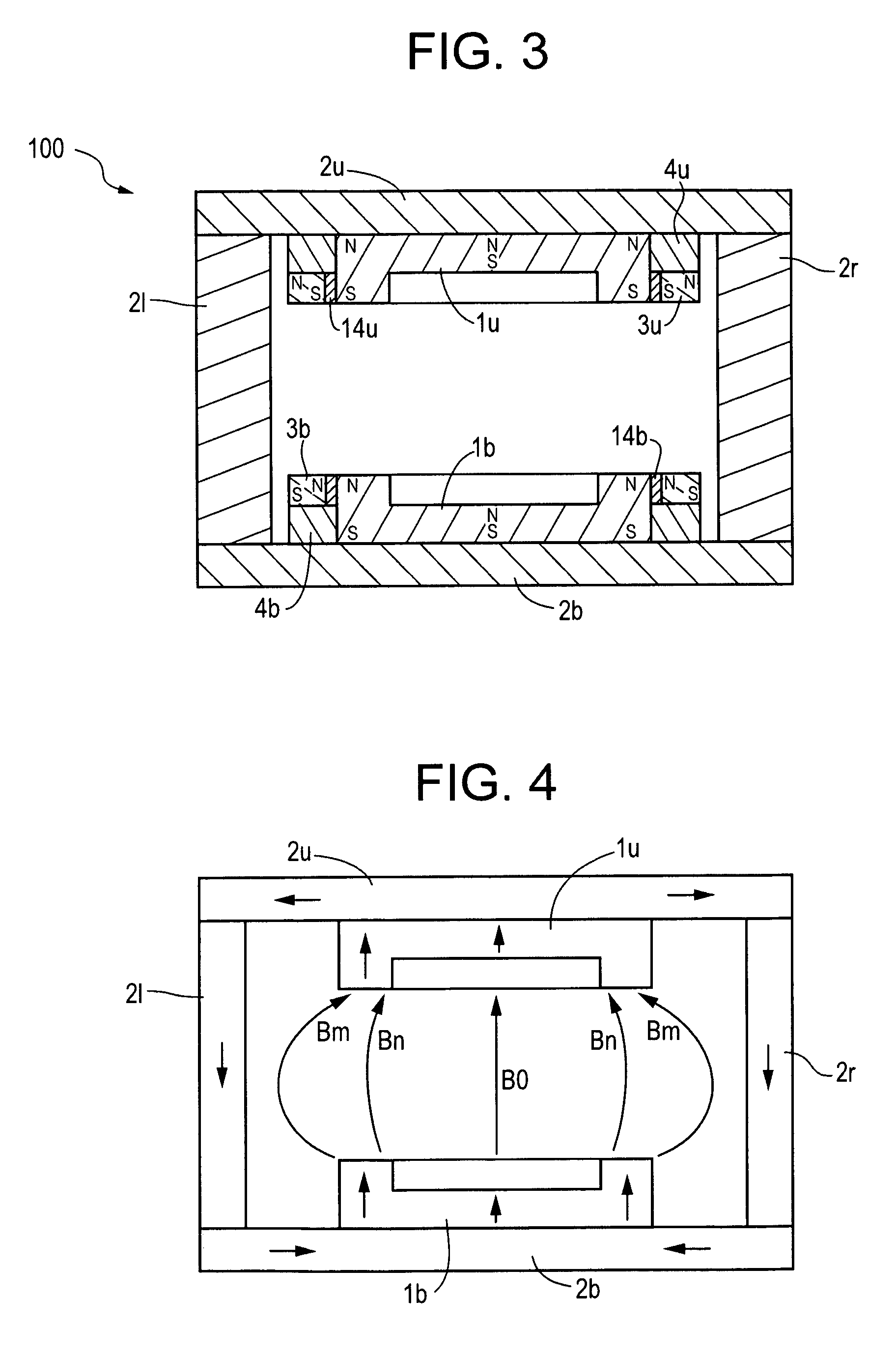
[0054]FIG. 1 is a front view showing a static magnetic field generating magnet section of an MRI apparatus 100 according to an embodiment 1. FIG. 2 is a cross-sectional view taken along line A–A′ of FIG. 1. FIG. 3 is a sectional typical view taken along line B–B′ of FIG. 1.
[0055]The MRI apparatus 100 is equipped with an upper main magnet 1u and a lower main magnet 1b of which the front surfaces are opposite to each other in the vertical direction with a space with an object placed therein being interposed therebetween, an upper yoke 2u, a right yoke 2r, a lower yoke 2b and a left yoke 2l which magnetically connect the back surfaces of the main magnets 1u and 1b, a plurality of upper auxiliary magnets 3u disposed around the upper main magnet 1u, an upper support table 4u for fixing the height of each upper auxiliary magnet 3u with respect to the upper yoke 2u, a plurality of lower auxiliary magnets 3b disposed around the lower main magnet 1b, a lower support table...
embodiment 2
[0072][Embodiment 2]
[0073]Spacers 14u and 14b may be formed of an adhesive mixed with a filler (e.g., ferrite bead) corresponding to a magnetic body.
[0074]Varying the material for the magnetic body and the amount of mixing thereof makes it possible to control the effects of auxiliary magnets 3u and 3b.
embodiment 3
[0075][Embodiment 3]
[0076]FIGS. 7 and 8 respectively show an MRI apparatus 200 according to an embodiment 3.
[0077]The MRI apparatus 200 has a gap g defined between an upper main magnet 1u and upper auxiliary magnets 3u and a gap g defined between a lower main magnet 1b and lower auxiliary magnets 3b.
PUM
 Login to View More
 Abstract
Description
Claims
Application Information
 Login to View More