
Scalable and unified multiplication methods and apparatus
- Summary
- Abstract
- Description
- Claims
- Application Information
AI Technical Summary
Problems solved by technology
Method used
Image

Examples
Embodiment Construction
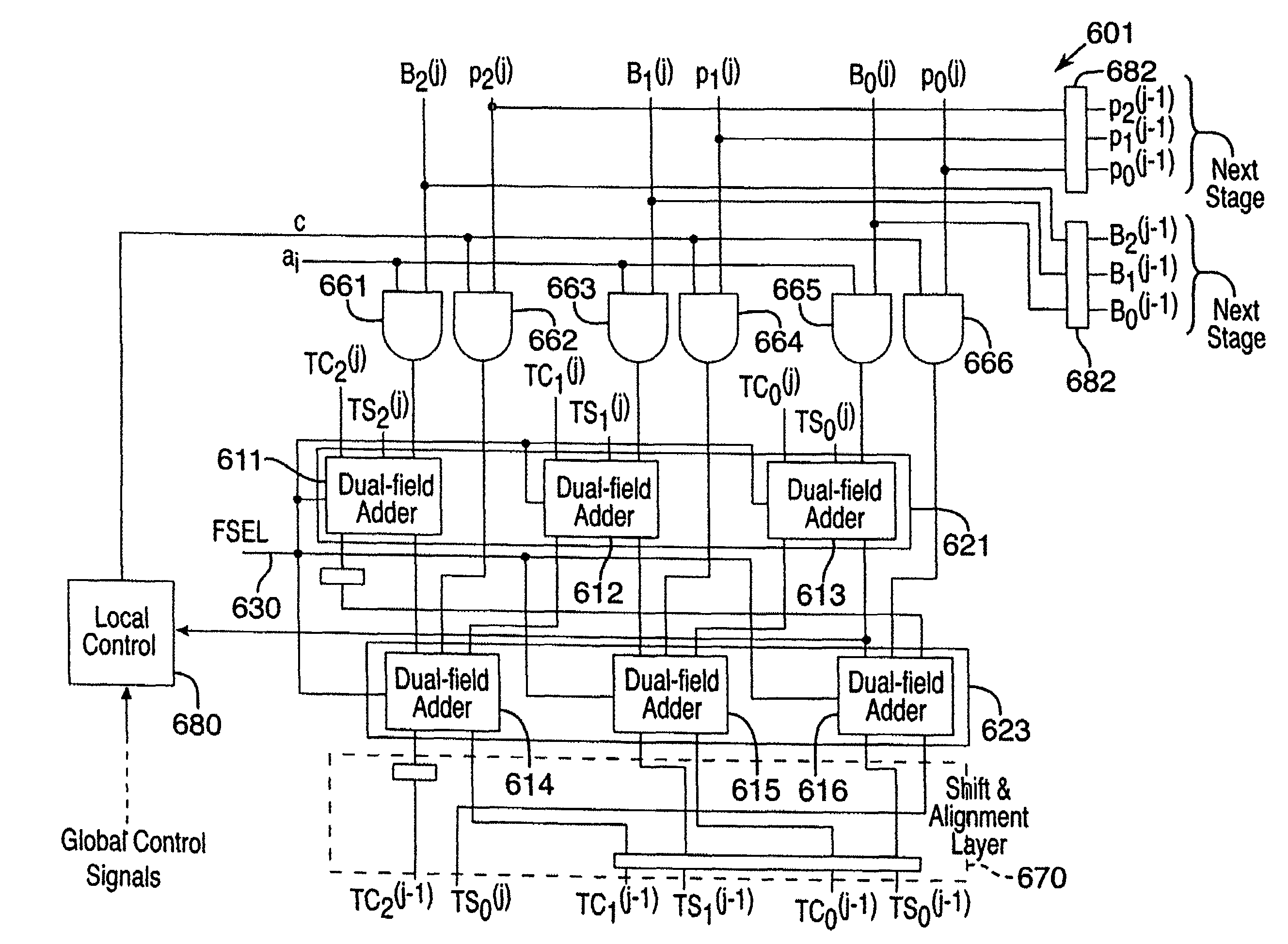
[0034]Methods and apparatus are provided for Montgomery multiplication of elements of the finite field GF(p), wherein p is a prime number, and the finite field GF(2m), wherein m is a positive integer. The field GF(p) is generated by the prime number p, and the field GF(2m) is generated by an arbitrary irreducible polynomial p(x). These methods and apparatus are suitable for multiplication of elements of either GF(p) or GF(2m) and are scalable, permitting multiplication of elements of arbitrary precision. Such methods and apparatus are referred to as unified and scalable. Increases in area or decreases in speed associated with such a unified multiplication module are acceptable in many applications. In addition, the design of such a module can involve only slightly more design effort than a multiplier for a single finite field, and no significant modification in circuit control logic is needed. Because of the magnitude of the design effort expended in designing a multiplier module or...
PUM
 Login to View More
 Abstract
Description
Claims
Application Information
 Login to View More