Check patentability & draft patents in minutes with Patsnap Eureka AI!

Embedded substrate interconnect for underside contact to source and drain regions

a technology of drain region and substrate, applied in the field of semiconductor processing, can solve the problems of limiting the switching speed of transistors, limiting the arrangement of metallization structures, and occupying valuable die spa

Inactive Publication Date: 2008-03-18
NXP USA INC
View PDF10 Cites 0 Cited by
  • Summary
  • Abstract
  • Description
  • Claims
  • Application Information

AI Technical Summary

Benefits of technology

This approach reduces parasitic capacitance, loosens alignment specifications, enables higher density circuits, and allows for more efficient use of die space by enabling conductive lines to contact source and drain regions directly, improving switching speed and circuit density.

Problems solved by technology

Such interconnect lines do not permit traversal over unrelated conductive regions on the same plane of the die and, consequently, their routing is typically limited to interconnection between adjacent conductive elements and cannot be extended to traverse over several devices.
In some cases, however, the arrangement of metallization structures may be limited, particularly in regard to components of field effect transistors.
Such a capacitance may limit the switching speed of a transistor, an affect which is expected to become more prevalent as smaller feature dimensions continue to be imposed by advancements in technology.
In conventional designs, such a spacing is generally greater than approximately 70 nm, causing valuable die space to be occupied.
In particular, source and drain regions need to be sufficiently large to provide such a spacing as well as room for the contact structures or local interconnects and a margin of error for deviations of alignment when forming the contact structures or local interconnects on the source and drain regions.
In addition or alternative to the arrangement of local interconnects being limited with regard to the location of transistor gates, the restriction of local interconnects over limited regions of a circuit imparts a significant constraint for connecting conductive components within non-adjacent devices at a level near the base of the integrated circuit, forcing many interconnects to be formed at higher levels within a circuit.
It is generally recognized, however, that the formation of features within design specifications becomes increasingly more difficult within higher levels of a circuit.
As a result, problems with step coverage of deposited materials may arise.
Furthermore, if a topography is nonplanar, a patterned image may be distorted and the intended structure may not be formed to the specifications of the device.

Method used

the structure of the environmentally friendly knitted fabric provided by the present invention; figure 2 Flow chart of the yarn wrapping machine for environmentally friendly knitted fabrics and storage devices; image 3 Is the parameter map of the yarn covering machine
View more

Image

Smart Image Click on the blue labels to locate them in the text.
Viewing Examples
Smart Image
  • Embedded substrate interconnect for underside contact to source and drain regions
  • Embedded substrate interconnect for underside contact to source and drain regions
  • Embedded substrate interconnect for underside contact to source and drain regions

Examples

Experimental program
Comparison scheme
Effect test

Embodiment Construction

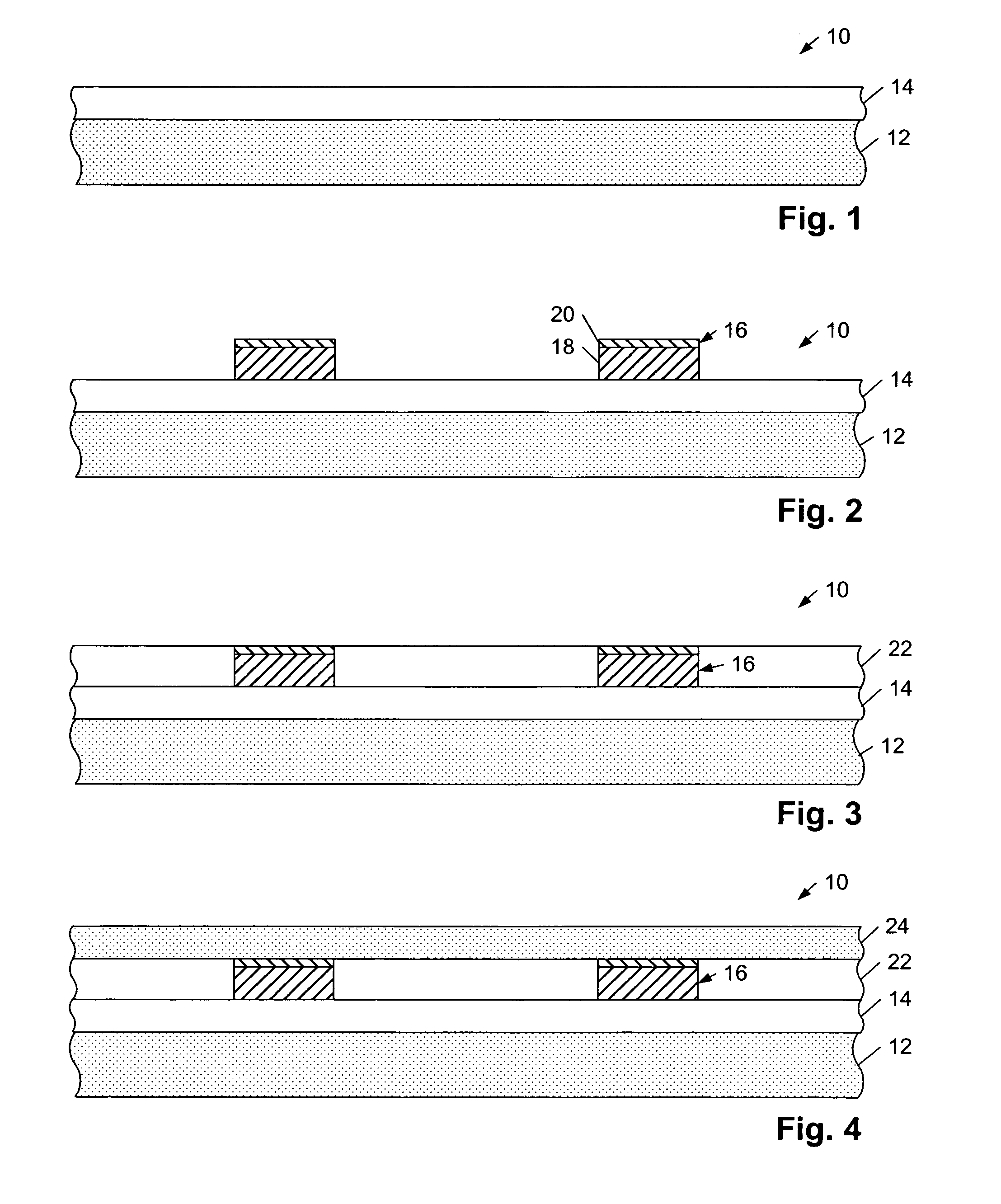
[0017]With regard to the drawings, an exemplary method for fabricating a semiconductor-on-insulator (SOI) substrate with an embedded conductive line is shown in FIGS. 1-4. In addition, FIGS. 5-7 illustrate a method for processing a SOI substrate having an embedded conductive line such that one of a pair of source and drain regions extends through an upper semiconductor layer of the SOI substrate to the conductive line. As used herein, an “upper” semiconductor layer of a SOI substrate refers to the layer within the substrate above which devices, such as transistors, are most remotely formed or slated to be formed. Therefore, the orientation of a semiconductor topography including such a substrate (i.e., whether the topography is arranged sideways, flipped, or upright relative to the position of the upper semiconductor layer within the substrate) does not affect the reference of the upper semiconductor layer. In other words, the upper semiconductor layer of a SOI substrate may not nec...

the structure of the environmentally friendly knitted fabric provided by the present invention; figure 2 Flow chart of the yarn wrapping machine for environmentally friendly knitted fabrics and storage devices; image 3 Is the parameter map of the yarn covering machine
Login to View More

PUM

No PUM Login to View More

Abstract

A semiconductor topography (10) is provided which includes a semiconductor-on-insulator (SOI) substrate having a conductive line (16) arranged within an insulating layer (22) of the SOI substrate. A method for forming an SOI substrate with such a configuration includes forming a first conductive line (16) within an insulating layer (22) arranged above a wafer substrate (12) and forming a silicon layer (24) upon surfaces of the first conductive line and the insulating layer. A further method is provided which includes the formation of a transistor gate (28) upon an SOI substrate having a conductive line (16) embedded therein and implanting dopants within the semiconductor topography to form source and drain regions (30) within an upper semiconductor layer (24) of the SOI substrate such that an underside of one of the source and drain regions is in contact with the conductive line.

Description

BACKGROUND OF THE INVENTION[0001]1. Field of the Invention[0002]This invention generally relates to semiconductor processing and, more specifically, to the formation of interconnects within substrates for making underside contact to source and drain regions of field effect transistors.[0003]2. Description of the Related Art[0004]The following descriptions and examples are not admitted to be prior art by virtue of their inclusion within this section.[0005]The fabrication of integrated circuits includes the formation of several different metallization structures, including interconnect lines, contacts, and vias, to connect conductive components of a circuit. In particular, contacts and vias are generally used to provide vertical electrical connections between conductive components arranged among different planes of a circuit. In some cases, contacts may refer to metallization structures used to connect a transistor component (e.g., a source or drain region or agate electrode) with an ...

Claims

the structure of the environmentally friendly knitted fabric provided by the present invention; figure 2 Flow chart of the yarn wrapping machine for environmentally friendly knitted fabrics and storage devices; image 3 Is the parameter map of the yarn covering machine
Login to View More

Application Information

Patent Timeline
no application Login to View More
Patent Type & Authority Patents(United States)
IPC IPC(8): H01L27/01
CPCH01L21/84H01L27/12H01L29/41733
Inventor PELLEY, III, PERRY H.COOPER, TROY L.MENDICINO, MICHAEL A.
Owner NXP USA INC
Features
  • R&D
  • Intellectual Property
  • Life Sciences
  • Materials
  • Tech Scout
Why Patsnap Eureka
  • Unparalleled Data Quality
  • Higher Quality Content
  • 60% Fewer Hallucinations
Social media
Patsnap Eureka Blog
Learn More