
Double-sided liquid crystal display device
a liquid crystal display device and display device technology, applied in the direction of identification means, instruments, details of portable computers, etc., can solve the problems of affecting the portability of such information terminals, affecting the quality of image display, and unable to obtain a sufficient angle of inclination for wedge-shaped light-guiding plates, etc., to achieve simple and reliable switching operation of backlight, high-quality image display, and low power consumption
- Summary
- Abstract
- Description
- Claims
- Application Information
AI Technical Summary
Benefits of technology
Problems solved by technology
Method used
Image

Examples
first exemplary embodiment
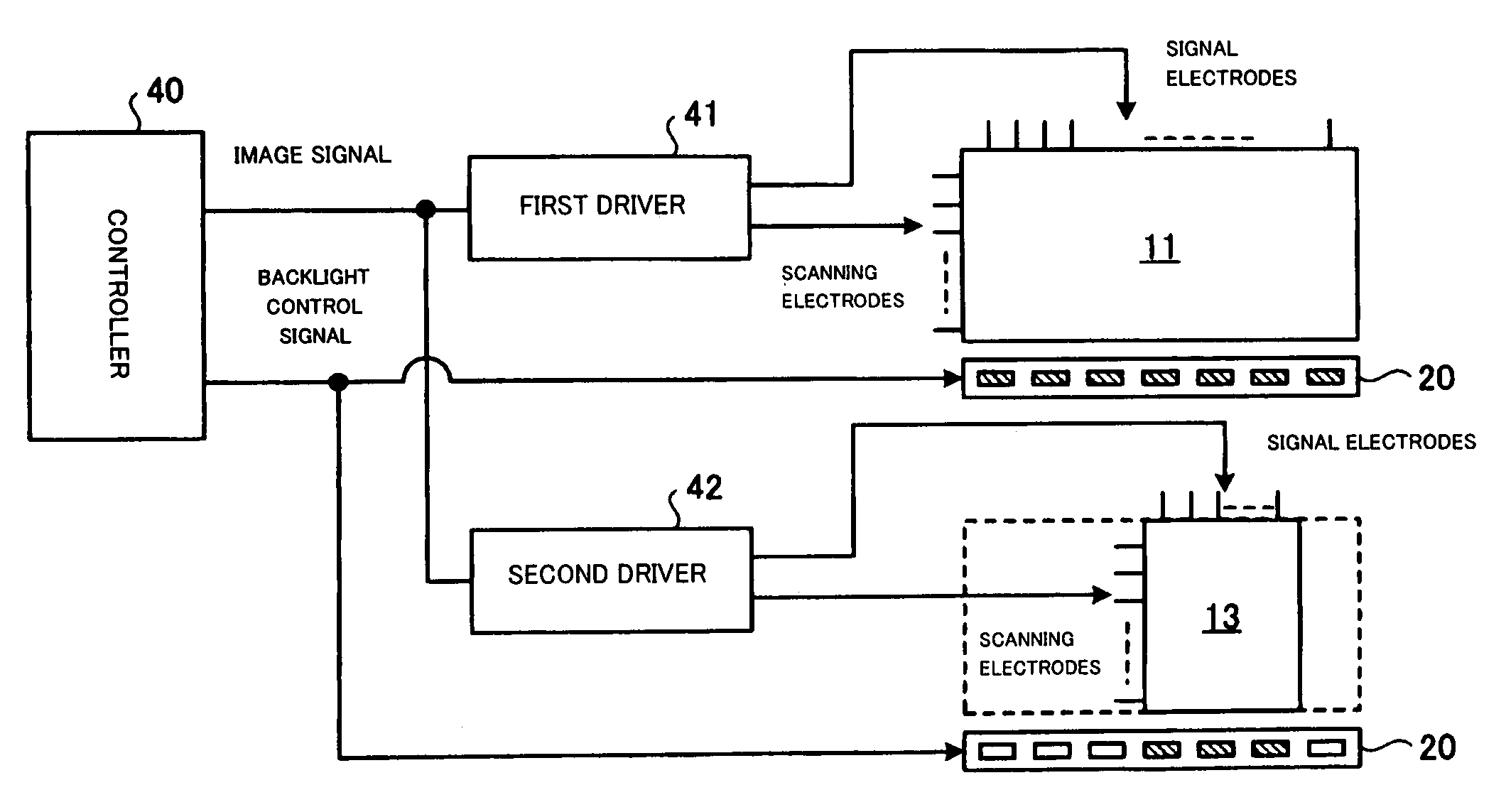
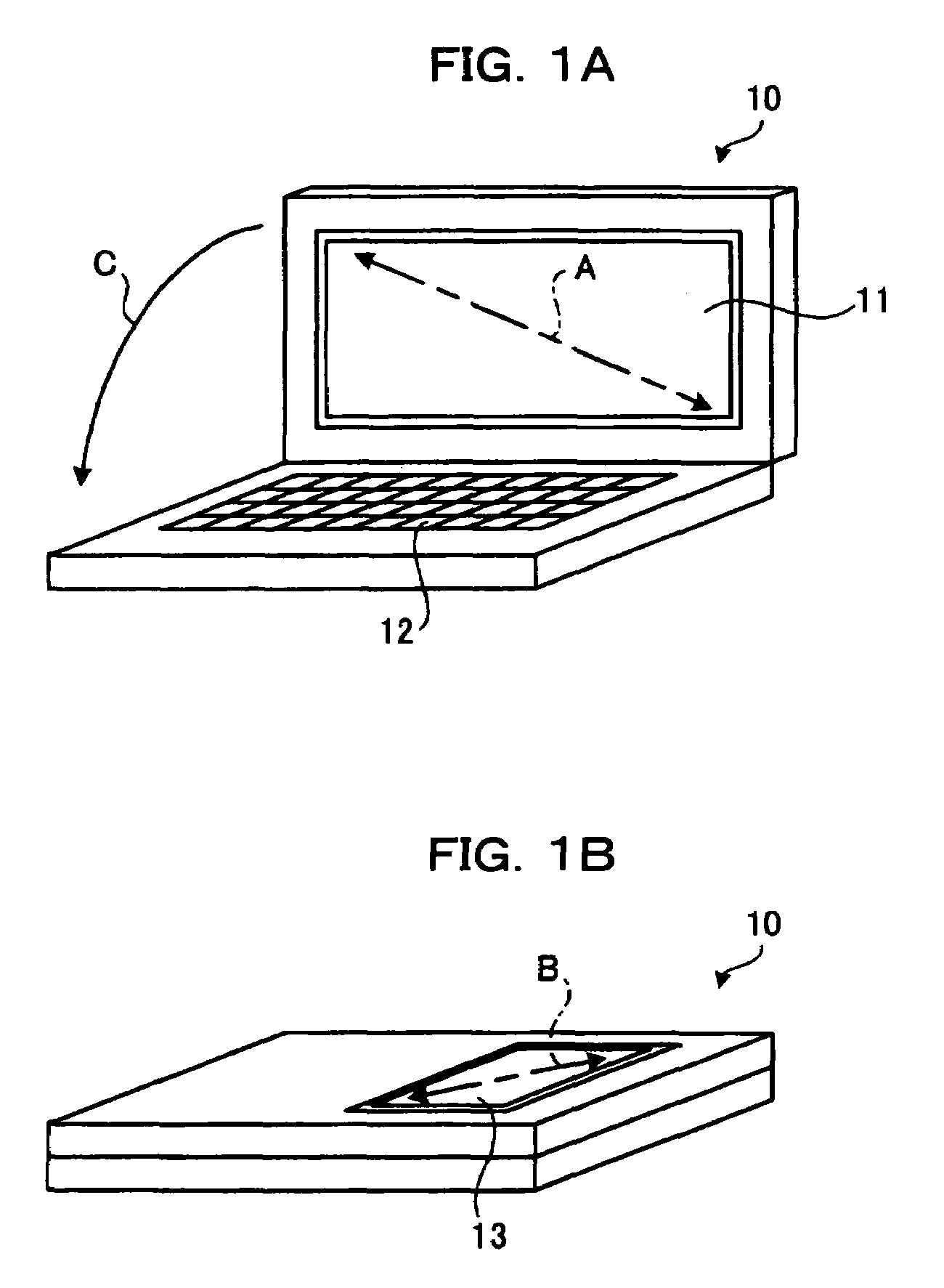
[0030]FIGS. 1A and 1B are schematics of a foldable PDA (Personal Digital Assistant) 10 including a double-sided liquid crystal display device of a first exemplary embodiment according to the present invention. FIG. 1A is a schematic showing the PDA 10 in a state where a cover is opened. FIG. 1B is a schematic showing the PDA 10 in a state where the cover is closed. As shown in FIG. 1A, the PDA 10 is provided with a 5-inch main display panel 11 (A=5 inches) on the inner surface of the cover, and a main body 12 which is combined with the cover by a hinge in a foldable manner and which includes, for example, a keyboard, a controller, a processor, and memory. When the cover of the PDA 10 is closed in a direction indicated by an arrow C, as seen from FIG. 1B, the PDA 10 is provided with a 2-inch sub-display panel 13 (B=2 inches) on the outer surface, i.e. the rear surface of the cover.
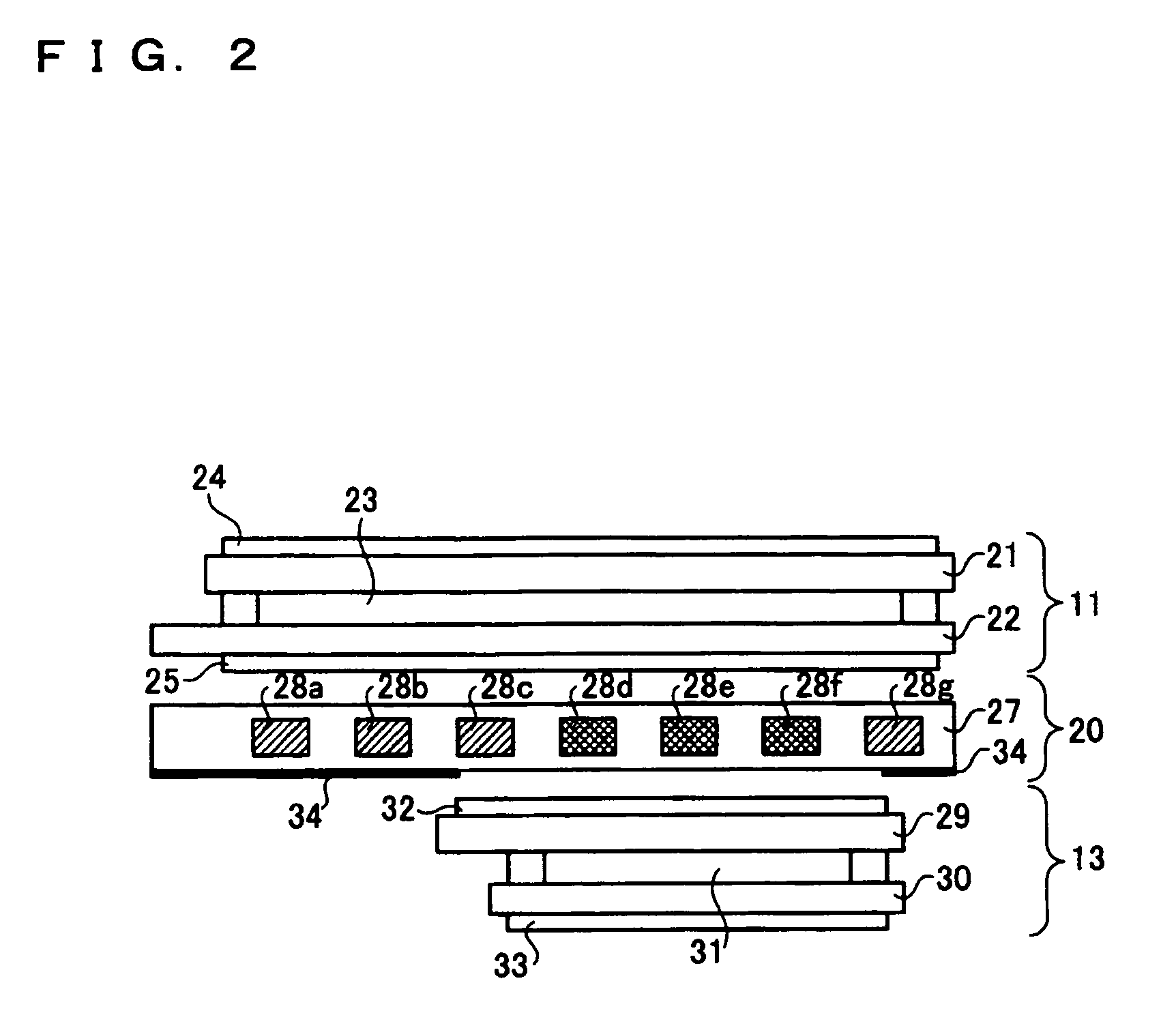
[0031]FIG. 2 is a schematic illustrating the structure of the main display panel 11 and the sub-display ...
second exemplary embodiment
[0045]FIG. 7 is a schematic illustrating a main display panel and a sub-display panel according to a second exemplary embodiment. In FIG. 7, components that are similar or corresponding to the components in FIG. 2 are indicated by the same reference numerals, and the description of those components will be omitted. The main feature of the second exemplary embodiment is that the main display panel 11 and the sub-display panel 13 have the same size but are not aligned with each other in a cross-sectional view. Even in this case, the power consumption of the LEDs of the backlight 20 is similarly reduced.
[0046]In related art devices, all six LEDs had to be turned on when the display operation was performed in the main display panel 11 or the sub-display panel 13. However, referring to FIG. 7, according to the second exemplary embodiment, only four LEDs need to be turned on to perform image display in the main display panel 11 or in the sub-display panel 13. This reduces the power consum...
third exemplary embodiment
[0048]FIG. 8 is a schematic illustrating a main display panel and a sub-display panel according to a third exemplary embodiment. In FIG. 8, components that are similar or corresponding to the components in FIG. 2 are indicated by the same reference numerals, and the description of those components will be omitted. The main feature of the third exemplary embodiment is that the sub-display panel 13 is larger than the main display panel 11, and the two panels are positioned such that they do not overlap with each other. Also in this case, the power consumption of the LEDs of the backlight 20 is reduced.
[0049]In related art devices, all six LEDs had to be turned on when the display operation was performed in the main display panel 11 or the sub-display panel 13. However, referring to FIG. 8, according to the third exemplary embodiment, only two LEDs need to be turned on for image display by the main display panel 11, reducing the power consumption by about 66%. Moreover, four LEDs need ...
PUM
| Property | Measurement | Unit |
|---|---|---|
| transparent | aaaaa | aaaaa |
| thickness | aaaaa | aaaaa |
| area | aaaaa | aaaaa |
Abstract
Description
Claims
Application Information
 Login to View More