Unlock instant, AI-driven research and patent intelligence for your innovation.

Adaptive channel estimation by means of variation of the integration length during the despreading of spread-coded training symbol sequences

a spread-coded radio signal and integration length technology, applied in the field of adaptive channel estimation for the transmission of spread-coded radio signals, can solve the problems of inability to correctly detect transmitted data without a correction mechanism, inability to use a correction mechanism, and the length of the digital filter must be very long, so as to achieve the effect of low implementation complexity and high estimation accuracy

Inactive Publication Date: 2008-05-06
INTEL CORP
View PDF5 Cites 1 Cited by
  • Summary
  • Abstract
  • Description
  • Claims
  • Application Information

AI Technical Summary

Benefits of technology

The present invention provides a method and apparatus for adaptive channel estimation in spread-coded transmission systems that can achieve high estimation accuracy with less implementation complexity. The method involves correlating pilot symbols or training symbols with the received signal, eliminating the influence of the training symbols on the signal. The resulting signal is then despread and integrated over a number of signal values. A digital filter with fixed or variable filter coefficients is used to produce channel estimation values. The invention takes into account the channel dynamic range and the signal-to-noise ratio to optimize the estimation process. The technical effects of the invention include improved estimation accuracy, simplified implementation, and adaptability to different conditions.

Problems solved by technology

The signal distortion which is caused by the multipath propagation makes it impossible to correctly detect the transmitted data without a correction mechanism.
This assumption is not as valid when SF is very large and / or there are high relative speeds between the mobile station and the base station as when SF is small and / or the relative speeds are low.
The major disadvantage of the known methods is that the length of the digital filter must be chosen to be very long in order also to actually achieve the theoretical estimation gains at low relative speeds.

Method used

the structure of the environmentally friendly knitted fabric provided by the present invention; figure 2 Flow chart of the yarn wrapping machine for environmentally friendly knitted fabrics and storage devices; image 3 Is the parameter map of the yarn covering machine
View more

Image

Smart Image Click on the blue labels to locate them in the text.
Viewing Examples
Smart Image
  • Adaptive channel estimation by means of variation of the integration length during the despreading of spread-coded training symbol sequences
  • Adaptive channel estimation by means of variation of the integration length during the despreading of spread-coded training symbol sequences
  • Adaptive channel estimation by means of variation of the integration length during the despreading of spread-coded training symbol sequences

Examples

Experimental program
Comparison scheme
Effect test

Embodiment Construction

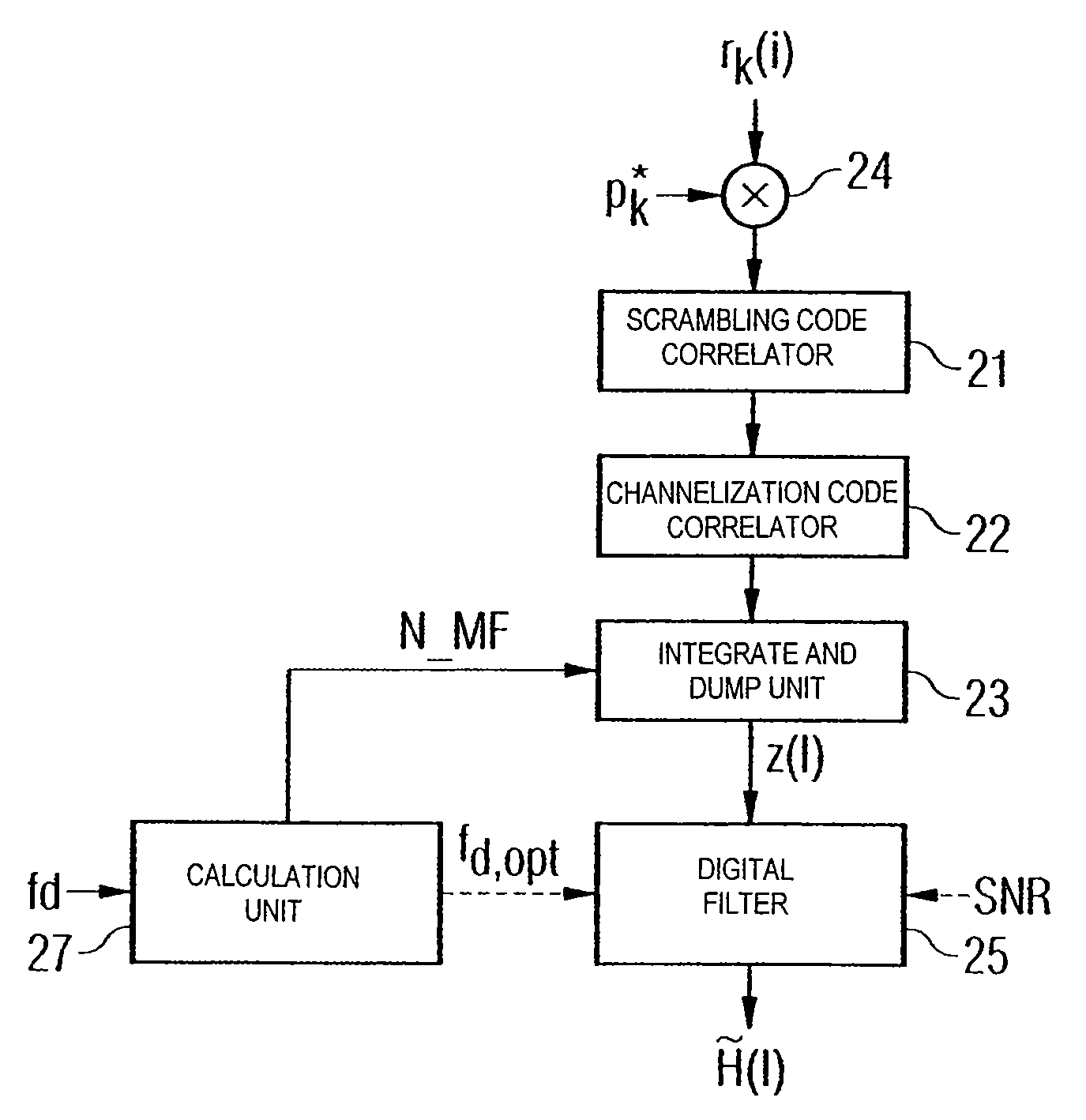
[0046]FIG. 3 once again shows the conventional estimation method based on a block diagram which is more schematic than that shown in FIG. 1. While the previous text has referred only in general terms to spread coding and decoding, this is in practice intended to mean so-called channelization codes (for channel identification) and scrambling codes (for base station identification), with the former often being referred to, in a generalizing manner, as spread codes. A received chip data sequence rk(i) is accordingly first of all passed to a scrambling code correlator 11, and then to a channelization code correlator 12. The two correlators 11 and 12 correspond to the correlator M1 in FIG. 1. The despread chip data sequence is then passed to the integrate and dump unit 13, to which the spreading factor SF is applied, and an integration process is carried out in a corresponding manner over SF chips (corresponding to INT in FIG. 1). The process of correlation with the complex-conjugate tra...

the structure of the environmentally friendly knitted fabric provided by the present invention; figure 2 Flow chart of the yarn wrapping machine for environmentally friendly knitted fabrics and storage devices; image 3 Is the parameter map of the yarn covering machine
Login to View More

PUM

No PUM Login to View More

Abstract

In the method, the received spread-coded signal sequence rk(i) is first of all correlated with the spread-coded training symbol sequence in a correlator (24) so as to counteract the influence of the transmitted training symbols. The signal sequence which results from the correlation process is then despread in a despreading apparatus (21, 22). The despread signal sequence is integrated over a number (N_MF) of signal values, with the number (N_MF) being set as a function of the channel dynamic range (λ). The sequence of data symbols produced in this way is filtered with fixed or variable filter coefficients in a digital filter (25) in order to produce channel estimation values ({tilde over (H)}(l)).

Description

PRIORITY[0001]This application claims priority to German application no. 103 37 068.4 filed Aug. 12, 2003.TECHNICAL FIELD OF THE INVENTION[0002]The present invention relates to a method for adaptive channel estimation for the transmission of spread-coded radio signals by reception and evaluation of a training symbol sequence, and to a corresponding apparatus for adaptive channel estimation.BACKGROUND OF THE INVENTION[0003]In mobile radio systems, the signals are propagated via two or more propagation paths between a transmitter and a receiver. The influence of this multipath propagation on the signal can be described in the form of a linear, time-variant transformation. The signal distortion which is caused by the multipath propagation makes it impossible to correctly detect the transmitted data without a correction mechanism. This correction mechanism, which is known as adaptive equalization and which can also be carried out in a RAKE receiver, is based on continuously repeated mea...

Claims

the structure of the environmentally friendly knitted fabric provided by the present invention; figure 2 Flow chart of the yarn wrapping machine for environmentally friendly knitted fabrics and storage devices; image 3 Is the parameter map of the yarn covering machine
Login to View More

Application Information

Patent Timeline
no application Login to View More
Patent Type & Authority Patents(United States)
IPC IPC(8): H04B1/707H04L25/02
CPCH04L25/0228H04B1/712H04B2201/70701H04L25/0216
Inventor NIEDERHOLZ, JURGENSPETH, MICHAEL
Owner INTEL CORP