

Method and system for processing asynchronous event notifications
a technology of event notification and event processing, applied in computing, electric digital data processing, instruments, etc., can solve problems such as inability to appropriately respond to software applications, inability to provide an efficient way to upgrade software applications, and difficulty in deciphering information
- Summary
- Abstract
- Description
- Claims
- Application Information
AI Technical Summary
Benefits of technology
Problems solved by technology
Method used
Image

Examples
Embodiment Construction
[0021]To facilitate an understanding of the various adaptive aspects of the present invention, the general architecture and operation of a system using a HBA is described. The specific architecture and operation of the other embodiments are described with reference to the general architecture.
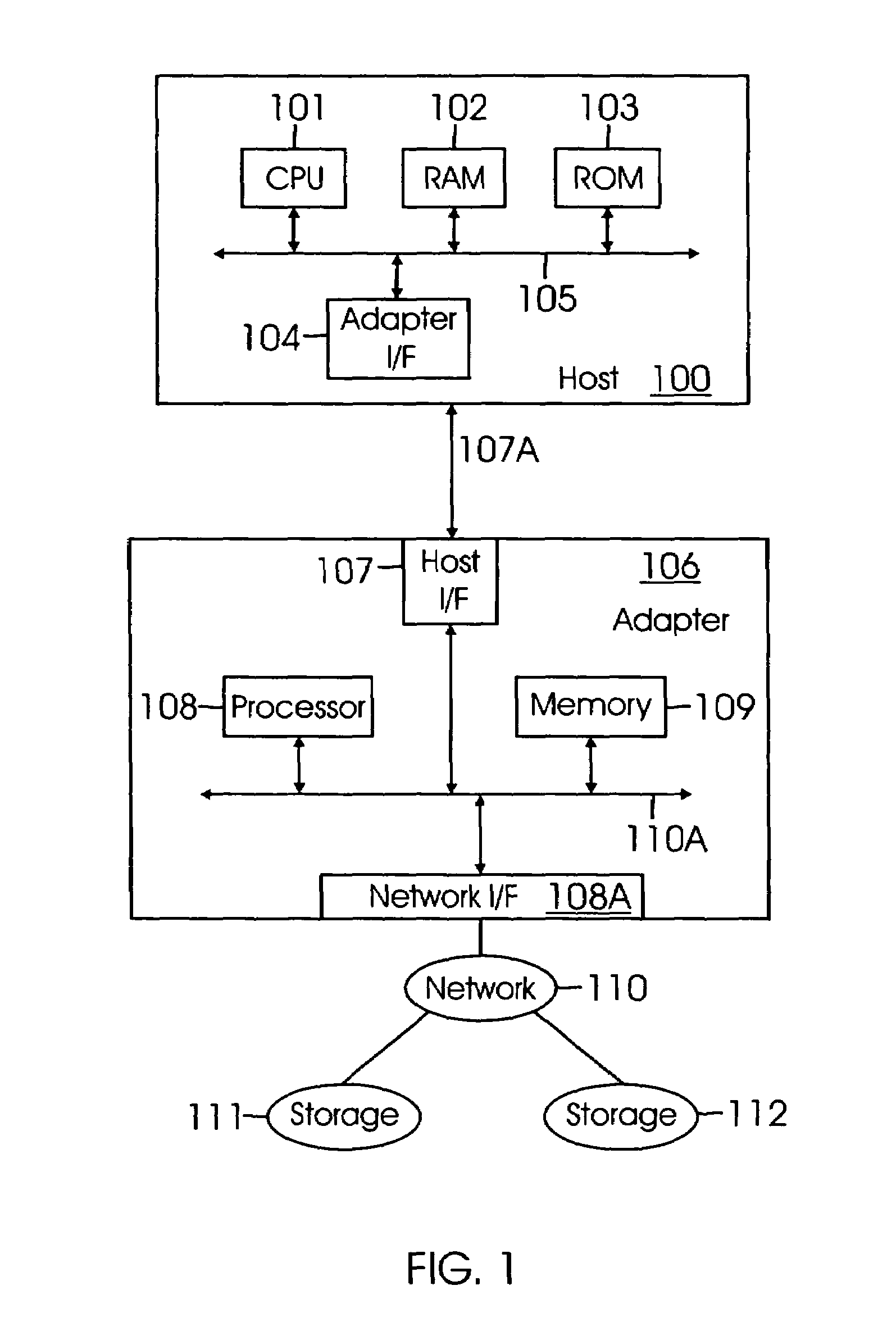
[0022]FIG. 1 shows a block diagram of a host computing system 100 (also referred to as “host system”) having a central processing unit 101 that executes program instructions out of memory 102 that may be random access memory (RAM). Read only memory (ROM) 103 is also provided to store invariant instruction sequences, such as start-up instruction sequences or basic input / output operating system (BIOS).
[0023]Host computing system 100 interfaces with HBA 106 using an adapter interface 104 and bus 107A. Bus 107A may be a PCI, PCI-X, PCI-Express or any other standard / non-standard bus. The standard bus specifications are incorporated herein by reference in their entirety.
[0024]In one embodiment, HBA 1...
PUM
 Login to View More
 Abstract
Description
Claims
Application Information
 Login to View More