
Processor having electronic fuses for storing secret data
a technology of electronic fuse and secret data, which is applied in the field of processors, can solve the problems of non-volatile memory for storing device-unique secret data, such as pins, high manufacturing costs, and very expensive programming of those memories, and achieves the effects of easy detection by an attacker, very cost-effective manufacturing, and annoying the user
- Summary
- Abstract
- Description
- Claims
- Application Information
AI Technical Summary
Benefits of technology
Problems solved by technology
Method used
Image

Examples
Embodiment Construction
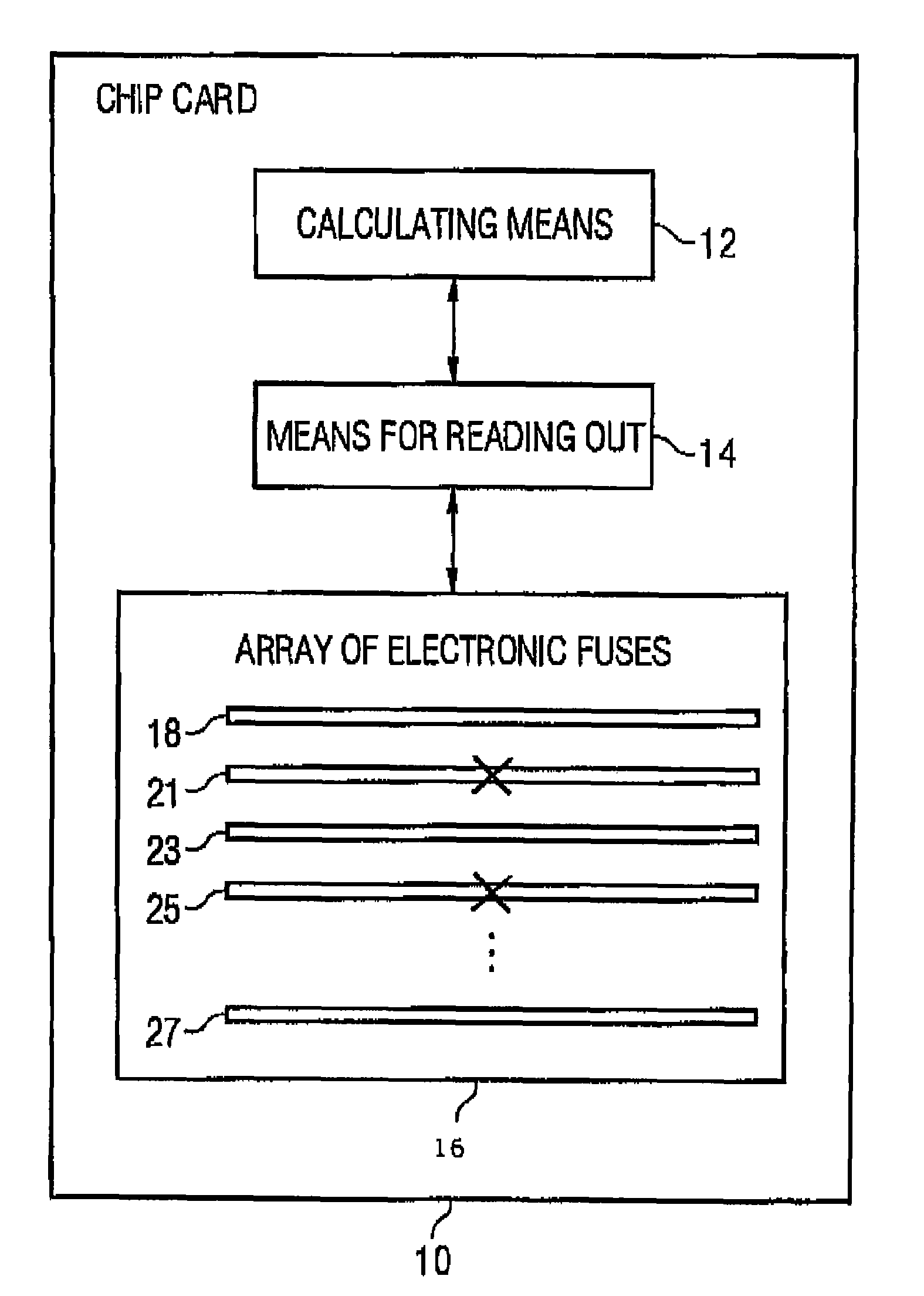
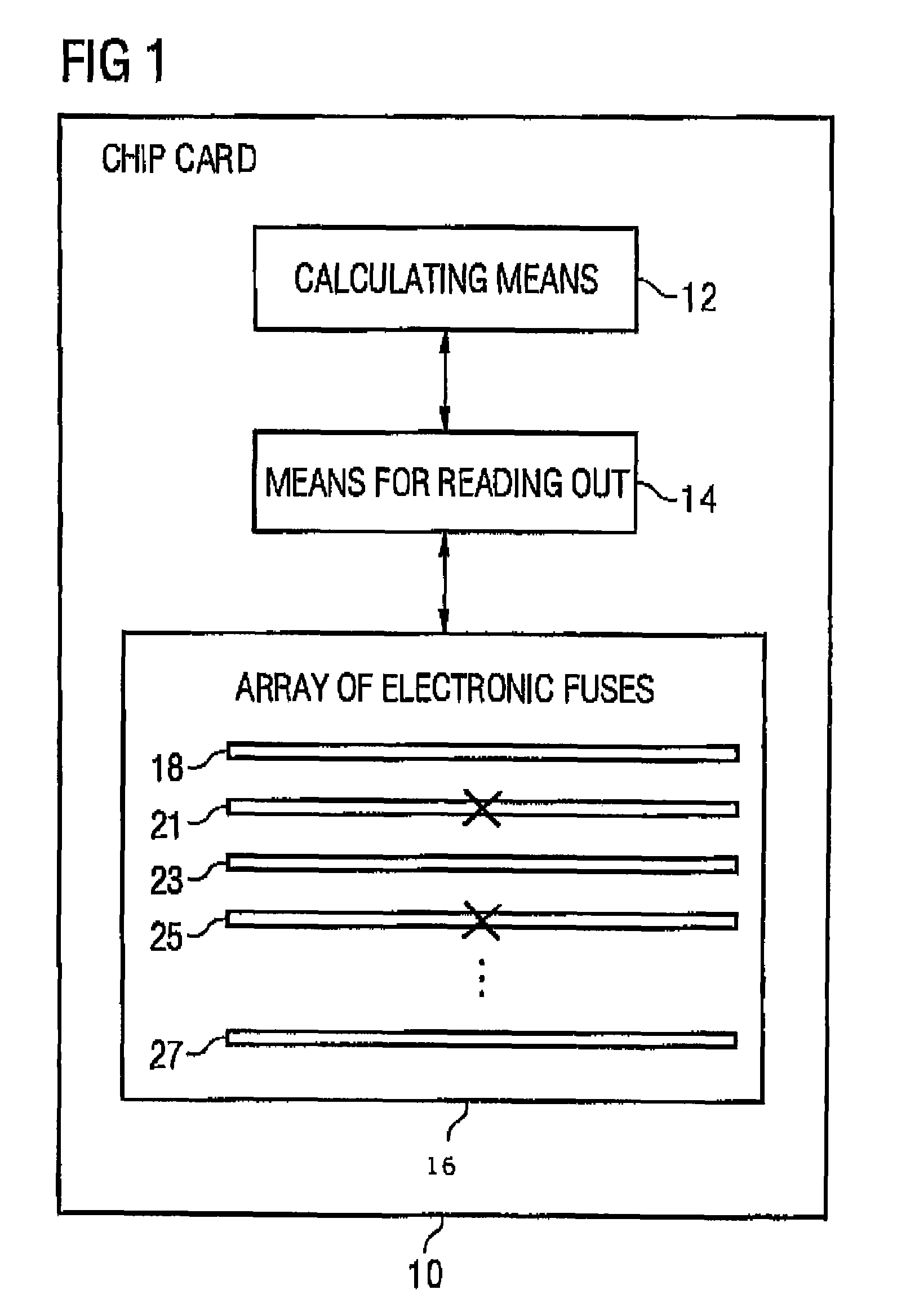
[0028]FIG. 1 shows a chip card 10 having a processor means including a calculating means 12 for processing payload data considering secret data presentable by binary information units. Calculating means 12 is coupled to means 14 for reading out an array 16 of electronic fuses to determine secret data presented in the electronic fuses by binary information units. The array 16 of electronic fuses serves for storing secret data presentable by the binary information unit. The array of electronic fuses includes any number of individual fuses 18,21,23,25,27. A fuse, like for example fuse 18, is implemented to present a first binary value for a binary information unit in its integer state. Another fuse, like for example fuse 20, is implemented to present a second binary value for a binary information unit in a non-integer state, i.e. a defect state as it is indicated by “x” in FIG. 1, wherein the second binary value is different from the first binary value. Thus, it is arbitrary whether an...
PUM
 Login to View More
 Abstract
Description
Claims
Application Information
 Login to View More