Unfortunately, those responsible for evaluating data from monitoring devices are now overwhelmed by information from their monitoring systems.
Effectively monitoring today's electrical power distribution systems is cumbersome, expensive, and inefficient.
There are two problems here: the amount of data to be analyzed and the context of the data.
Accordingly, the data transmitted to the system computer from each monitoring device is often misaligned in that data from each monitoring device on the system does not arrive at the
monitoring system's computer simultaneously.
Because of the data's complexity, quantity, and relative disjointed relationship from one monitoring device to the next, manual analysis of all the data is an enormous effort that often requires experts to be hired to complete the task.
This process is tedious, complex, prone to error and oversight, and time-consuming.
And this solution still requires the evaluation of large amounts of data because the system is only temporally in context; not spatially in context.
Synchronizing data using GPS systems is also disadvantageous because of
time delays associated with other hardware in the system.
Furthermore, any alignment of data by a GPS-based system can only be as accurate as the
propagation delay of the GPS
signal, which means that the data still may not be optimally aligned when a GPS system is used.
The addition of supplemental monitoring devices in the electrical system does nothing more than generate more information about the electrical system at the point where the meter is added in the electrical system, increasing complexity without any benefit.
Any usefulness of the data is generally limited to the locality of the monitoring device that was added, while even more data is amassed.
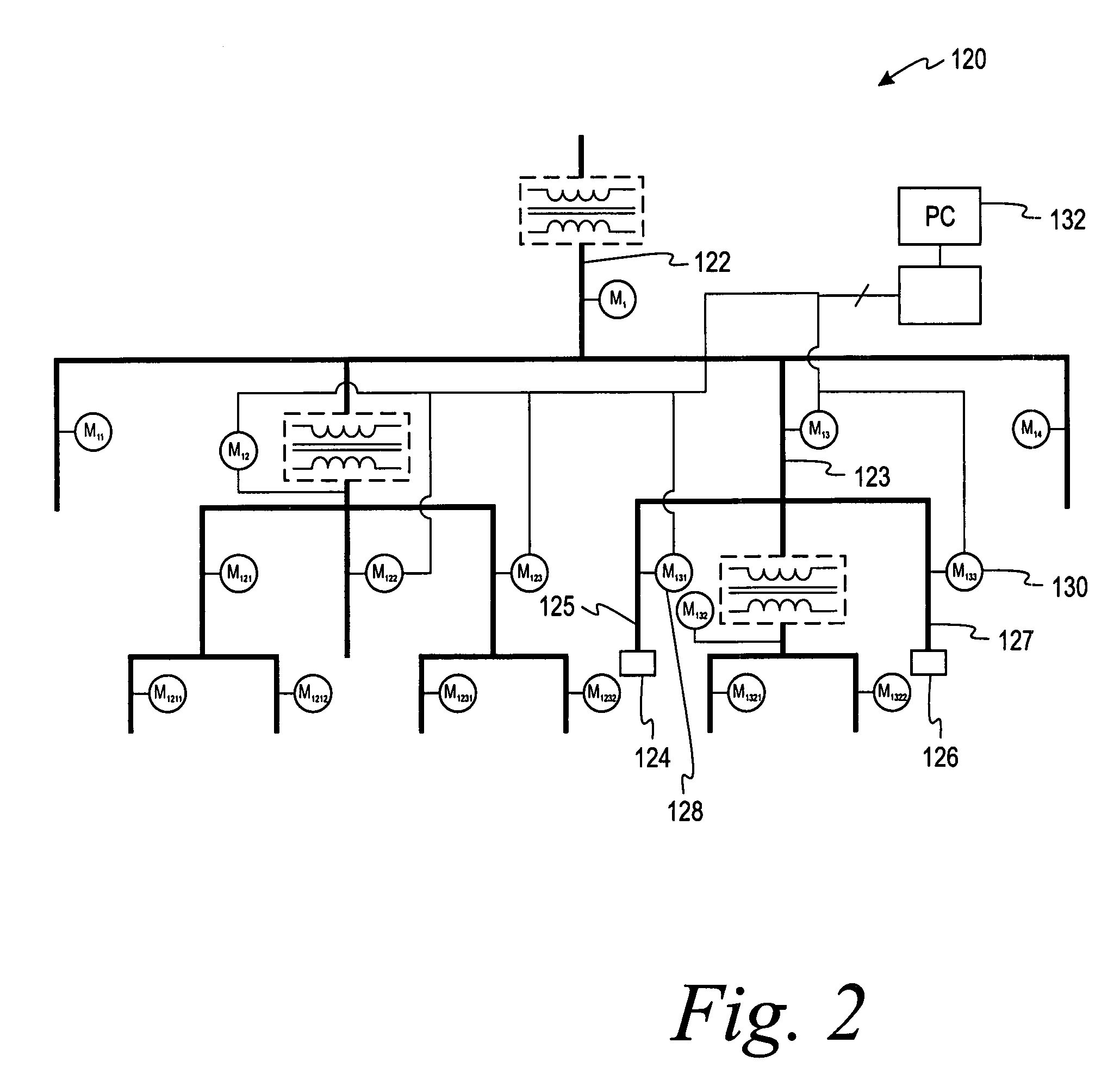
The complexity of many electrical systems usually necessitates an involved configuration process of monitoring systems because each metered point in the electrical system has different characteristics, which is why multiple monitoring devices are installed in the first place.
As a result of the enormous volume of complex data accumulated from electrical monitoring systems heretofore, a thorough analysis of the data is typically not feasible due to
limited resources, time, and / or experience.
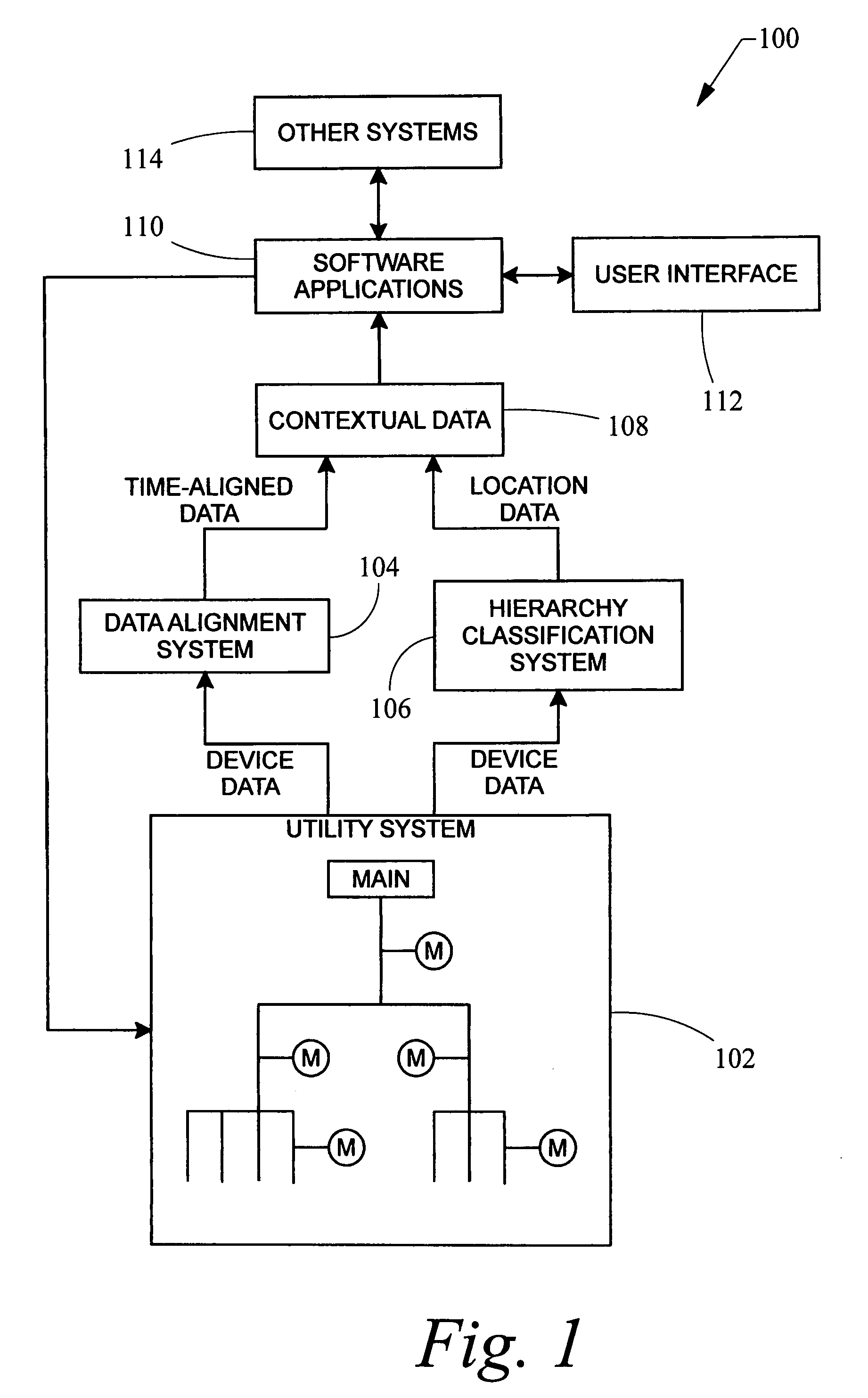
Power monitoring devices measure the electrical system's operating parameters, but do not provide information about how the parameters at different points on the power
monitoring system relate to each other.
Heretofore, the only techniques for passably integrating data were complex, expensive, manually intensive, and time-consuming for the user.
These techniques also permit only limited integration of data and require additional hardware (such as GPS hardware),
data lines, and supplemental monitoring device accessories.
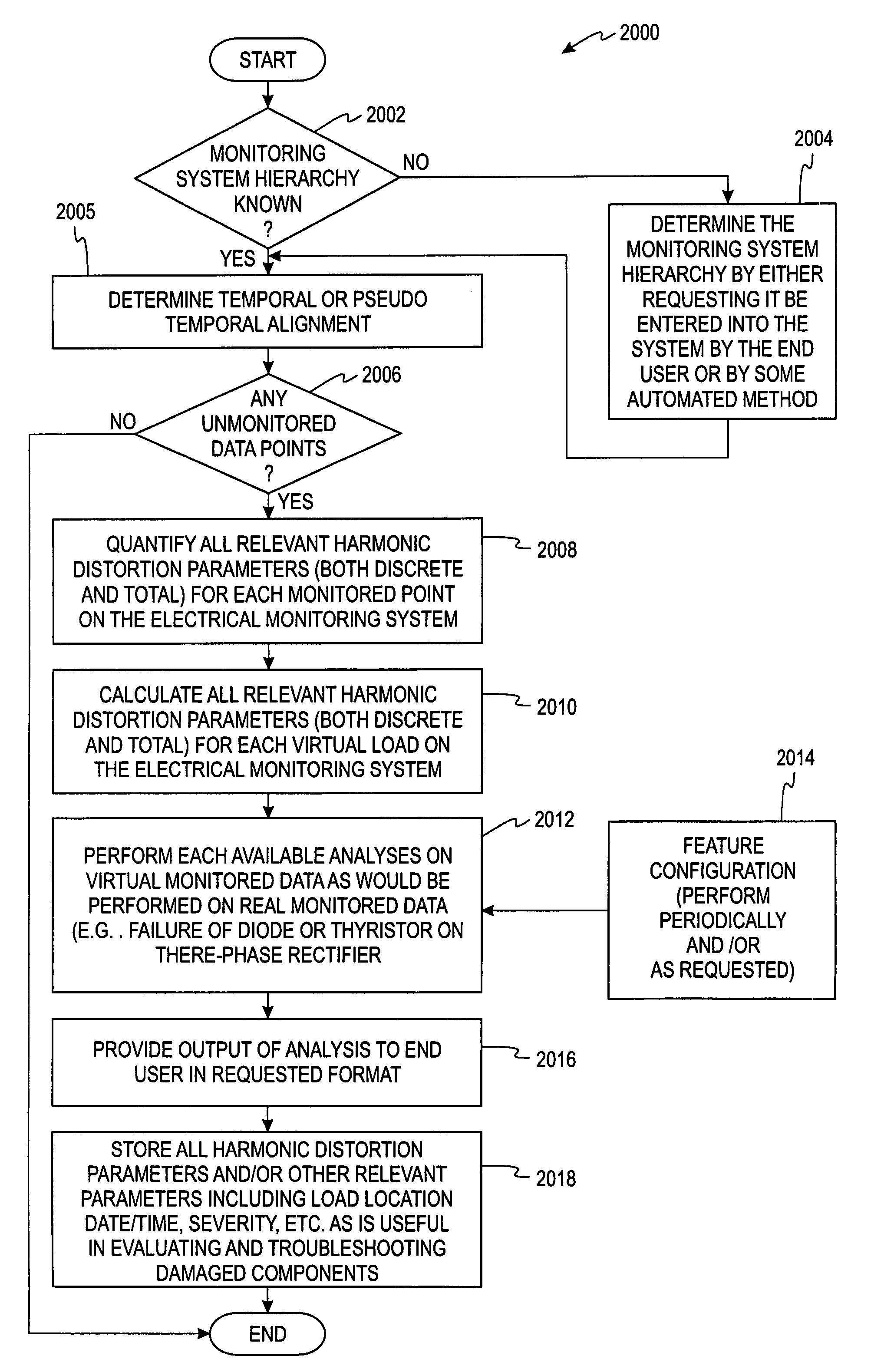
A particular issue is the occurrence of harmonic distortion on an electrical system.
Harmonic distortion results in many
potential electrical vulnerabilities including equipment misoperation, degradation, and potentially, failure.
As more and more non-linear loads are connected to the
electrical grid, issues associated with harmonic distortion will substantially increase—even in facilities that were previously not susceptible to harmonic distortion.
There are various sources of harmonic distortion, most which are non-linear loads.
High-impedance sources and inadequate
electrical wiring can exacerbate harmonic distortion concerns.
Because most loads are designed to operate most effectively at or near some designed
nominal frequency, such loads may not operate as effectively when other frequencies are induced into the system.
A few problems that can occur as a result of harmonic distortion include lack of
phase synchronization, undervoltage circuit activation, interferences, control problems, etc.
Furthermore, the measured harmonic distortion data from various meters may or may not be analyzed within a spatial context.
In any case, harmonic distortion data is not currently analyzed to take
advantage of both spatial and temporal or pseudo-temporal alignment of
monitoring data from multiple devices, and thus limits the useful information and analysis that may be achieved.
Such
software is difficult to use and alterations are expensive and resource consuming.



 Login to View More
  Login to View More