Historically, these
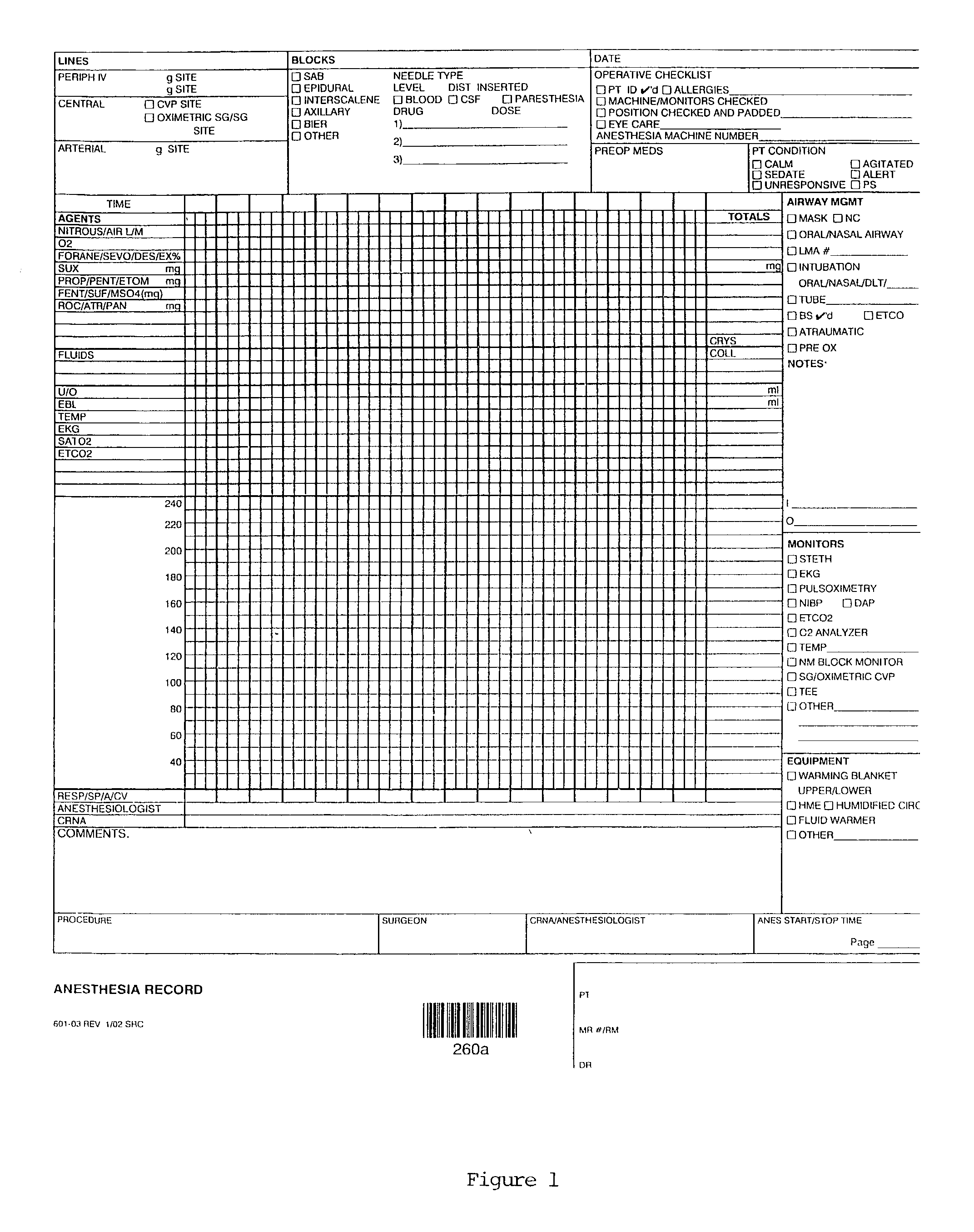
data management systems constituted voluminous paper records and a complex web of sub-systems allowing for various subsequent tasks and records to be produced.
Such a practice is susceptible to mistakes particularly by not documenting appropriate information in view of a busy operating / procedure room environment.
By not documenting appropriate information, insufficient information is recorded on the anesthesia
record.
Further, because the operating / procedure room environment is extremely busy, anesthesia providers don't readily document
pharmacy drug charges or supply charges, which results in lost revenue for the hospital.
By having to rely on handwritten
documentation, time is wasted that could otherwise be used to direct and provide needed care to the patient.
Further, since there is only one copy of the multiple different forms created, losing just one particular form would have a significant negative
impact on
documentation, billing,
drug charges, supply charges, or altering the results of
quality assurance.
By losing the anesthesia
record, you have no
documentation of what happened and what kind of care was provided.
By losing the billing form, supply charges form, or
pharmacy drug charge form, you are dealing with lost revenue, and by losing the quality assurance form, you are not creating accurate results of the evaluation of care provided.
Traditionally, computer applications have been written in an attempt to solve the problems of anesthesia recording, but have met with limited success.
Utilizing a software application on a standard
personal computer (PC) not only brought limited benefits, but created additional problems as well.
For example, the PC is stationary, bulky, and takes up space that is already limited in the operating / procedure room.
The PC is typically fixed behind the anesthesia provider, such that the anesthesia provider is not monitoring the patient, which means that the patient is not receiving the full attention of the anesthesia provider.
The prior art anesthesia applications may be complicated and not straightforward to use, often requiring classes or other extensive training in order to use the application.
This may create additional problems when a locum tenens anesthesia provider, who is usually not given any orientation, is providing care.
Also, because the application is typically set up such that data is automatically pulled from the patient monitors, errors can result on the anesthesia
record due to a variety of circumstances.
For example, this may occur when the surgeon is using an electrical cauterizing device, which interferes with the PC system, which in turn causes the PC to document spurious or incorrect data.
These prior art systems are also limited because the data cannot be edited.
If a problem occurs and the
data needs to be examined, the anesthesia professional is therefore in the awkward position of defending a document that was intended to defend the user.
In the prior systems, this causes an additional
delay that is not in the best interests of the patient who now must wait for the printing before being taken to the post anesthesia care unit for
recovery.
Each of these “fixes” limits the utility of the prior computer-based systems and does not adequately address the problems with paper-based systems.


 Login to View More
  Login to View More