
Manufacturing method of group III nitride semiconductor light-emitting device
a nitride semiconductor and manufacturing method technology, applied in the direction of superimposed coating process, vacuum evaporation coating, coating, etc., can solve the problem of difficult epitaxial growth of crystals directly on the substrate, large lattice mismatch, and inability to obtain favorable crystals, etc., to achieve favorable crystallinity
- Summary
- Abstract
- Description
- Claims
- Application Information
AI Technical Summary
Benefits of technology
Problems solved by technology
Method used
Image


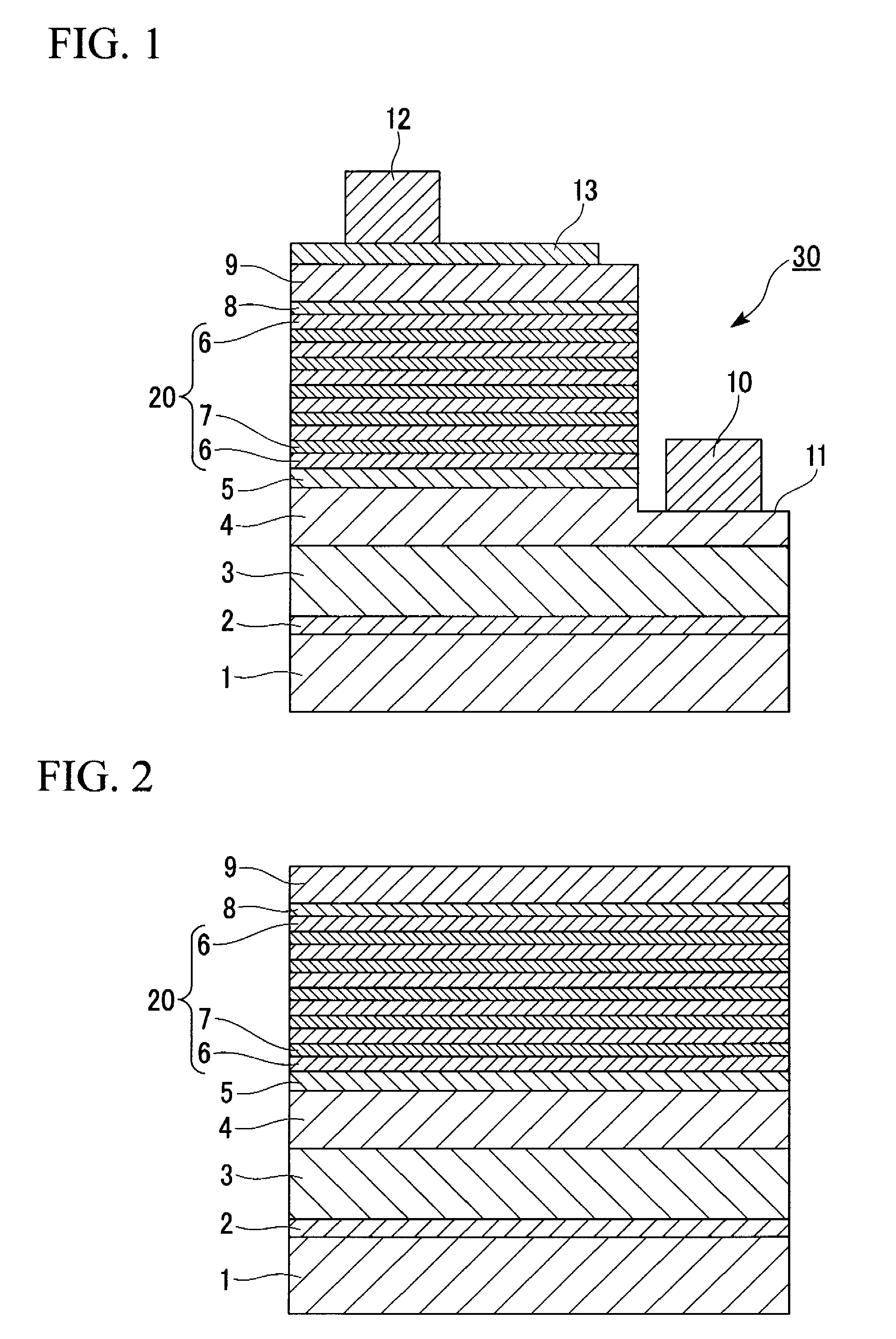

Examples
example 1
[0105]A (0001) c-plane sapphire substrate with a diameter of 2 inches whose surface was mirror-polished is cleaned with a hydrofluoric acid and an organic solvent, and was then introduced into a chamber of a sputtering apparatus. The sputtering apparatus had a mechanism which had a radio frequency power source and rotated a magnet in a sputtering target to thereby cause a magnetic field applied area to be shifted.
[0106][Substrate cleaning] Nitrogen gas was introduced into the chamber at a flow rate of 15 sccm, and then a substrate temperature was increased to 750° C. Furthermore, with an intrachamber pressure maintained at 0.08 Pa, a radio frequency bias at 50 W was applied to the substrate side while rotating a magnet in a sputtering target, to expose the substrate surface to N2 plasma. Thereby, the substrate was cleaned. After that, the plasma generation was stopped.
[0107][Buffer layer formation] Next, in addition to nitrogen gas, argon gas was newly introduced, and the substrate ...
example 2
[0115]In Example 2, a sample made of a buffer layer, a foundation layer, and an n-type contact layer was fabricated in the same condition as in Example 1, the exception being that Si doping was performed in forming the n-type contact layer. The Si doping was formed by the sputter deposition with an Si small piece being placed on the Ga sputtering target. The ratio of a surface area of the Si small piece to that of a Ga metal in the Ga sputtering target was approximately 0.2%.
[0116]A surface of the n-type contact layer of the sample obtained in Example 2 was specular and transparent. A Hall effect measurement on the n-type contact layer was performed, which showed n-type conductivity and a carrier concentration of 2×10¹⁸ / cm3. The results of Example 2 are shown in Table 2.
[0117]
TABLE 2Example 2gas atmosphereArgon gas flow10rate (sccm)Nitrogen gas flow10rate (sccm)gas flow ratio50%of N2 to ArHall effectconductivityn-typemeasurementcarrier concentration2 × 1018(unit: / cm3)crystallinitygo...
example 3
[0118]In Example 3, a sample made of a buffer layer, a foundation layer, and an n-type contact layer was fabricated similar to Example 2, the exception being that when the n-type contact layer was formed, a substrate temperature was 900° C. and that the intrachamber gas atmosphere had an argon gas flow rate of 5 sccm and a nitrogen gas flow rate of 15 sccm (the ratio of N2 to the whole gas being 75%).
[0119]A surface of the n-type contact layer of the sample obtained in Example 3 was specular and transparent. A Hall effect measurement on the n-type contact layer was performed. It showed n-type conductivity and a carrier concentration of 7×10⁹ / cm3.
PUM
| Property | Measurement | Unit |
|---|---|---|
| RF voltage | aaaaa | aaaaa |
| distance | aaaaa | aaaaa |
| temperature | aaaaa | aaaaa |
Abstract
Description
Claims
Application Information
 Login to View More