[0008]Further aspects of the present invention are directed to replicating the content of only a subset of files onto the various volumes, while all of the directory information is stored on all of the volumes. This provides a much higher reliability than if each volume stored only a portion of the total aggregate directory information.
[0009]Further aspects of the present invention are directed to making such a seamless distributed storage resource easily expandable. For example, in response to plugging in additional hard drives or using hard drives on another computer, storage may be automatically expanded to include the new devices. Instead of seeing multiple volumes, the user should just see a larger C: drive (for example) on their machine in response to plugging in the additional drive or adding storage units on another computer. Depending on the user preferences, the additional storage may be used by the system to automatically and seamlessly increase the amount of data that can be stored and / or to automatically and seamlessly increase the reliability of that data by creating redundant copies.
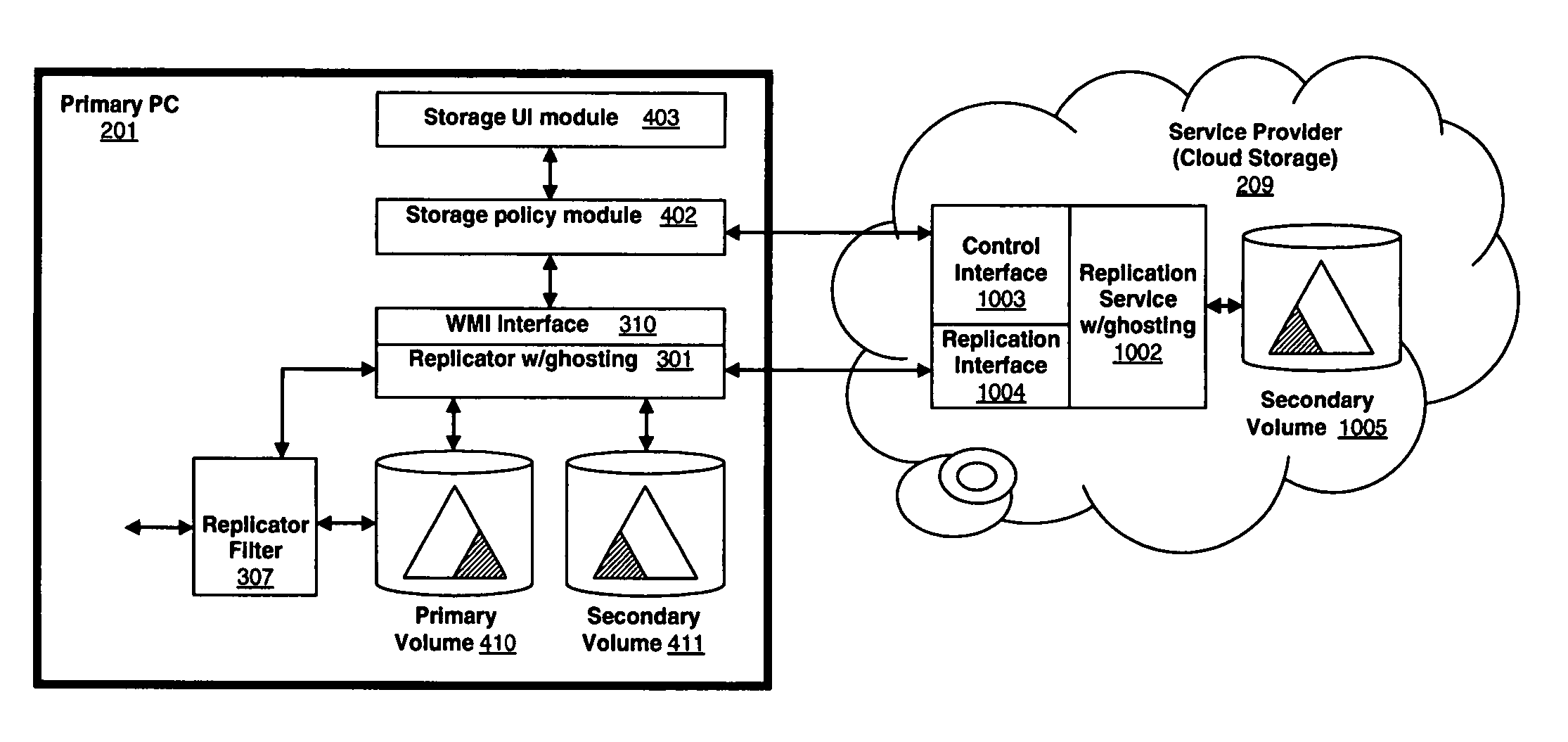
[0010]Still further aspects of the present invention are directed to allowing the user to specify a storage policy that may be global or at the individual object level such as for single files or directories. The storage policy may include a replication level that specifies the number (or the minimum number) of copies that should be maintained for a particular file. For example, depending on the importance of their data, users may want to specify a particular replication level between 1 and k, where k does not exceed the number of physical volumes in the system since storing multiple copies of a file on the same disk does not significantly improve reliability. For instance, a user may want to always keep three copies of her photos and two copies of her word processing documents. Additionally, for particularly valuable data, users may want to specify that one copy of the files should at all times be stored in the cloud storage.
[0011]Yet further aspects of the present invention are directed to gracefully handling the situation where one of the volumes becomes unavailable, either expectedly or unexpectedly. In this situation, the system may perform any required repair or rebalancing operations automatically without the need for any user intervention. For example, a hard drive may fail, be removed from the system temporarily or permanently, or in the case of a remote hard drive on the other side of a network, the network may fail and thereby cause the hard drive to be unavailable for lack of communication. For those objects stored on that hard drive that have a replication level greater than one (i.e., for which the user has directed the system to keep at least two copies on two separate volumes, or to keep one copy in the cloud storage), then such unavailability of a single hard drive would not significantly impact the accessibility of those objects. Responsive to detecting that the hard drive has become unavailable, and possibly depending upon the reason for the unavailability, the system may automatically restore the desired replication level in the background by creating additional copies of those objects, without the need for any user intervention.
[0013]Still further aspects of the present invention are directed to providing a distributed storage system that may work on top of existing file systems, such as the Microsoft WINDOWS NTFS file system. Thus, an entirely new file system would not need to be created to practice aspects of the present invention. This may make the distributed storage system easier to implement and more reliable, and it preserves the substantial investments already made in existing local file systems.
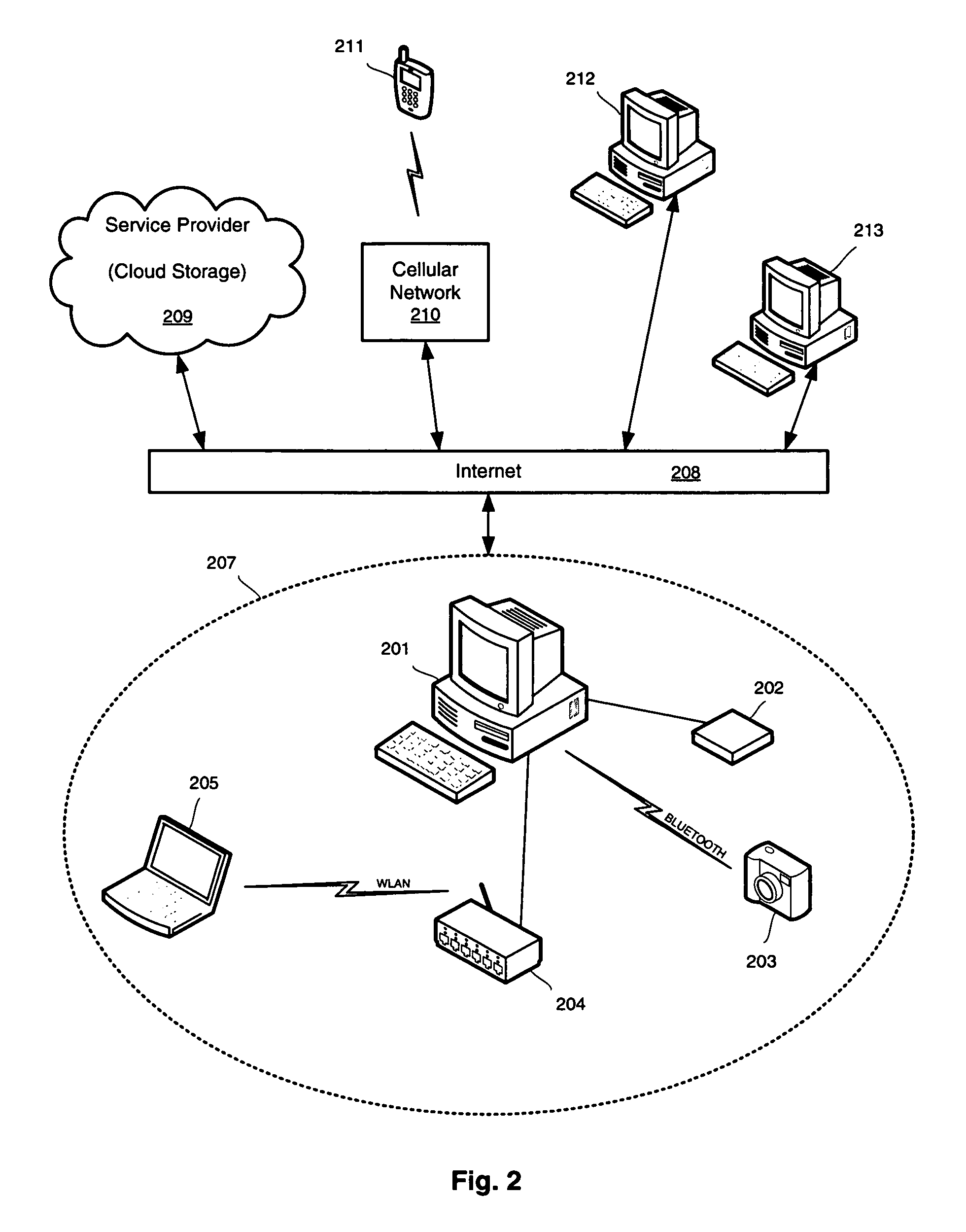
[0015]Thus, using various aspects of the present invention, the user may have access to a virtually infinite storage resource that scales to the user's needs. In addition, this virtually infinite storage resource may provide a single logical view to the user across all of the user's machines, that is particular to the user. The user may access his or her data from anywhere, even from another machine that is not normally under the user's administrative control, such as through an Internet webpage. Due to the smart redundancy provided by the system and the fact that data is no longer tied to the user's particular computer, the data stored thereon is highly protected from disastrous failure, and so the user's data is effectively protected and considered to be reliable for the user's entire life or as long as desired.


 Login to View More
  Login to View More