External spring supercharger bypass valve

a supercharger and bypass valve technology, applied in the direction of liquid fuel engines, machines/engines, combination engines, etc., to achieve the effects of reducing the charge, prolonging the valve closing period, and saving fuel

US8046997B2Inactive Publication Date: 2011-11-01BELL JAMES E +1
9 Cites 0 Cited by

Patent Information

Authority / Receiving Office
US · United States
Patent Type
Patents(United States)
Current Assignee / Owner
Publication Date
2011-11-01
Estimated Expiration
Not applicable · inactive patent

Smart Images

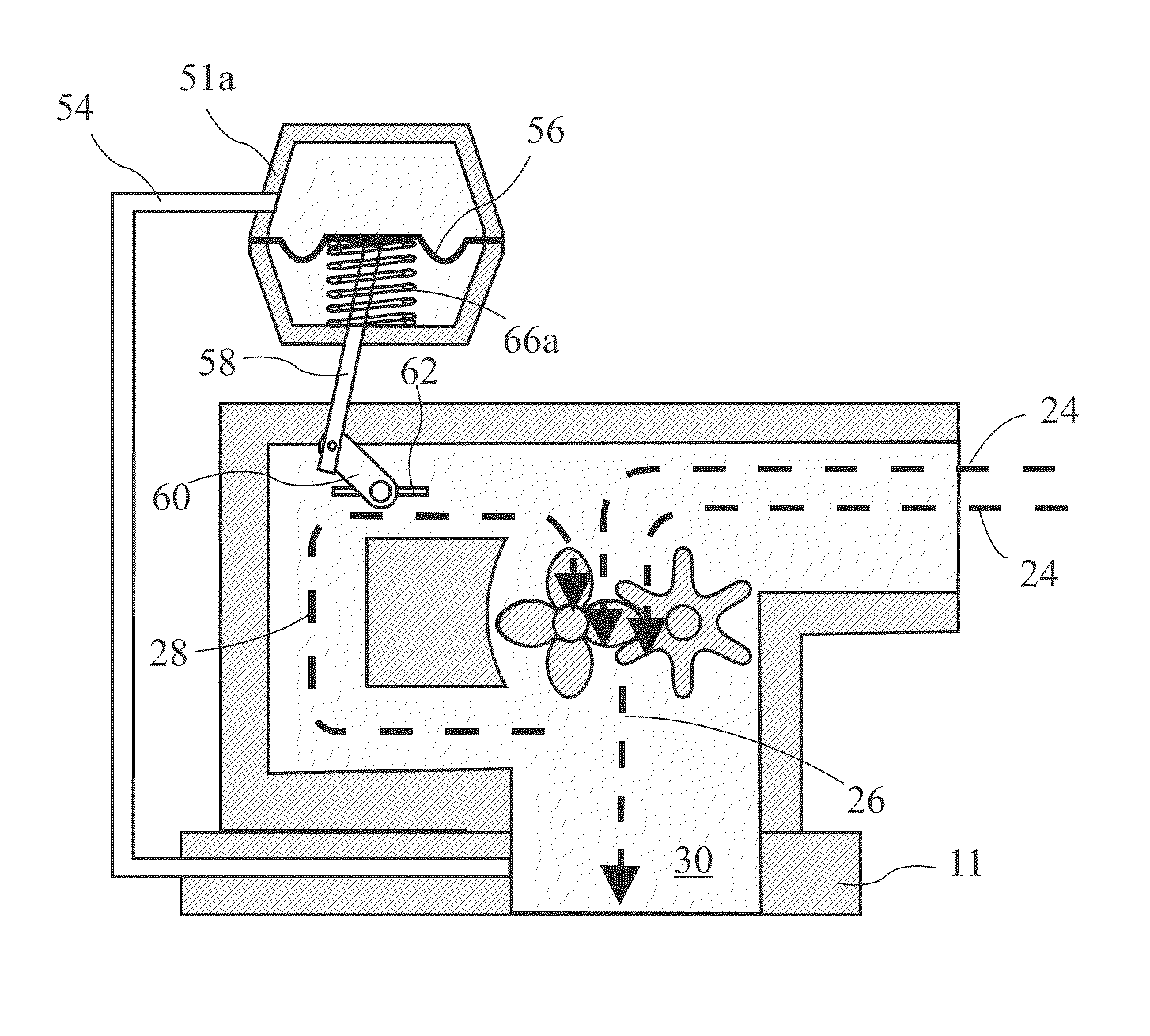
  • Figure 1
    Figure 1
  • Figure 2
    Figure 2
  • Figure 3
    Figure 3
Patent Text Reader

Abstract

A screw compressor type supercharger includes an improved supercharger bypass valve including a spring biasing the bypass valve towards an open position. The spring may be a compression spring integrated into a bypass valve diaphragm, an extension spring extending parallel to a diaphragm arm, or a torsion spring on a bypass valve butterfly shaft. The spring is selected and installed to hold the bypass valve open at all vacuum levels and at up to one PSI of boost, and then to allow the bypass to close between one PSI and six PSI boost, and to be closed at above six PSI boost. The resulting control of the bypass valve prevents damage to the supercharger.
Need to check novelty before this filing date? Find Prior Art

Description

BACKGROUND OF THE INVENTION

[0001] The present invention relates to supercharger bypass valves and in particular to an external spring used to alter closing of the supercharger bypass valve.

[0002] Power production of an internal combustion engine is ultimately limited by the amount of air introduced into each engine cylinder. Fuel systems can at best provide an optimal amount of fuel to burn with the air contained in the cylinder, and adding more fuel than required for a stoichiometric air-fuel ratio does not result in more energy being produced. The power production of non-supercharged engines is thus limited by the engine's ability to draw air into each cylinder, referred to the Volumetric Efficiency (VE) of the engine, where 100 percent VE is equivalent to complete filling of the cylinder at bottom dead center at one atmosphere of pressure. While some engines achieve greater than 100 percent VE using tuned intake manifolds, the effects are generally limited to a small RPM range whic...

Examples

Embodiment Construction

[0040]The following description is of the best mode presently contemplated for carrying out the invention. This description is not to be taken in a limiting sense, but is made merely for the purpose of describing one or more preferred embodiments of the invention. The scope of the invention should be determined with reference to the claims.

[0041]In the following description, pressure is referred to as vacuum, boost, and PSI Absolute (PSIA) depending on the context. Where Manifold Absolute Pressure (MAP) is referenced, the value in units of pounds per square inch is, PSIA. Where vacuum in referenced, the value in inches of Hg is 2.04*(14.7 PSI minus PSIA). There boost is referenced, the value in units of pounds per square inch is (PSIA minus 14.7).

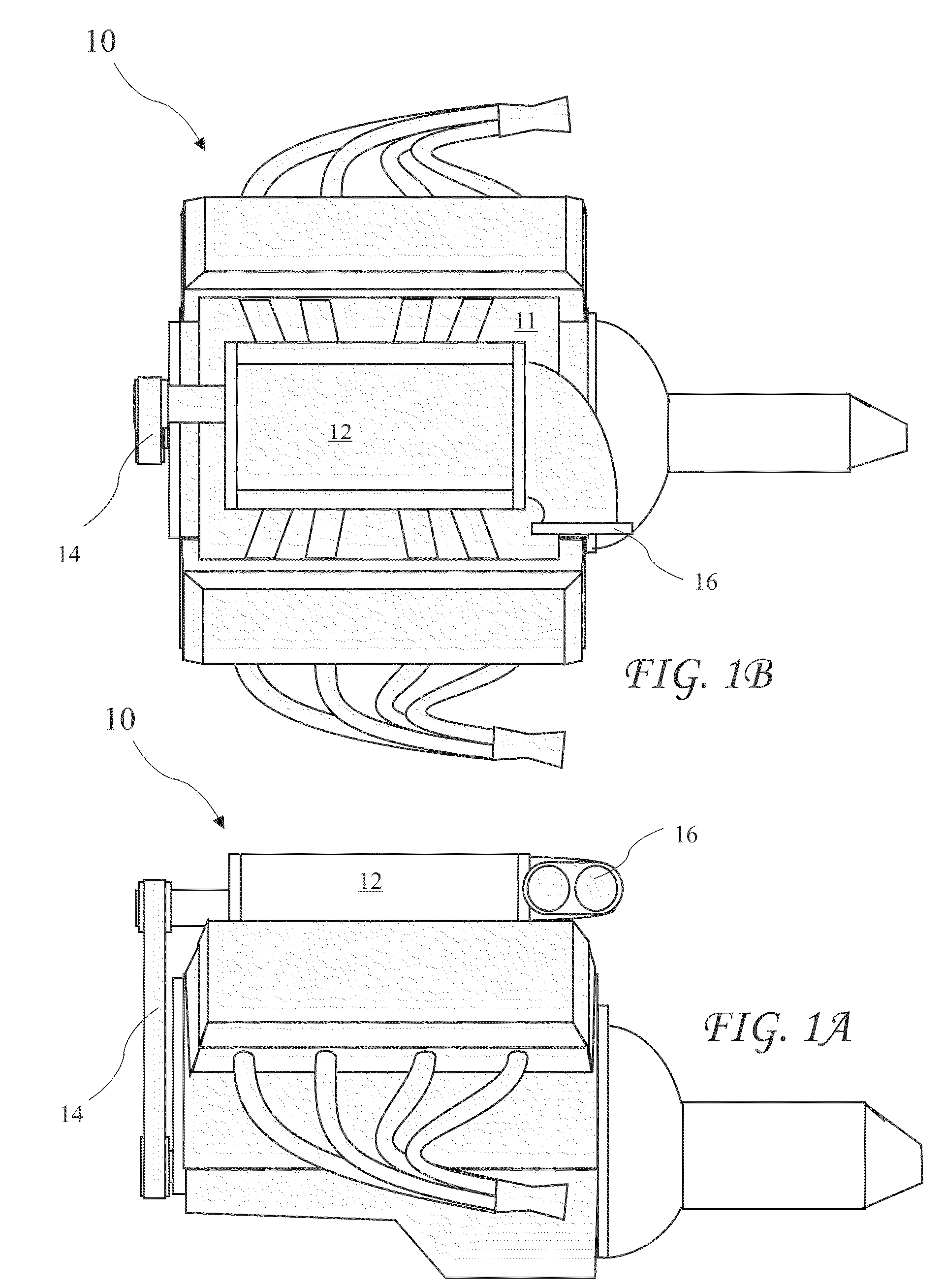
[0042]A side view of a supercharged engine 10 according to the present invention is shown in FIG. 1A and a top view of the supercharged engine 10 is shown in FIG. 1B. The supercharged engine 10 includes a screw compressor type supercharger ...