
Liquid crystal display device
a liquid crystal display and display device technology, applied in liquid crystal compositions, instruments, chemistry apparatus and processes, etc., can solve the problems of increasing oblique light leakage, only a remarkably poorer polarization degree with respect to light incoming from a oblique direction, etc., to achieve the effect of suppressing light leakage and preferable viewing angle characteristics
- Summary
- Abstract
- Description
- Claims
- Application Information
AI Technical Summary
Benefits of technology
Problems solved by technology
Method used
Image

Examples
first example
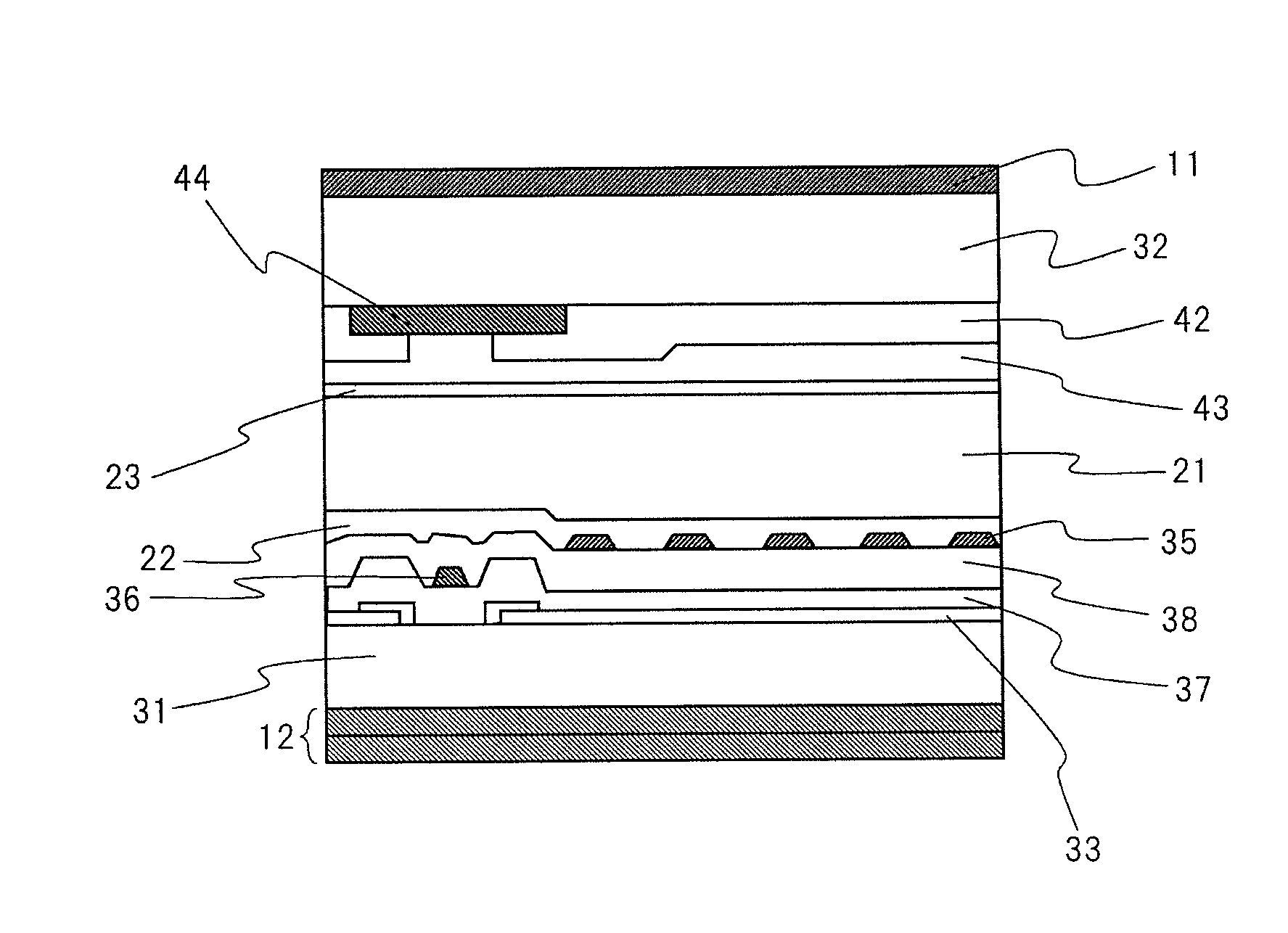
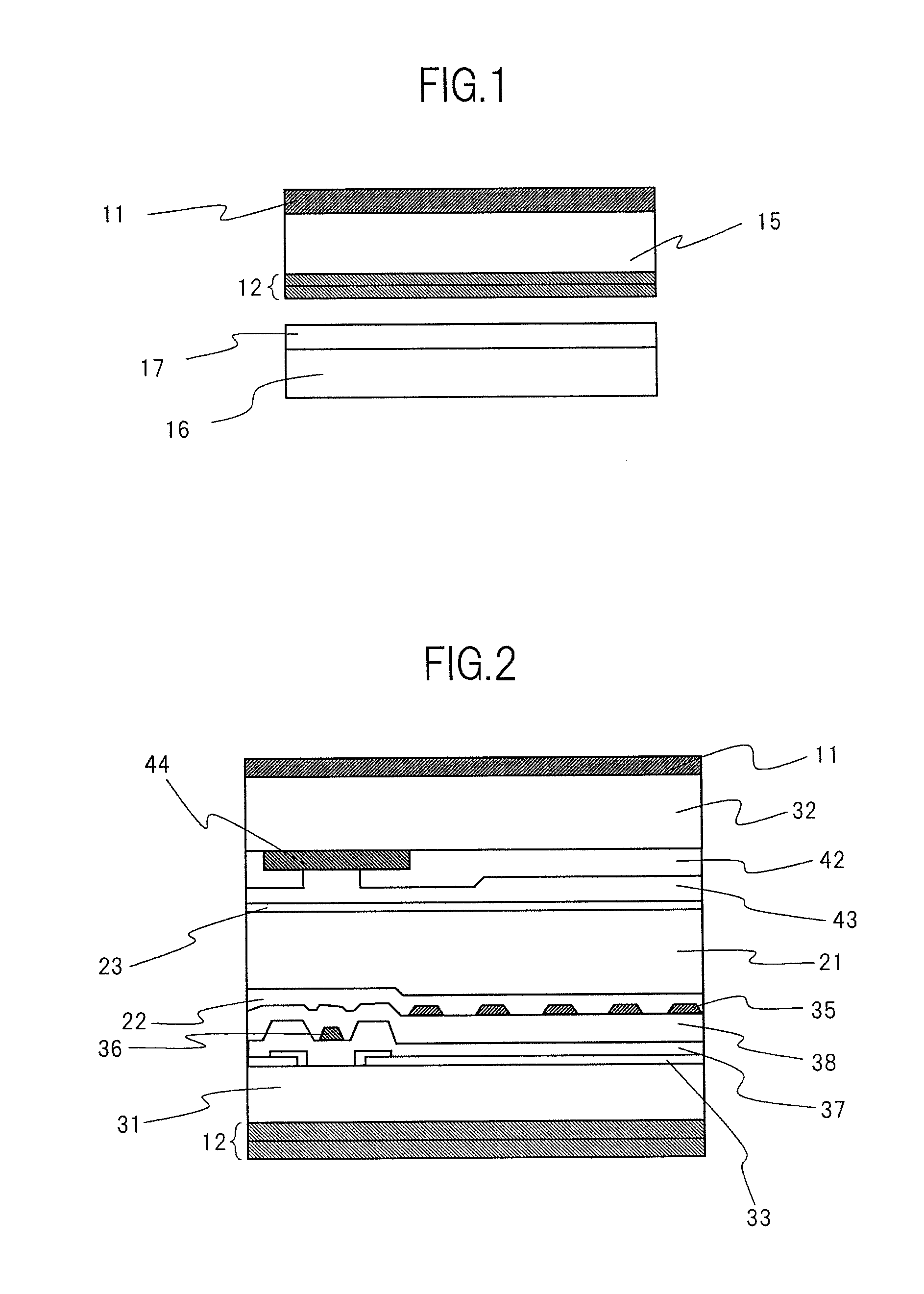
[0108]In the first example, nematic liquid crystal composite having a nematic-liquid phase transition temperature being 368 K, anisotropy of refractive index being 0.085 (wavelength 546 nm, 373 K) K1 being 9.9×10⁻¹²N, K2 being 7.2×10⁻¹²N, and K3 being 15.8×10⁻¹² N is enclosed in the liquid crystal cell 15 of a liquid crystal display device according to the above described embodiment.
[0109]A panel contrast ratio of a liquid crystal display device in the first example is 1520; and a contrast ratio for a direction at an in-plane azimutal angle of a polarization axis being 45 degrees and a polar angle being 45 degrees is 170.
[0110]Note that a panel contrast ratio (a front contrast ratio) is defined as a contrast ratio unique to a liquid crystal panel, which is defined based on the minimum luminance and maximum luminance with respect to an identical light source intensity without light modulation by a backlight source. In measurement, a value is obtained by dividing the maximum luminance...
second example
[0111]In the second example, nematic liquid crystal composite having anisotropy of refractive index being 0.084 (wavelength 546 phase, 313 K), K1 being 9.2×10⁻¹²N, K2 being 6.7×10⁻¹²N, and K3 being 17.4×10⁻¹² N, and a nematic-liquid phase transition temperature being 384 K is enclosed in the liquid crystal cell 15 of a liquid crystal display device according to the above described embodiment.
[0112]A front contrast ratio in the second example is 1610; and a contrast ratio for a direction at the azimuthal angle and the polar angle both being 45 degrees (φ=θ=45°) is 200.
third example
[0113]In the third example, nematic liquid crystal composite having anisotropy of refractive index being 0.091 (wavelength 546 nm, 313 K), K1 being 9.8×10⁻¹²N, K2 being 7.8×10⁻¹²N, and K3 being 17.6×10¹² N, and a nematic-liquid phase transition temperature being 390 K is enclosed in the liquid crystal cell 15 of a liquid crystal display device according to the above described embodiment.
[0114]A front contrast ratio in the third example is 1800; and a contract ratio for a direction at the azimutal angle and the polar angle both being 45 degrees is 210.
PUM
| Property | Measurement | Unit |
|---|---|---|
| polar angle | aaaaa | aaaaa |
| refractive index | aaaaa | aaaaa |
| refractive index | aaaaa | aaaaa |
Abstract
Description
Claims
Application Information
 Login to View More