Vehicle brake system

a brake system and vehicle technology, applied in the direction of brake action initiation, brake system, transportation and packaging, etc., can solve the problems of inability to respond to solenoid valves, inability to create problems, and inability to impact noise, so as to achieve high responsiveness and minimize noise.

US8899695B2Active Publication Date: 2014-12-02HONDA MOTOR CO LTD
26 Cites 8 Cited by

Patent Information

Authority / Receiving Office
US · United States
Patent Type
Patents(United States)
Current Assignee / Owner
Publication Date
2014-12-02

Smart Images

  • Figure 1
    Figure 1
  • Figure 2
    Figure 2
  • Figure 3
    Figure 3
Patent Text Reader

Abstract

In a brake-by-wire vehicle brake system that uses a solenoid shut-off valve (24a, 24b), the electric power supplied to the solenoid (33) of the solenoid shut-off valve is controlled so as to decelerate a movement of a plunger (31, 32) of the valve as the plunger reaches a point immediately adjacent to a terminal point thereof. Thereby, a highly responsive property can be achieved while the noises that are generated by the plunger striking a stopper (36) or a valve seat (34) can be minimized. When actuating the plunger in the valve closing direction, the solenoid may receive electric power at a first level, a second level lower than the first level and a third level intermediate between the first and second levels in that order.
Need to check novelty before this filing date? Find Prior Art

Description

TECHNICAL FIELD

[0001] The present invention relates to a brake-by-wire vehicle brake system including a solenoid shut-off valve in a fluid path thereof, and in particular to a technology for reducing noises generated from such a solenoid shut-off valve.BACKGROUND OF THE INVENTION

[0002] In electric vehicles and hybrid vehicles, it is a common practice to use an electric motor which is connected to the drive axle of the vehicle as a generator that produces electric power and provides a braking force at the same time when decelerating the vehicle. This is called as regenerative braking. Such a brake-by-wire vehicle brake system that combines the hydraulic braking and the regenerative braking may also be incorporated with an ABS (anti-lock brake system) and a VSA (vehicle stability assist) system as disclosed in JP 2009-227023. In such a vehicle brake system, an ABS hydraulic unit and a VSA hydraulic unit are combined with a motor actuated cylinder which is typically provided with a simul...

Examples

Embodiment Construction

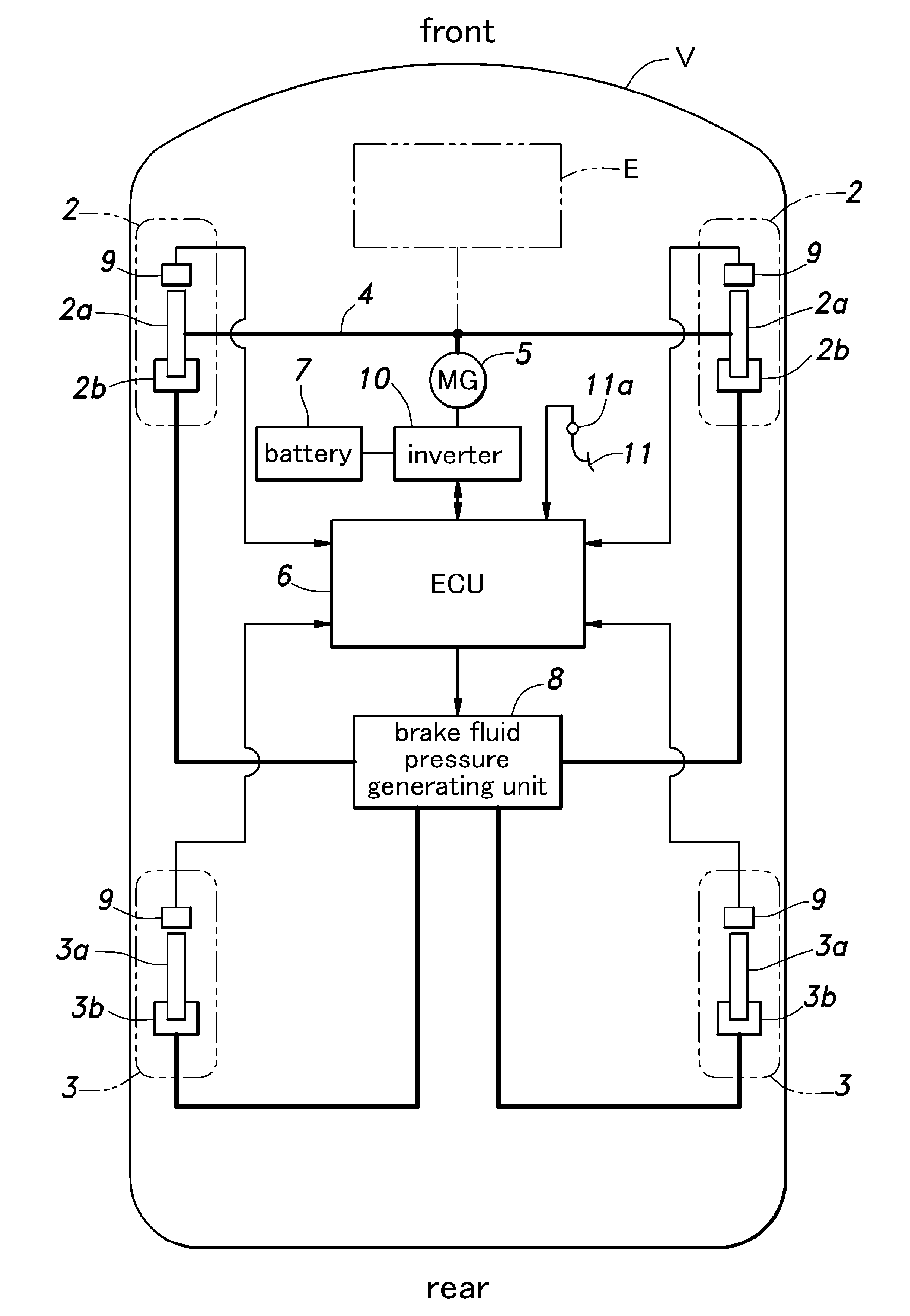
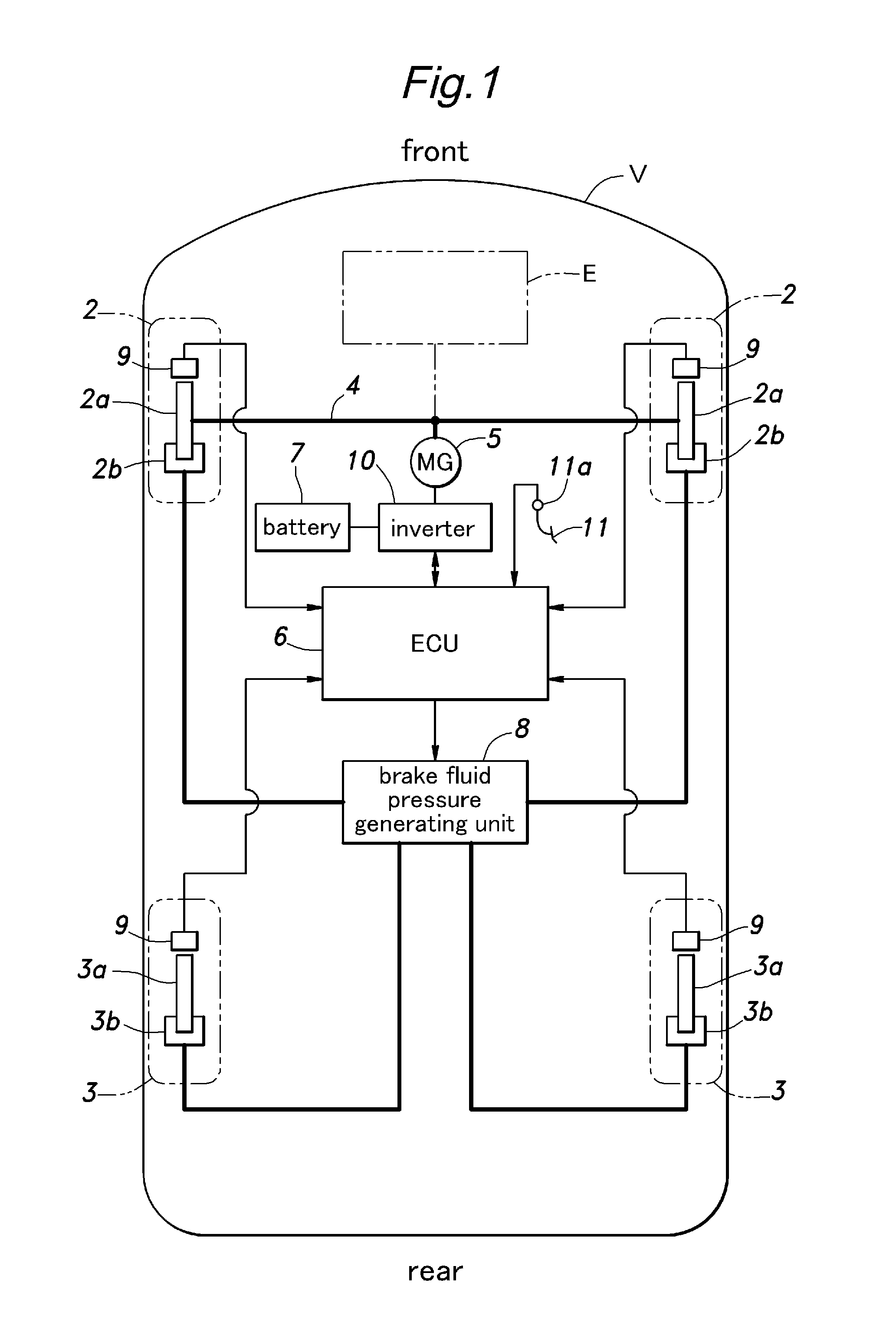
[0022]FIG. 1 shows a brake system of an electric or hybrid vehicle embodying the present invention. This vehicle V comprises a pair of front wheels 2 located on the front side thereof and a pair of rear wheels 3 located on the rear side thereof. The front wheels 2 are connected to front axles 4 which are in turn connected to a motor / generator 5 in a torque transmitting relationship via a differential gear device (not shown in the drawing).

[0023]The motor / generator 5 operates both as an electric motor for propelling the vehicle and a generator for providing a regenerative braking. More specifically, the motor / generator 5 can receive electric power from a rechargeable battery 7 serving as a power source via an inverter 10, and can also supply electric power to (recharge) the battery 7 by converting the kinetic energy into electric power by the regenerative braking.

[0024]A control unit (ECU) 6 incorporated with a CPU control circuit performs various control actions for the vehicle V in...