Supercharge Your Innovation With Domain-Expert AI Agents!

Non-volatile phase-change resistive memory

a phase-change resistive memory and non-volatile technology, applied in the direction of digital storage, instruments, electrical equipment, etc., can solve the problems of affecting the design of embedded systems, affecting the performance of embedded systems,

Inactive Publication Date: 2015-09-01
COMMISSARIAT A LENERGIE ATOMIQUE ET AUX ENERGIES ALTERNATIVES
View PDF8 Cites 0 Cited by
  • Summary
  • Abstract
  • Description
  • Claims
  • Application Information

AI Technical Summary

Benefits of technology

The memory cell maintains data integrity during solder reflow and assembly, enabling pre-programming without information loss, with improved writing speed and density.

Problems solved by technology

The intrinsically low access speed and the limited available bandwidth of this method means that loading the code is an operation that may take a great deal of time and slow down the manufacturing line.
This inevitably greatly complicates the design of the embedded system and also generally requires the development of a specialised programming tool for loading the code after assembly in the manufacturing line.
The main drawback of these memories is that programming thereof requires, as seen above, being able to apply high voltages and currents in order to transfer charges in or from the floating gate.
Writing thereof is a relatively slow and complicated operation that may have to be done, according to their internal structure of the so-called ET or OR type, on blocks of cells that must be deleted before being rewritten with the new data.

Method used

the structure of the environmentally friendly knitted fabric provided by the present invention; figure 2 Flow chart of the yarn wrapping machine for environmentally friendly knitted fabrics and storage devices; image 3 Is the parameter map of the yarn covering machine
View more

Image

Smart Image Click on the blue labels to locate them in the text.
Viewing Examples
Smart Image
  • Non-volatile phase-change resistive memory
  • Non-volatile phase-change resistive memory
  • Non-volatile phase-change resistive memory

Examples

Experimental program
Comparison scheme
Effect test

Embodiment Construction

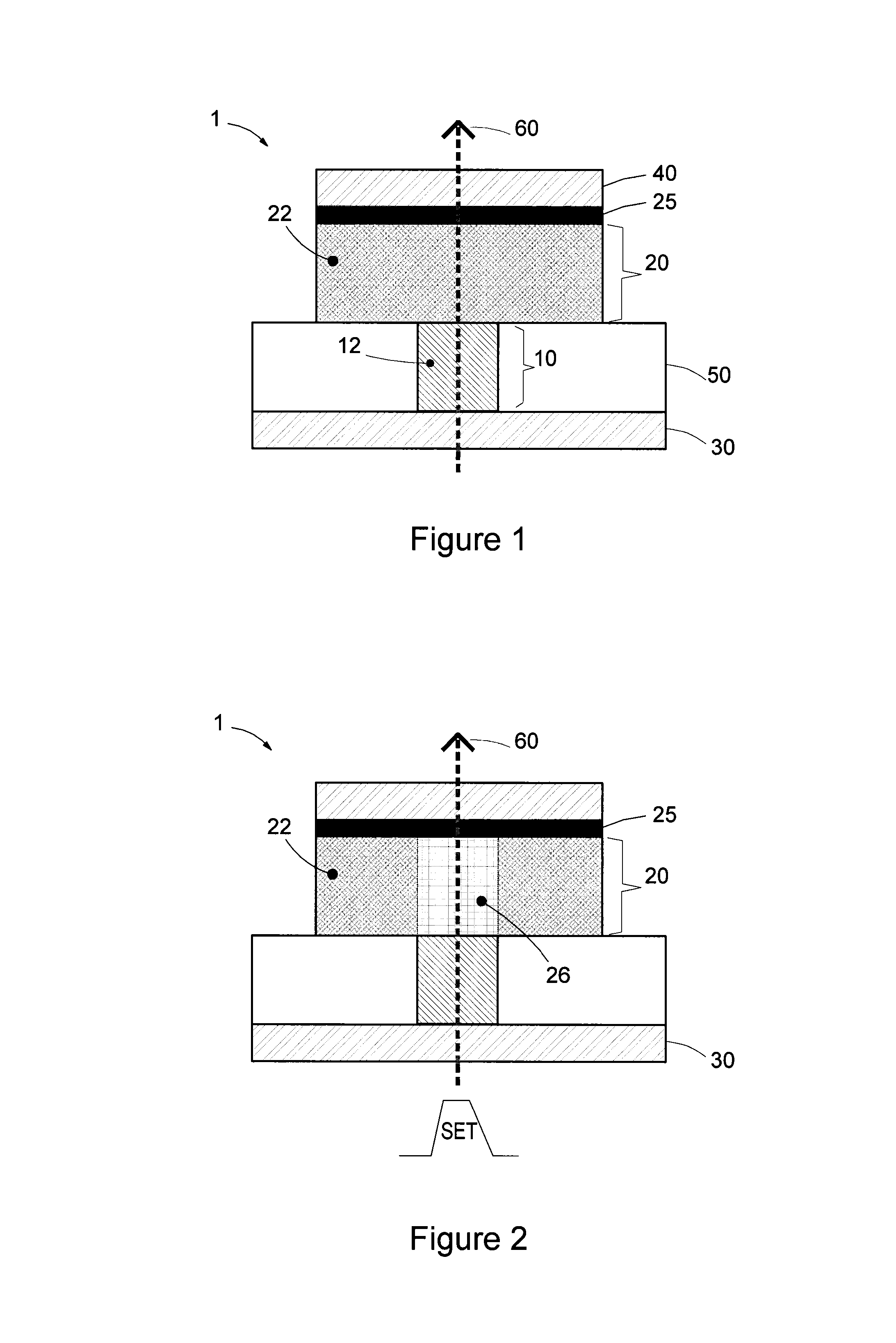
[0115]The so-called PCM resistive memories use a material the atomic structure of which can be varied under the effect of heat. The material constituting the memory element may change between two main solid phases: one where the material adopts a crystalline organised structure characterised by a low electrical resistance; and the other where the atomic structure is unorganised or amorphous and has high electrical resistance. Intermediate states may exist. It is necessary to remark that only the completely crystalline state is however naturally stable. In an environment where the material is subjected to higher temperatures than the maximum one for which it was designed to operate, it tends naturally to reorganise itself in a crystalline form. The amorphous states are energetically termed metastable, the associated information being lost if the material is subjected to a thermal stress.

[0116]In electronic memories of the PCM type it is the passage of a programming current that cause...

the structure of the environmentally friendly knitted fabric provided by the present invention; figure 2 Flow chart of the yarn wrapping machine for environmentally friendly knitted fabrics and storage devices; image 3 Is the parameter map of the yarn covering machine
Login to View More

PUM

No PUM Login to View More

Abstract

A method for implementing a system containing at least one memory device including a plurality of non-volatile memory cells each including a phase-change material configured to change state reversibly between at least an amorphous state and a crystalline state having different electrical resistances. The method includes steps of manufacturing the memory cells, including the formation of a layer of a phase-change material having an original amorphous state at the end of the steps of manufacturing the memory cells. The method for implementing the embedded system includes, after the steps of manufacturing the memory cells, at least the following steps: (i) pre-programming the memory device consisting of an electrical recrystallization of a selection of memory cells from their original amorphous state; and (ii) assembling the pre-programmed memory device in the system during which the device is subjected to a temperature of between 240° C. and 300° C.

Description

CROSS REFERENCE TO RELATED APPLICATIONS[0001]The present application is a 35 U.S.C. §371 national stage patent application of International patent application PCT / EP2012 / 067614, filed on Sep. 10, 2012, published as WO / 2013 / 037720 on Mar. 21, 2013, the text of which is incorporated by reference, and claims the benefit of the filing date of French application nos. 11 58031, filed on Sep. 9, 2011, and 12 53212, filed on Apr. 6, 2012, the text of each of which is also incorporated by reference.TECHNICAL FIELD OF THE INVENTION[0002]The present invention concerns in general non-volatile resistive memories using a material the resistivity of which is made to vary under the effect of heat, and more particularly a resistive memory that can be used in the context of an industrial process for managing embedded systems where it is highly advantageous to be able to pre-programme it without the information stored being able to be affected by the following operations, in particular the thermal ass...

Claims

the structure of the environmentally friendly knitted fabric provided by the present invention; figure 2 Flow chart of the yarn wrapping machine for environmentally friendly knitted fabrics and storage devices; image 3 Is the parameter map of the yarn covering machine
Login to View More

Application Information

Patent Timeline
no application Login to View More
Patent Type & Authority Patents(United States)
IPC IPC(8): G11C11/21G11C13/00H01L45/00
CPCG11C13/0069G11C13/0004H01L45/06H01L45/1233H01L45/144H01L45/16G11C2013/0083H10N70/231H10N70/8828H10N70/011H10N70/826
Inventor PERNIOLA, LUCA
Owner COMMISSARIAT A LENERGIE ATOMIQUE ET AUX ENERGIES ALTERNATIVES
Features
  • R&D
  • Intellectual Property
  • Life Sciences
  • Materials
  • Tech Scout
Why Patsnap Eureka
  • Unparalleled Data Quality
  • Higher Quality Content
  • 60% Fewer Hallucinations
Social media
Patsnap Eureka Blog
Learn More