Supercharge Your Innovation With Domain-Expert AI Agents!

Automated test system with edge steering

a test system and automatic technology, applied in the direction of electronic circuit testing, measurement devices, instruments, etc., can solve the problem that the test system clock may not provide the desired timing resolution

Active Publication Date: 2016-03-08
TERADYNE
View PDF26 Cites 3 Cited by
  • Summary
  • Abstract
  • Description
  • Claims
  • Application Information

AI Technical Summary

Benefits of technology

This approach reduces the number of verniers needed without compromising user flexibility, resulting in smaller, lower-cost, and more energy-efficient automated test systems that maintain high throughput and precision in testing semiconductor devices.

Problems solved by technology

However, the test system clock may not provide a desired timing resolution.

Method used

the structure of the environmentally friendly knitted fabric provided by the present invention; figure 2 Flow chart of the yarn wrapping machine for environmentally friendly knitted fabrics and storage devices; image 3 Is the parameter map of the yarn covering machine
View more

Image

Smart Image Click on the blue labels to locate them in the text.
Viewing Examples
Smart Image
  • Automated test system with edge steering
  • Automated test system with edge steering
  • Automated test system with edge steering

Examples

Experimental program
Comparison scheme
Effect test

Embodiment Construction

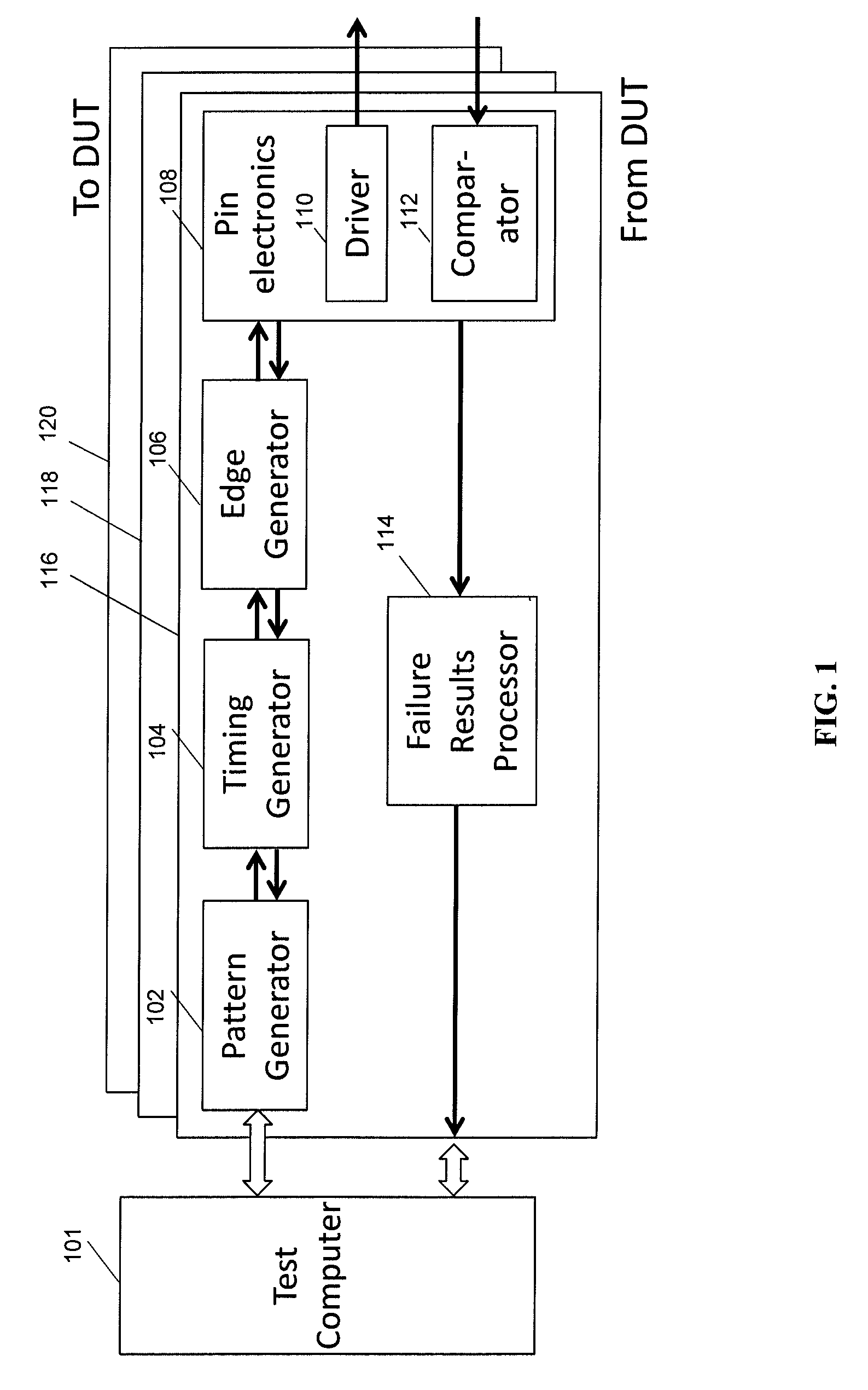
[0011]The inventors have recognized and appreciated techniques to reduce the cost and complexity of automated test equipment without decreasing functionality. In some aspects, the number of timing verniers in an automated test system may be reduced without reducing user flexibility in programming drive signals output by the test system. Such a reduction may be achieved by circuitry that dynamically steers time specifications for edges to verniers that output an indication of when the edges are to occur. Based on the time specifications, the steering circuitry may reduce the total number of edges that are required to control a driver to generate a desired output for one cycle of tester operation. By reducing the number of required edges, the number of verniers in each tester channel may be reduced and tester hardware may be designed with fewer verniers. Such tester hardware may be smaller, lower cost, consume less power, and / or dissipate less heat than conventional tester designs off...

the structure of the environmentally friendly knitted fabric provided by the present invention; figure 2 Flow chart of the yarn wrapping machine for environmentally friendly knitted fabrics and storage devices; image 3 Is the parameter map of the yarn covering machine
Login to View More

PUM

No PUM Login to View More

Abstract

A semiconductor device-under-test (DUT) may be tested by an automated test system that processes test programs specifying a number of edges per tester cycle that may be greater than the number of edges the tester is capable of generating. The test system may include circuitry that reduces the number of edges in each cycle of a test program based on data specifying operation of the tester in that cycle and / or a prior cycle. Such a reduction simplifies the circuitry required to implement an edge generator by reducing the total number of timing verniers per channel. Nonetheless, flexibility in programming the test system is retained.

Description

DISCUSSION OF RELATED ART[0001]Semiconductors may be tested by automated test equipment (ATE), which automates the process of generating signals for testing a device-under-test (DUT). Using ATE, sometimes called a “tester,” it is possible to effectively test chips at a high throughput.[0002]For many types of tests, operations of a tester are controlled by event signals in each of a number of channels, each of which is connected to a test point, sometimes called a “pin”, on the DUT. The event signals are generated by a timing generator associated with the channel, and are sent to pin electronics. Pin electronics include a driver and a comparator. When applied to a driver, the event signals are sometimes called “edges.” Some edges, when fired, cause the driver to drive a HI output. Other edges, when fired, cause the driver to drive a LO output. By specifying which of these edges fires, and the time at which they fire, within a tester cycle, a digital stimulus signal may be defined. Si...

Claims

the structure of the environmentally friendly knitted fabric provided by the present invention; figure 2 Flow chart of the yarn wrapping machine for environmentally friendly knitted fabrics and storage devices; image 3 Is the parameter map of the yarn covering machine
Login to View More

Application Information

Patent Timeline
no application Login to View More
Patent Type & Authority Patents(United States)
IPC IPC(8): G01R31/26G01R31/319
CPCG01R31/31922G01R31/2601G01R31/31726G01R31/318307
Inventor LIN, HOWARDCHAMPION, CORBIN L.VAN DER WAGT, JAN PAUL ANTHONIESARTSCHEV, RONALD A.
Owner TERADYNE
Features
  • R&D
  • Intellectual Property
  • Life Sciences
  • Materials
  • Tech Scout
Why Patsnap Eureka
  • Unparalleled Data Quality
  • Higher Quality Content
  • 60% Fewer Hallucinations
Social media
Patsnap Eureka Blog
Learn More