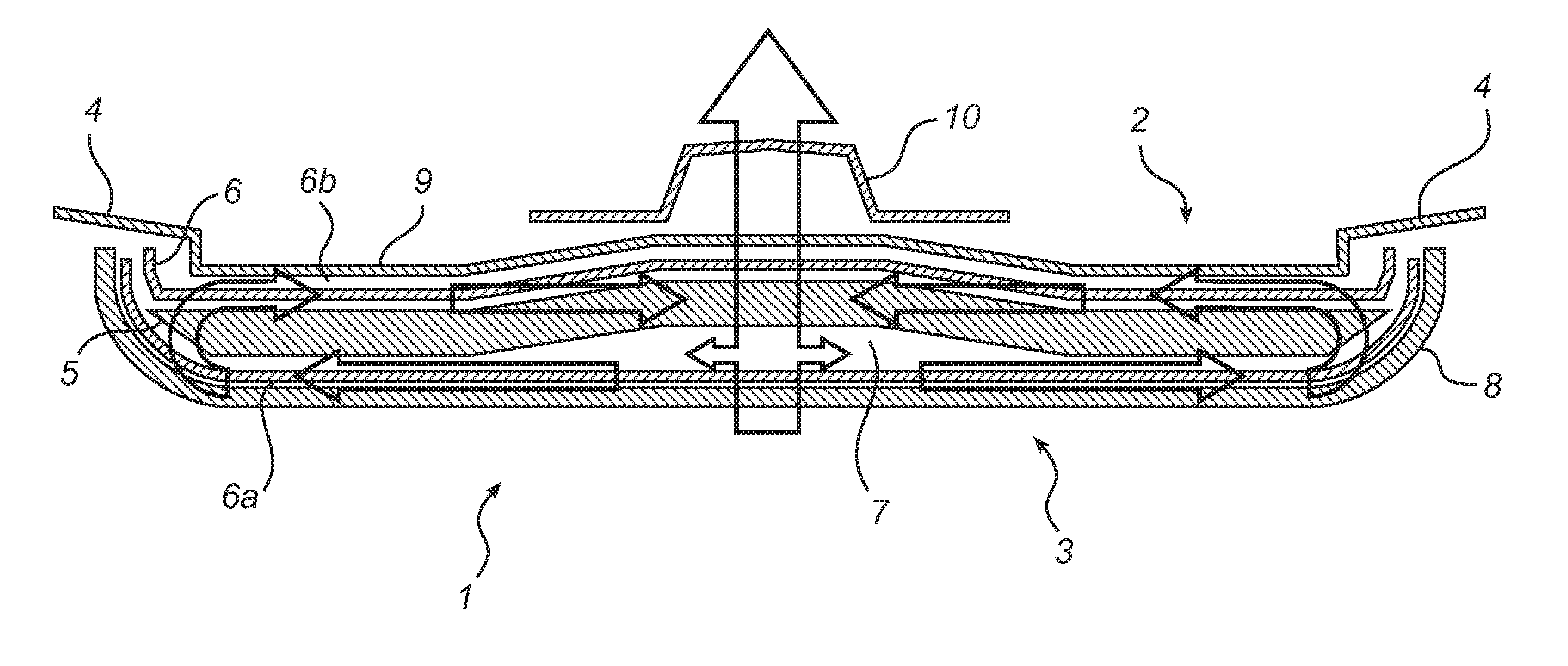
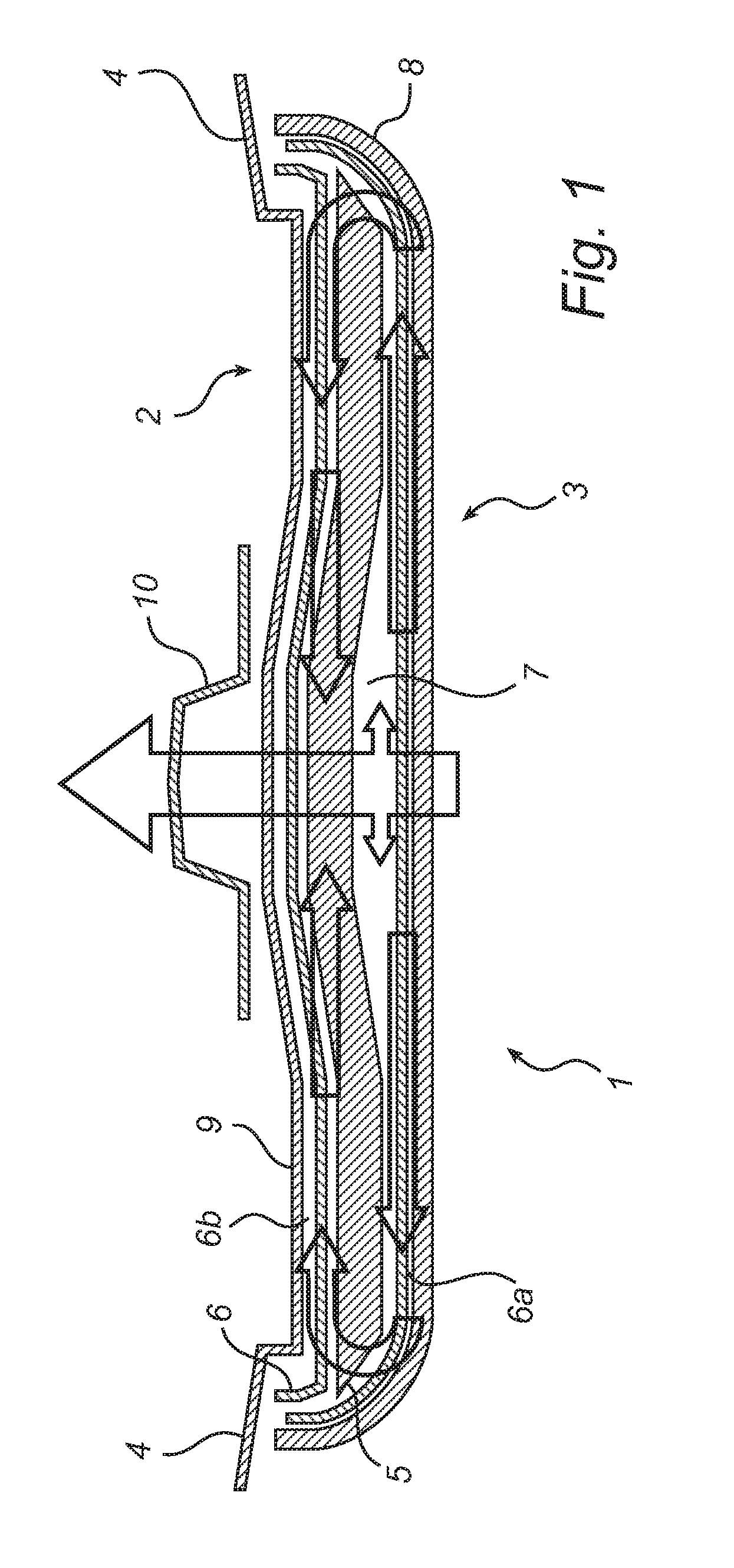
[0011]The fibres extending in an oblique direction with respect to said length direction will form vacuum-paths across the laminate pre-form. Further, gas escape paths are provided through the material in a vertical direction via an open structure of the non-continuous layer(s) of resin. Where these paths are inhibited in a local area due to local variation in the material, the distribution channel can divert gas in the length direction of the laminate around the local inhibition. The evacuation of the air from the laminate take place through the laminate, which at the beginning of the curing process is a porous structure allowing air to be evacuated. During the curing process the porosity is gradually decreased such that in the end of the curing process the laminate forms a substantially dense structure with a low porosity, suitably down to below 0,5%. In the curing process, the gradual decrease of the porosity will lead to a reduced capacity of air removal through the laminate. In other words, the distribution channel is arranged to redistribute evacuation flow from an area of the laminate pre-form having lower air removal capacity to another area having higher air removal capacity. The local air removal capacity will largely depend on how far the curing process has proceeded in the area concerned. The inventive laminate pre-form thereby allows air trapped within the structure to be removed in a very efficient way.
[0012]Furthermore, by arranging the distribution channels in the length direction of the laminate and parallel to the fibre tows, the channels may be formed without bending or stretching the continuous fibres in the fibre tows. In the event the channels would be running in a cross direction to the extension of the fibre tows, the individual fibres would be curled by an imprinting of a channel into the laminate. After curing of the laminate by application of heat, the curled property of the continuous structure will remain. This will increase the elasticity of the laminate in an undesired fashion. On the other hand, in the event the distribution channels and the fibre tows extend in the length direction, imprinting of the channels will not bend or curl the continuous fibres in the fibre tows, which leads to that the desired rigidity of the laminate will be obtained.
[0017]Laminate structures made with these materials may be very long, for example up to 40-80 m, but having a narrow width, for example less than 1 m,—in these components, the biaxial fabric will form a vacuum-path across the part (i.e. across the narrow dimension) successfully enough. Vacuum paths in the vertical direction will be provided by the arrangement of the layer(s) of resin in a non-continuous fashion, that is by arranging the layers of resin with an open area. However, due to local variation in the material sometimes the path can be inhibited in a local area—in which case having an additional longitudinal vacuum path that can divert ‘around’ the local inhibition is attractive. This allows other areas of higher permeability to transmit their vacuum to the local inhibited area that would otherwise have a lower vacuum level.
[0018]Preferably, the prepreg or semi-preg envelope is a biaxial prepreg, e.g. a 600-1200 gsm+−45 deg biaxial E-glasssemipreg or prepreg. Alternatively the envelope may be a 600-1200 gsm unidirectional E-glass prepreg or semipreg. These materials have excellent properties in terms of forming the kind of vacuum paths desired according to the invention.
[0026]In a further step, the inventive method further comprises removal of air from the pre-form. Thereby, the amount of trapped air included in the pre-form is minimized. As a consequence, the strength of the finished pre-form is increased.
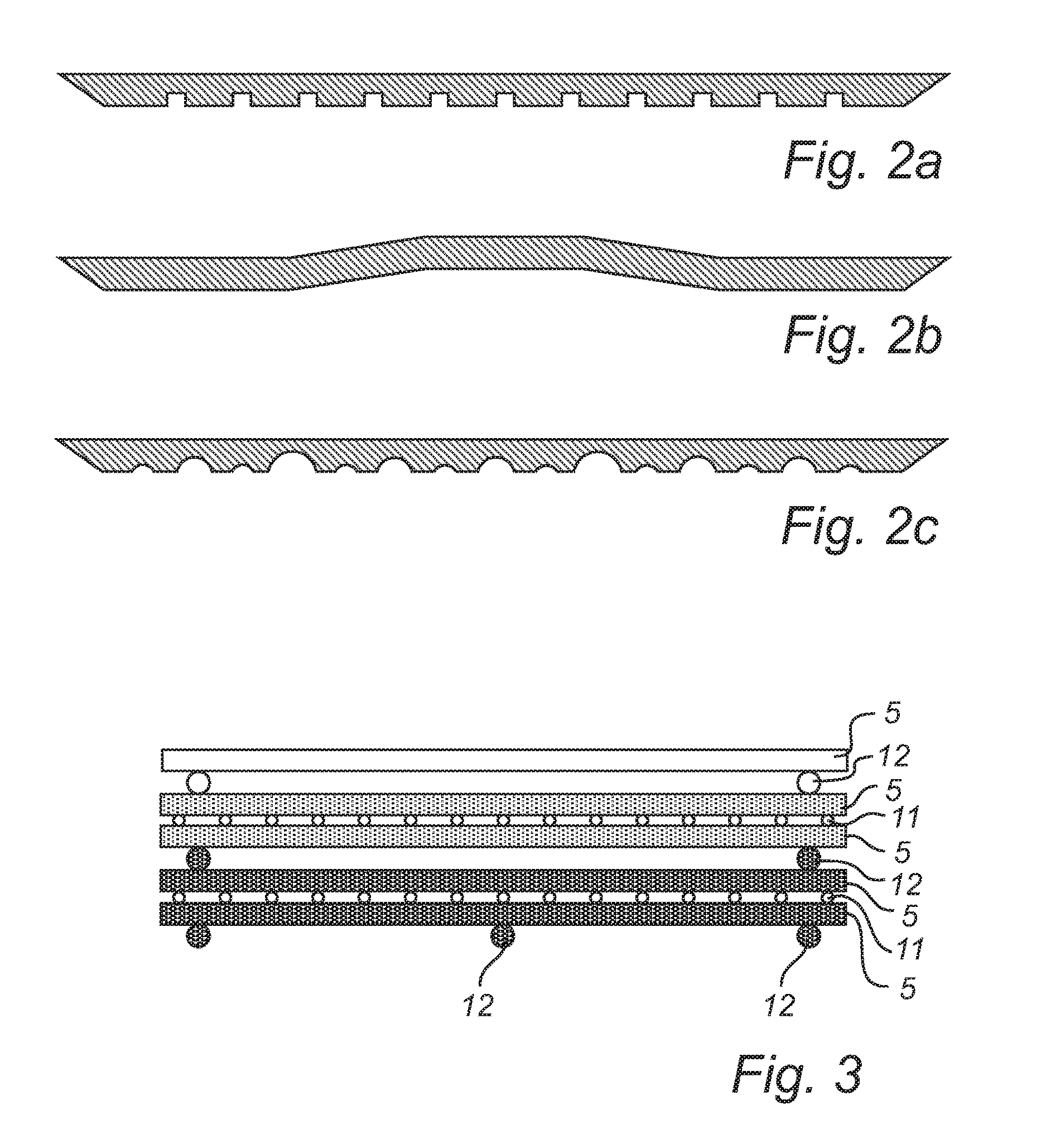
[0031]Internal redistribution channels may be provided by the provision of a sheet of resin having a three dimensional structure. Internal redistribution channels may assist the distribution channel provided on the back side of the laminate with redistribution of gas along the length extension of the laminate in order to reduce the occurrence of gas pockets in the laminate. In this event the sheet of resin should have a structural rigidity to carry the next layer of fibres, when the pre-form is built.


 Login to View More