Method and apparatus for correlating flight identification data with secondary surveillance radar data
a secondary surveillance and flight identification technology, applied in direction finders using radio waves, instruments, reradiation, etc., can solve the problem that none of the currently used or planned mode s downlink formats provides for the transmission of flight identification data
- Summary
- Abstract
- Description
- Claims
- Application Information
AI Technical Summary
Benefits of technology
Problems solved by technology
Method used
Image



Examples
Embodiment Construction
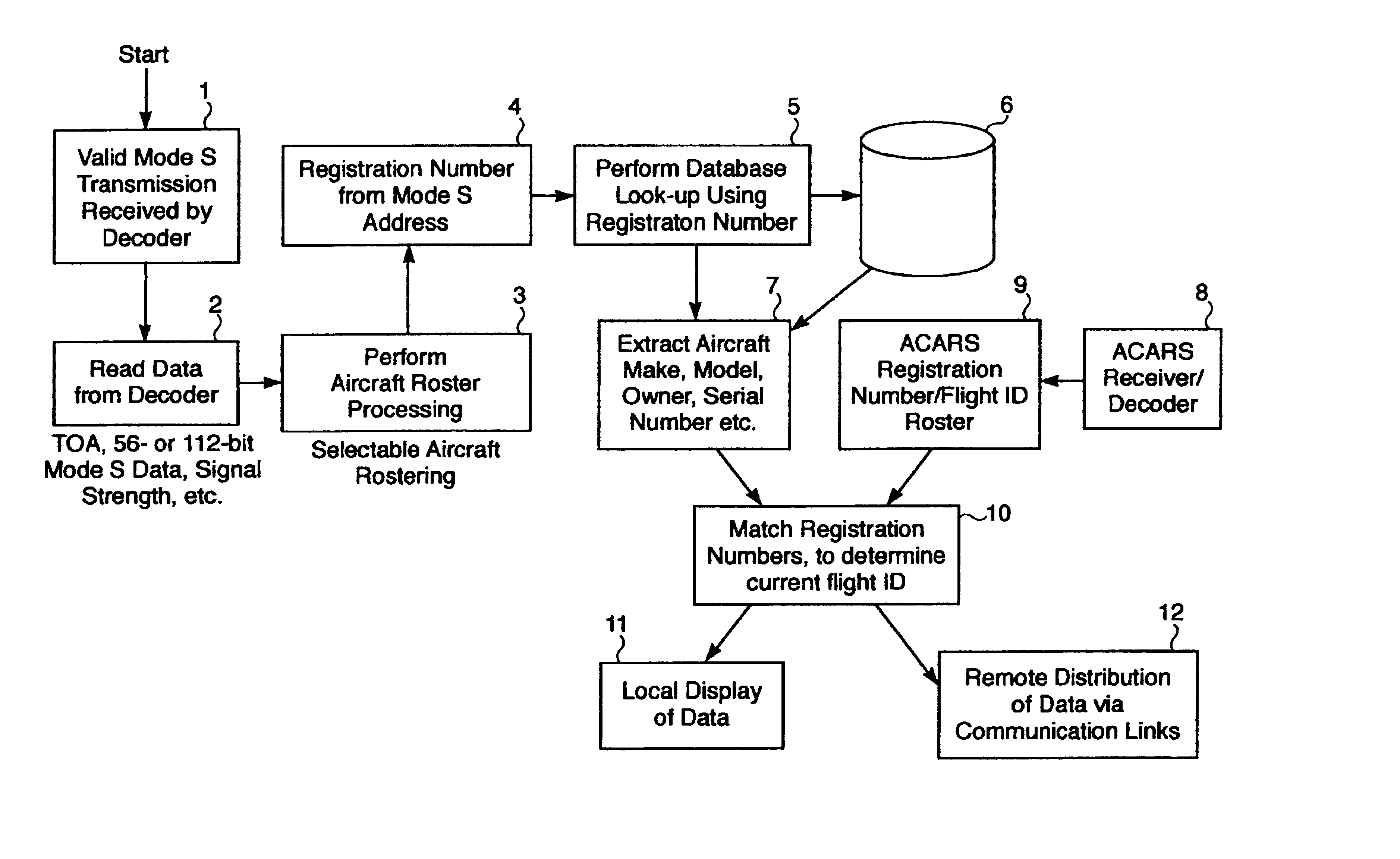
[0017]The present invention is now described with reference to the figures where like reference numbers denote like elements or steps in the process.
[0018]Referring to FIG. 1, 1090 MHz, Mode S transponder signals are received by a receiver / decoder in step 1. In step 1, the received analog Mode S signal is converted to digital data. In step 2, the Mode S address is extracted from the digital data. The Mode S address is then stored in a roster in step 3 and used to generate the aircraft registration or “N” number which is extracted in step 4. U.S. aircraft registration numbers may be determined directly by an algorithm, while foreign aircraft registrations may be determined by a lookup table.
[0019]The aircraft registration number from step 4 may then be used to perform a database look-up in step 5. Step 5 utilizes a database 6 which may contain details of aircraft make, model, serial number, owner / operator, owner / operator address, engine type, engine noise class, engine modifications ...
PUM
 Login to View More
 Abstract
Description
Claims
Application Information
 Login to View More