

KMethod for carrying out germchit production for brown alga sargassum through breeding induction and controlled fertilization
A technology of hijiki and brown algae, which is applied in the field of marine biology, can solve problems affecting production promotion, ovulation and sperm discharge, large-scale application, etc., and achieve the effect of improving attachment efficiency
- Summary
- Abstract
- Description
- Claims
- Application Information
AI Technical Summary
Problems solved by technology
Method used
Image

Examples
Embodiment Construction
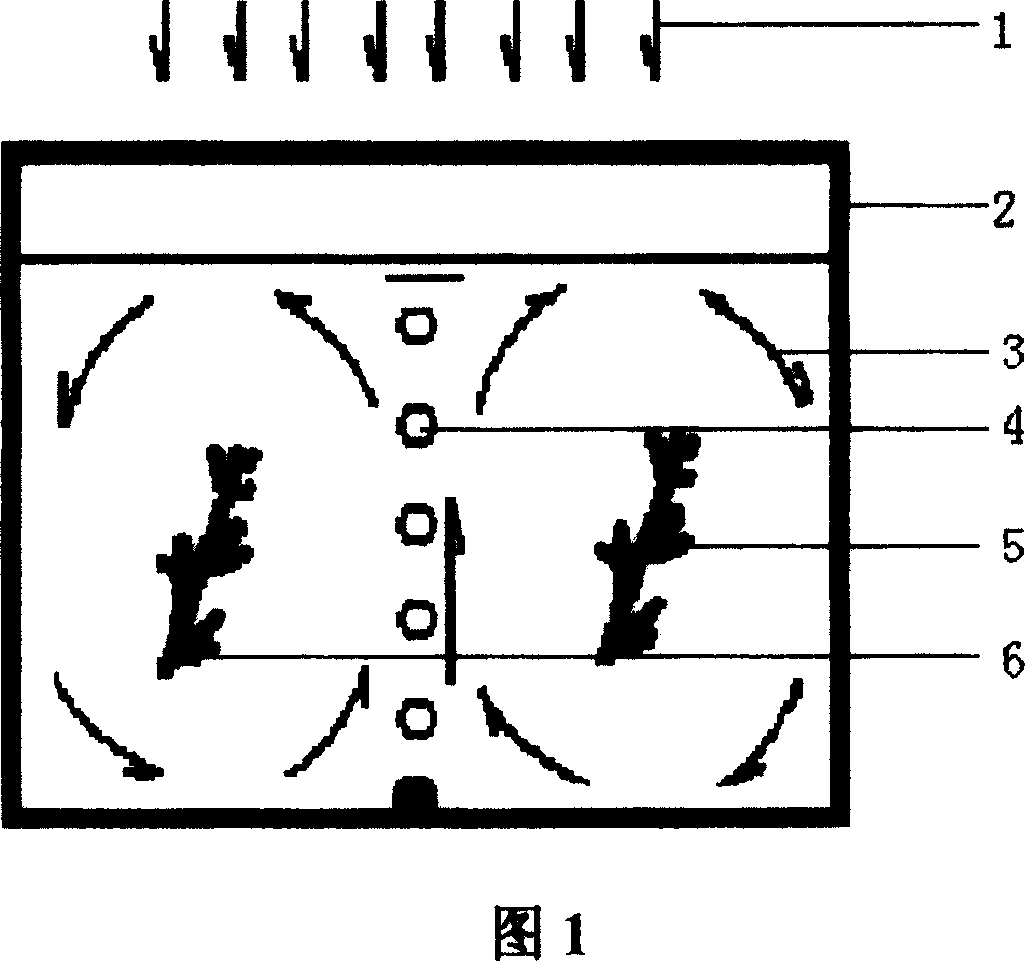
[0017] As shown in Fig. 1, the cultivation water tank system mainly includes a cultivation water tank 2 containing seawater, and a female vegetable 5 and a male vegetable 6 placed therein to promote the circulation of the vegetable by introducing air bubbles 4 into it.
[0018] (1) Sexual reproduction induction technology: using water tank culture system (Figure 1), select male and female to grow vegetables, cultivate with seawater, control the culture temperature at 15-20℃, control the light cycle at 16 hours / day, and control the light intensity at 10000-15000 lux (lux), change the water 1-2 times a day, cultivate for 1-2 months, and form a vegetable with male and female reproductive receptacles.
[0019] (2) Simultaneous discharge of eggs and sperm: using a water tank culture system (Figure 1), select natural or artificially induced planting vegetables with male and female reproductive receptacles, the ratio of male and female planting vegetables is 2:1, and cultured with seawat...
PUM
 Login to View More
 Abstract
Description
Claims
Application Information
 Login to View More