Class-D amplifier
A class D amplifier and integrator technology, applied in the direction of amplifiers, amplifiers with semiconductor devices/discharge tubes, electrical components, etc., can solve the problem that digital amplifier circuits cannot be arranged to provide analog circuits, analog input signals cannot be amplified, and increase costs, etc. question
- Summary
- Abstract
- Description
- Claims
- Application Information
AI Technical Summary
Problems solved by technology
Method used
Image

Examples
Embodiment 1
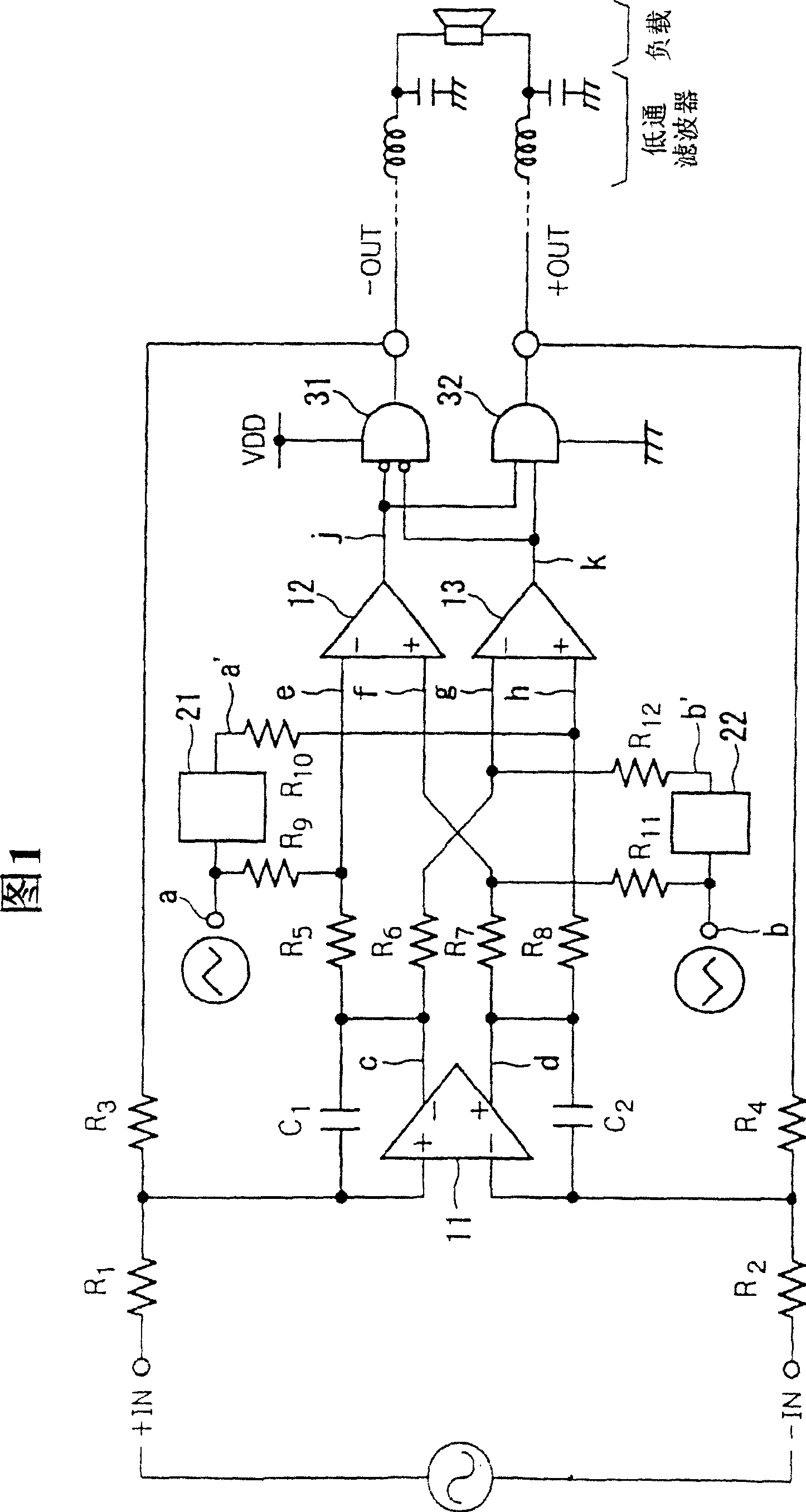
[0092] FIG. 1 is a circuit diagram showing a configuration example of a class D amplifier according to Embodiment Mode 1 of the present invention.
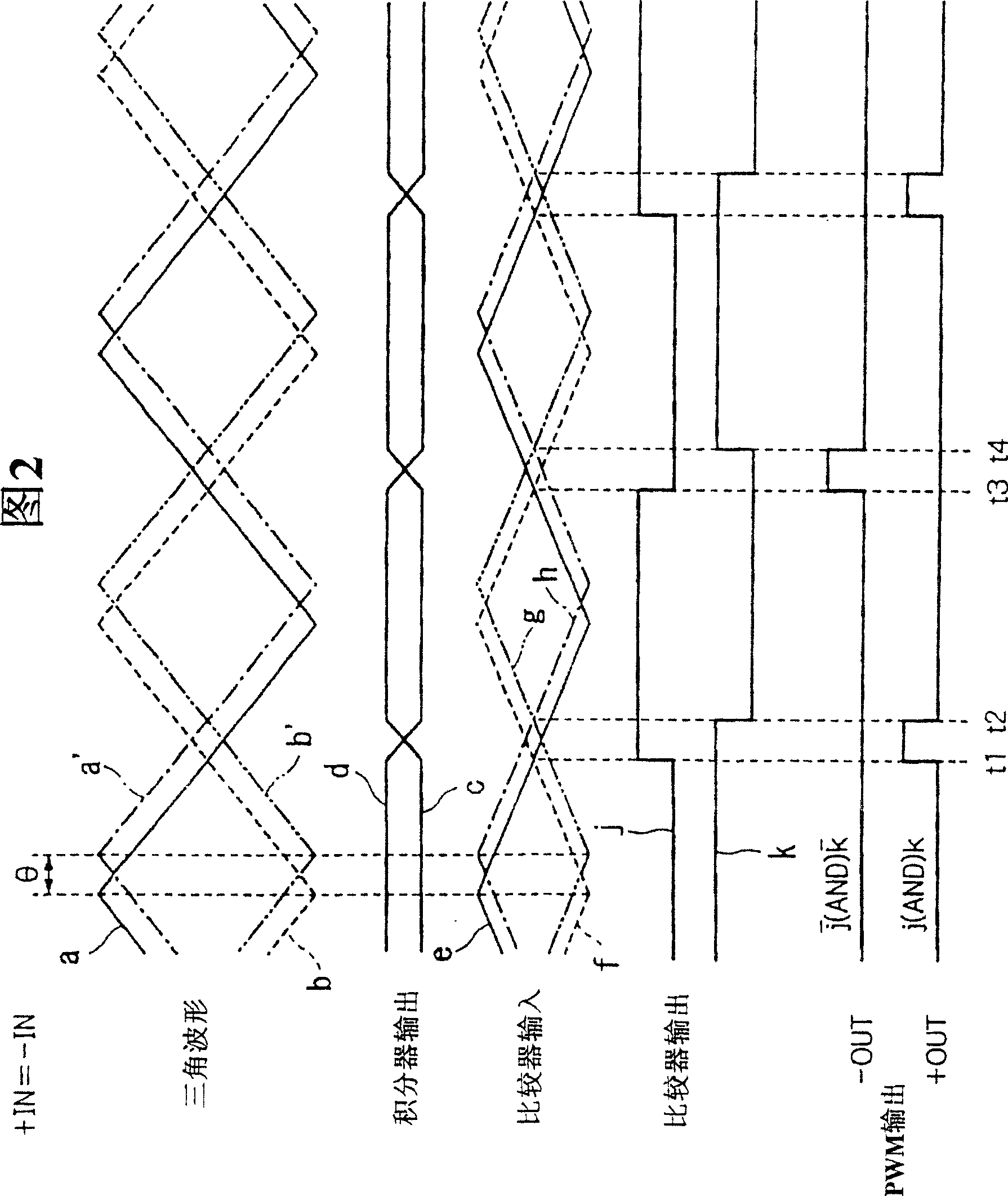
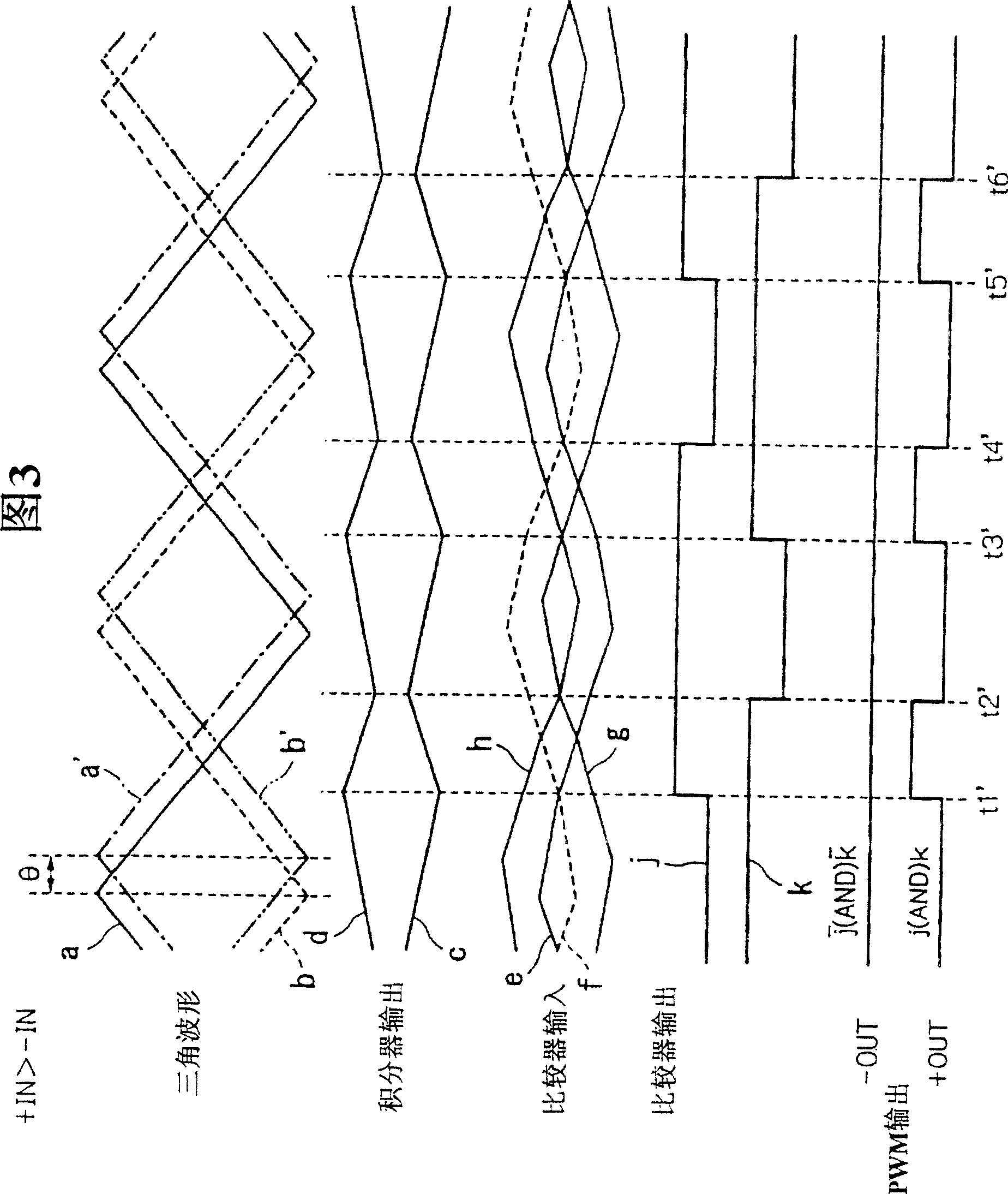
[0093] The class D amplifier is arranged with resistors R1, R2, R3, R4, R5, R6, R7, R8, R9, R10, R11 and R12, capacitors C1 and C2, operational amplifier 11, comparators 12 and 13, delay circuit 21 and 22, AND circuit 31 (low active), and another AND circuit 32. As shown, predetermined triangular waveform signals "a" and "b" are supplied to one terminal of resistors R9 and R10, respectively. The triangular waveform signal "a" and the triangular waveform signal "b" are signals that have the same waveform but are out of phase with each other by 180 degrees.
[0094] One terminal of the resistors R1 and R2 respectively constitutes a differential input terminal of the analog input signal. However, one terminal of the resistor R1 constitutes a positive-side input terminal (+IN), and one terminal of the resistor R2 constitutes a negat...
Embodiment 2
[0124] Next, Embodiment 2 of the present invention will be described with reference to FIG. 5 . FIG. 5 is a circuit diagram showing a configuration example of a class D amplifier according to Embodiment Mode 2 of the present invention. The class D amplifier arrangement has resistors R51, R52, R53, R54, R55 and R56, capacitor C51, optional amplifiers 61 and 64, comparators 62 and 63, AND circuit (low active) 71, and another AND circuit 72 . A triangular waveform signal "a" is supplied to the positive side input terminal of the comparator 62, and another triangular waveform signal "b'" is supplied to the positive side input terminal of the comparator 63.
[0125] The triangular waveform signal "b'" corresponding to the triangular waveform signal generated by the phase of the triangular waveform signal "b" is further delayed by a very small angle "θ", wherein the triangular waveform signal "b" passes through the reverse triangular waveform Signal "a" (ie, phase delayed by 180 d...
Embodiment 3
[0138] Next, Embodiment 3 of the present invention will be described with reference to FIGS. 8 to 11 . FIG. 8 is a circuit diagram showing a configuration example of a class D amplifier according to Embodiment Mode 3 of the present invention. Unlike the class D amplifier according to Embodiment 1, in this class D amplifier, the delay circuits 21 and 22 are not provided as structural components. In this class D amplifier, a triangular waveform signal "a" is supplied to one terminal of a resistor R10, and another triangular waveform signal "b" is supplied to a terminal of another resistor R12. Except for the circuit arrangement of the class D amplifier in FIG. 8 described above, the rest of the class D amplifier is similar to the class D amplifier shown in FIG. 1 . It should be understood that the respective resistance values of the resistors R5, R6, R7, R8, R9, R10, R11, and R12 constituting the synthesis circuit in this class D amplifier are different from those of the clas...
PUM
 Login to View More
 Abstract
Description
Claims
Application Information
 Login to View More
 - R&D
- Intellectual Property
- Life Sciences
- Materials
- Tech Scout
- Unparalleled Data Quality
- Higher Quality Content
- 60% Fewer Hallucinations
Browse by: Latest US Patents, China's latest patents, Technical Efficacy Thesaurus, Application Domain, Technology Topic, Popular Technical Reports.
© 2025 PatSnap. All rights reserved.Legal|Privacy policy|Modern Slavery Act Transparency Statement|Sitemap|About US| Contact US: help@patsnap.com