Unlock instant, AI-driven research and patent intelligence for your innovation.
Synthetic method for cationic surface sizing agent
What is Al technical title?
Al technical title is built by PatSnap Al team. It summarizes the technical point description of the patent document.
A surface sizing agent, cationic technology, applied in the field of polymer compound synthesis, can solve the problems of increasing the use of chemicals in the pulp system, demanding production process equipment, affecting paper drainage and forming, and improving the Cobb value. , The effect of reducing paper lint and powder and improving retention rate
Active Publication Date: 2011-05-18
广州星业科技股份有限公司
View PDF3 Cites 0 Cited by
Summary
Abstract
Description
Claims
Application Information
AI Technical Summary
This helps you quickly interpret patents by identifying the three key elements:
Problems solved by technology
Method used
Benefits of technology
Problems solved by technology
[0003] (1) Since recycled pulp is used more and the source of waste paper is complicated, the volatility of pulp is increased, which also leads to the instability of pulp sizing, and the effect of pulp sizing is limited;
[0004] (2) Adding in slurry increases the use of chemicals in the slurry system and affects the use of other chemicals (such as retention and drainage aids, enhancers, etc.);
[0005] (3) The one-way retention rate of the sizing agent in the slurry is preferably less than 90%, and many rosin sizing agents are only about 60%. The lost sizing agent will form various resins and anionic garbage in the slurry system After a certain period of accumulation, it will affect the water filtration and forming of the next paper, affect the strength of the paper, and even stain the net and felt, thus affecting normal production
However, this method has too strict requirements on production process equipment, which does not meet the national conditions of our country, and is not conducive to widespread application.
Method used
the structure of the environmentally friendly knitted fabric provided by the present invention; figure 2 Flow chart of the yarn wrapping machine for environmentally friendly knitted fabrics and storage devices; image 3 Is the parameter map of the yarn covering machine
View more
Image
Smart Image Click on the blue labels to locate them in the text.
Viewing Examples
Smart Image
Click on the blue label to locate the original text in one second.
Reading with bidirectional positioning of images and text.
Smart Image
Examples
Experimental program
Comparison scheme
Effect test
Embodiment 1
[0039] Weigh 1.5g tert-butyl peroxypivalate, dissolve in 75.0g acetic acid, then weigh 400.0g acetic acid, 80.0g styrene, 30.6g methyl methacrylate, 16.1g hydroxyethyl acrylate and 31.8g N, N-dimethyl hydroxyethyl (meth) acrylate, 16g methacryloyloxyethyltrimethyl ammonium chloride, 0.8g 3-hydroxyl-2-methylpropene, add in the 1000ml glass flask successively, And be warmed up to 157 ℃, slowly add 40g in the acetic acid solution that dissolves the tert-butyl peroxypivalate prepared above in the flask within 15min after starting to reflux, after keeping warm for 30min, the remaining tert-butyl peroxypivalate acetic acid After the solution was added dropwise within 90 minutes, continue to keep warm for 120 minutes, keep the system boiling, adjust the vacuum degree in the flask to -0.095 Mpa, remove excess acetic acid, reduce the temperature of the reaction system to 80 ° C, add 390.5 g of deionized water, and adjust the temperature with acetic acid. When the pH value reaches 3.2, ...
Embodiment 2
[0041] Weigh 6.5g peroxydicarbonate, dissolve in 300g ethanol, then weigh 100g ethanol, 95g styrene monomer, 90g methyl methacrylate monomer, 60g methacryloyloxyethyltrimethyl chloride Add ammonium chloride and 5g of allylamine into a 1000ml glass flask in turn, and heat up to 140°C. Slowly add 150g of the above-prepared ethanol solution in which peroxydicarbonate is dissolved in the flask within 10 minutes after the start of reflux, and keep warm for 30 minutes. Finally, drop the remaining ethanol solution of peroxydicarbonate in 120min, continue to keep warm for 150min, keep the system boiling, adjust the vacuum degree in the flask to -0.015Mpa, remove excess ethanol, and reduce the temperature of the reaction system to 80 ℃, add 578.5g deionized water, adjust the pH value to 3.2 with acetic acid, stir for 15min, and discharge at 40℃ to obtain a cationic polystyrene-acrylate surface sizing agent.
Embodiment 3
[0043] Weigh 3g of tert-butyl peroxypivalate, dissolve it in 150g of propionic acid, then weigh 300g of propionic acid, 60g of styrene monomer, 60g of hydroxyethyl acrylate monomer, and 24g of dimethylaminopropylene acrylamide , 3g of ethanolamine, sequentially added to a 1000ml glass flask, and heated up to 170°C, within 20min after the start of reflux, slowly add 90g of the propionic acid solution in which tert-butyl peroxypivalate prepared above was dissolved in the flask, and keep warm for 30min, Add the remaining propionic acid solution of tert-butyl peroxypivalate dropwise within 60 minutes, continue to keep warm for 100 minutes, keep the system boiling, adjust the vacuum degree in the flask to -0.010Mpa, remove excess propionic acid, and reduce the reaction system When the temperature reaches 80°C, add 337.5g of deionized water, adjust the pH value to 3.2 with acetic acid, stir for 15 minutes, and discharge at 40°C to obtain a cationic polystyrene-acrylic surface sizing ...
the structure of the environmentally friendly knitted fabric provided by the present invention; figure 2 Flow chart of the yarn wrapping machine for environmentally friendly knitted fabrics and storage devices; image 3 Is the parameter map of the yarn covering machine
Login to View More
PUM
Login to View More
Abstract
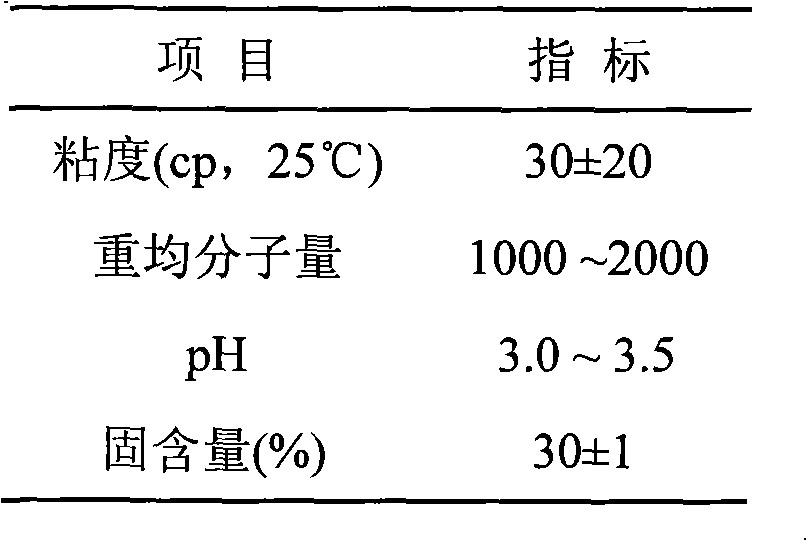
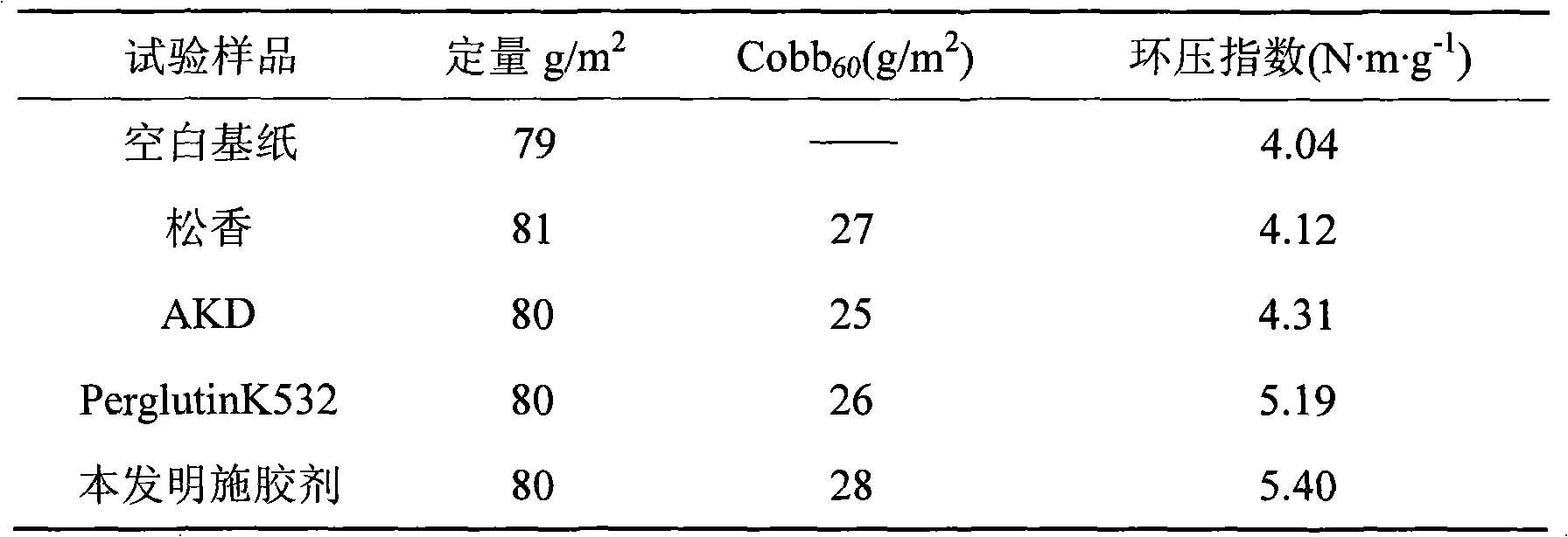
The invention provides a synthetic method for a cationic surface sizing agent, which comprises the following steps: taking an organic solvent as a homogeneous reaction medium, taking styrene, acrylic The invention provides a synthetic method for a cationic surface sizing agent, which comprises the following steps: taking an organic solvent as a homogeneous reaction medium, taking styrene, acrylicester and cationic monomer as comonomers, and adding a chain transfer agent and an initiator for polyreaction to prepare the cationic surface sizing agent with weight average molar mass between 1,000ester and cationic monomer as comonomers, and adding a chain transfer agent and an initiator for polyreaction to prepare the cationic surface sizing agent with weight average molar mass between 1,000and 2,000; and the weight percentage of the components is as follows: 60 to 75 percent of the organic solvent, 10 to 15 percent of the styrene, 10 to 15 percent of the acrylic ester, 2 to 10 percent oand 2,000; and the weight percentage of the components is as follows: 60 to 75 percent of the organic solvent, 10 to 15 percent of the styrene, 10 to 15 percent of the acrylic ester, 2 to 10 percent of the cationic monomer, 0.1 to 1 percent of the chain transfer agent and 0.1 to 1 percent of the initiator. The synthetic method adopts a homogeneous non-emulsion polymerization process and a high-efff the cationic monomer, 0.1 to 1 percent of the chain transfer agent and 0.1 to 1 percent of the initiator. The synthetic method adopts a homogeneous non-emulsion polymerization process and a high-efficiency catalytic system, and has high conversion rate; and the prepared surface sizing agent can improve the ring crush strength of paper, improve a Cobb value, quicken mature speed without getting diciency catalytic system, and has high conversion rate; and the prepared surface sizing agent can improve the ring crush strength of paper, improve a Cobb value, quicken mature speed without getting damp, reduce linting and dusting of the paper, obviously improve water resistance and strength of the paper, and improve application performances such as wear resistance, hydrophilicity of printing inkamp, reduce linting and dusting of the paper, obviously improve water resistance and strength of the paper, and improve application performances such as wear resistance, hydrophilicity of printing ink, ventilation property, stiffness and the like., ventilation property, stiffness and the like.
Description
technical field [0001] The invention belongs to the technical field of polymer compound synthesis, in particular to a method for synthesizing a cationic surface sizing agent, in particular to a method for synthesizing a cationic polystyrene-acrylate surface sizing agent. Background technique [0002] At present, in most domestic papermaking processes, the function of waterproof and moisture resistance depends on adding rosin or synthetic (such as AKD, ASA, etc.) sizing agents to the pulp. Rosin or synthetic sizing agents can give paper and Cardboard has a certain degree of sizing, but there are many disadvantages: [0003] (1) Since recycled pulp is used more and the source of waste paper is complicated, the volatility of pulp is increased, which also leads to the instability of pulp sizing, and the effect of pulp sizing is limited; [0004] (2) Adding in slurry increases the use of chemicals in the slurry system and affects the use of other chemicals (such as retention and...
Claims
the structure of the environmentally friendly knitted fabric provided by the present invention; figure 2 Flow chart of the yarn wrapping machine for environmentally friendly knitted fabrics and storage devices; image 3 Is the parameter map of the yarn covering machine
Login to View More
Application Information
Patent Timeline
Application Date:The date an application was filed.
Publication Date:The date a patent or application was officially published.
First Publication Date:The earliest publication date of a patent with the same application number.
Issue Date:Publication date of the patent grant document.
PCT Entry Date:The Entry date of PCT National Phase.
Estimated Expiry Date:The statutory expiry date of a patent right according to the Patent Law, and it is the longest term of protection that the patent right can achieve without the termination of the patent right due to other reasons(Term extension factor has been taken into account ).
Invalid Date:Actual expiry date is based on effective date or publication date of legal transaction data of invalid patent.

 Login to View More
  Login to View More