Method for transmitting ACK/NACK by using multiple antennae
An antenna and transmitting equipment technology, applied in the directions of diversity/multi-antenna system, multi-frequency code system, space transmit diversity, etc., to achieve the effect of low requirements
- Summary
- Abstract
- Description
- Claims
- Application Information
AI Technical Summary
Problems solved by technology
Method used
Image

Examples
Embodiment 1
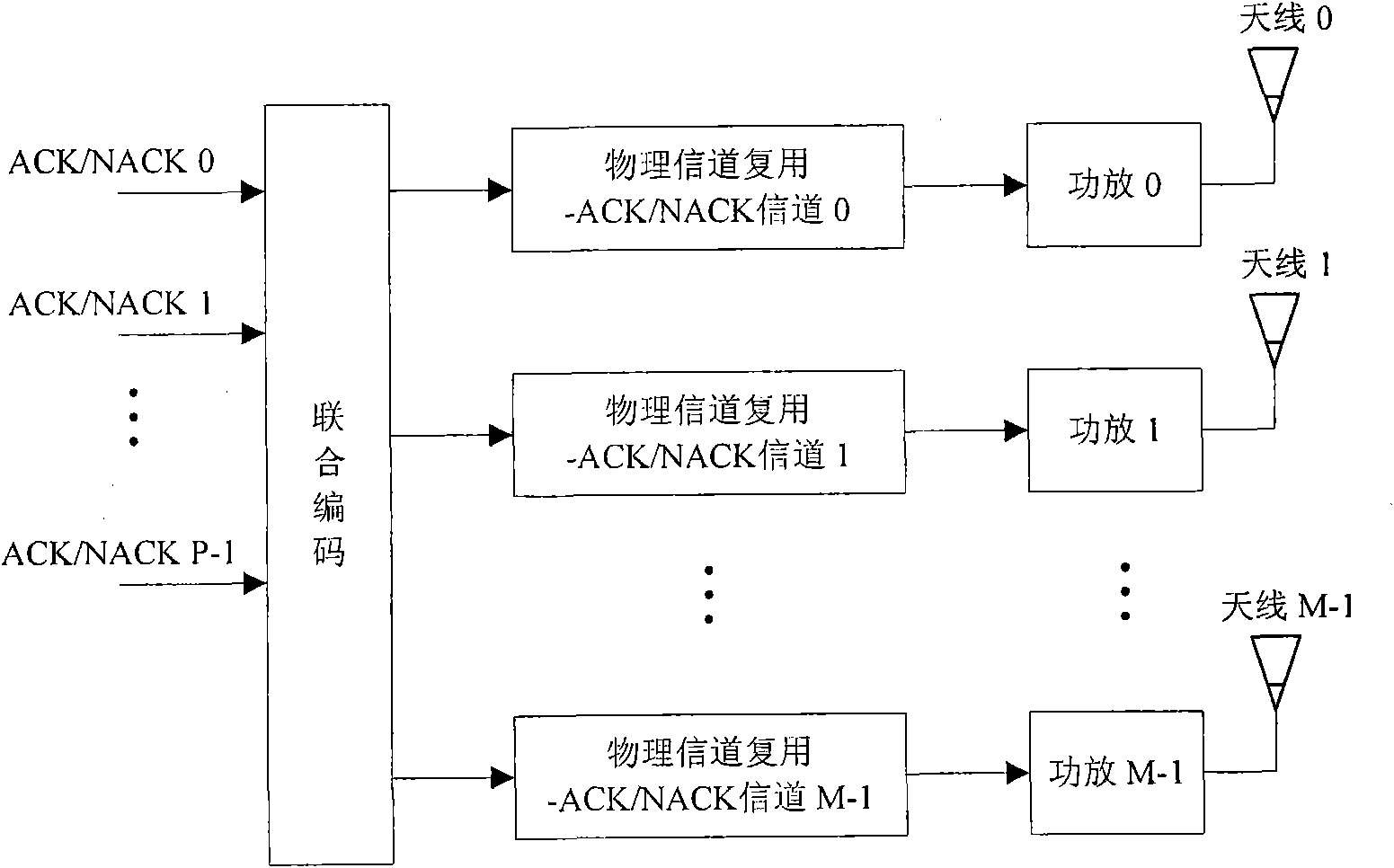
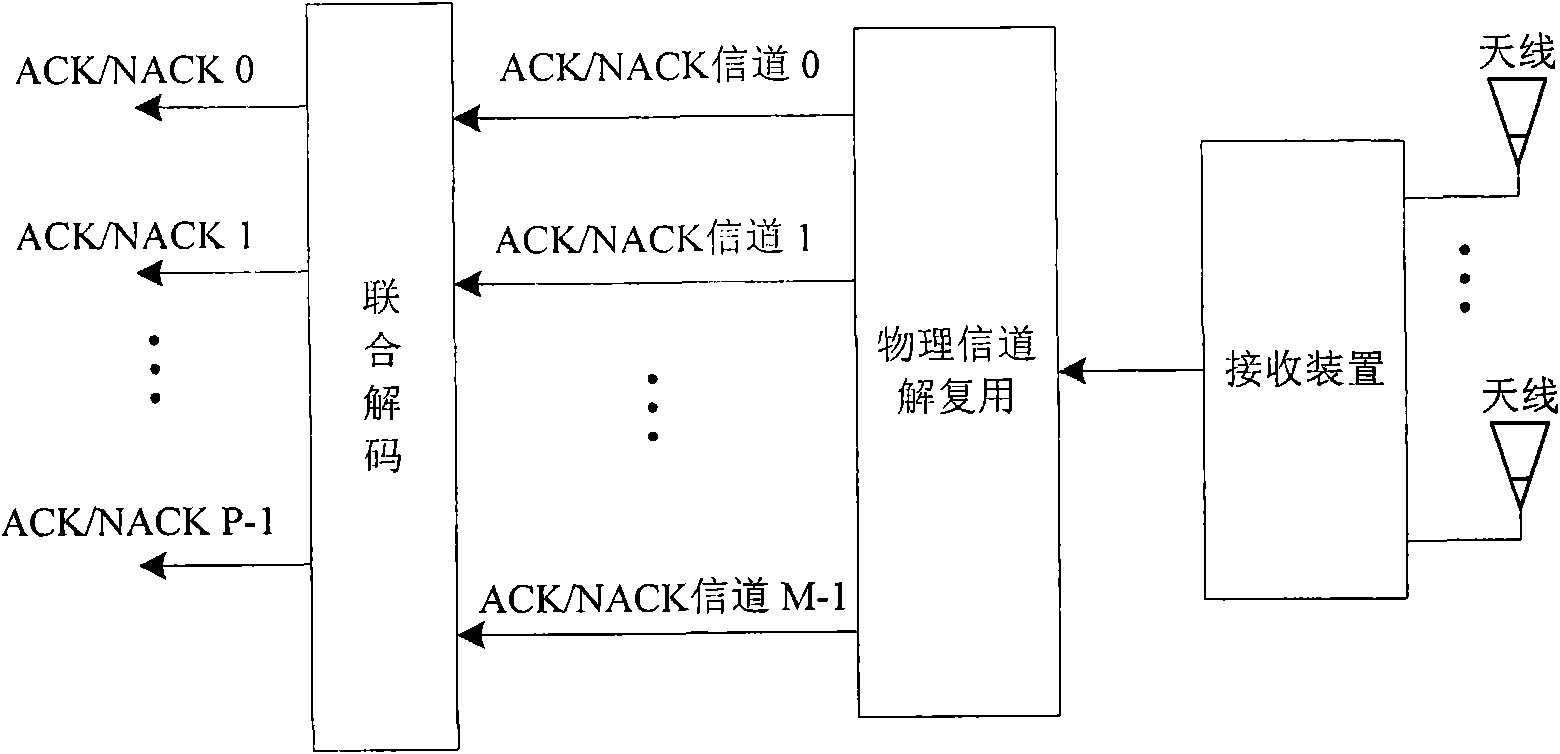
[0036] Assume that only the ACK / NACK information of data in one downlink subframe is transmitted in one uplink subframe, and assume that when MIMO is used for data transmission, the maximum number of codewords sent simultaneously in one subframe is P, for example, P equals 4. Each codeword generates 1-bit ACK / NACK information, so that at most P bits of ACK / NACK information need to be sent simultaneously in the uplink direction. Assuming that the number of CCEs contained in the PDCCH for scheduling downlink data transmission is greater than or equal to 2, then according to the mapping relationship between CCEs and ACK / NACK channels, the user equipment can have at least two available ACK / NACK channels, for example, they are the PDCCH with the smallest index The ACK / NACK channels mapped by the two CCEs. It is further assumed that the user equipment is configured with two power amplifiers and antennas. And it is assumed that the number of physical bits provided by each ACK / NACK c...
Embodiment 2
[0040] Assuming that the ACK / NACK information of the data of multiple downlink subframes is transmitted in one uplink subframe, and the base station sends data for the user equipment in P (greater than or equal to 2) downlink subframes, the ACK / NACK information of each subframe The information is combined to obtain one ACK / NACK bit, and a total of P ACK / NACK information bits are obtained. Each subframe obtains one ACK / NACK channel, so there are P ACK / NACK channels in total, and two of them are selected for transmitting ACK / ACK information. It is further assumed that the user equipment is configured with two power amplifiers and antennas. And it is assumed that the number of physical bits provided by each ACK / NACK channel is 4.
[0041] The user equipment receives data and generates P ACK / NACK bits. Then, the user equipment jointly encodes the P ACK / NACK bits to obtain 8 coded bits. Then, the 8 coded bits are equally divided into 2 blocks, and each block contains 4 bits; then...
Embodiment 3
[0044] It is assumed that the downlink frequency of the system is composed of multiple frequency bands, and PDCCH is sent in each downlink subframe on each frequency band to schedule downlink data transmission, and remember that the base station transmits for the user equipment in P (greater than or equal to 2) frequency bands If data is received, the ACK / NACK information of each frequency band is combined to obtain one ACK / NACK bit, and a total of P ACK / NACK information bits are obtained. Each frequency band obtains one ACK / NACK channel, so there are P ACK / NACK channels in total, and two of them are selected for transmitting ACK / ACK information. It is further assumed that the user equipment is configured with two power amplifiers and antennas. And it is assumed that the number of physical bits provided by each ACK / NACK channel is 4.
[0045] The user equipment receives data and generates P ACK / NACK bits. Then, the user equipment jointly encodes the P ACK / NACK bits to obtain ...
PUM
 Login to View More
 Abstract
Description
Claims
Application Information
 Login to View More
 - R&D
- Intellectual Property
- Life Sciences
- Materials
- Tech Scout
- Unparalleled Data Quality
- Higher Quality Content
- 60% Fewer Hallucinations
Browse by: Latest US Patents, China's latest patents, Technical Efficacy Thesaurus, Application Domain, Technology Topic, Popular Technical Reports.
© 2025 PatSnap. All rights reserved.Legal|Privacy policy|Modern Slavery Act Transparency Statement|Sitemap|About US| Contact US: help@patsnap.com