

Data transmission method, system and equipment
A data transmission method and data transmission technology, applied in the field of data transmission methods, systems and equipment, can solve the problems of reducing resource utilization, system efficiency, TDD system resource utilization, etc.
- Summary
- Abstract
- Description
- Claims
- Application Information
AI Technical Summary
Problems solved by technology
Method used
Image


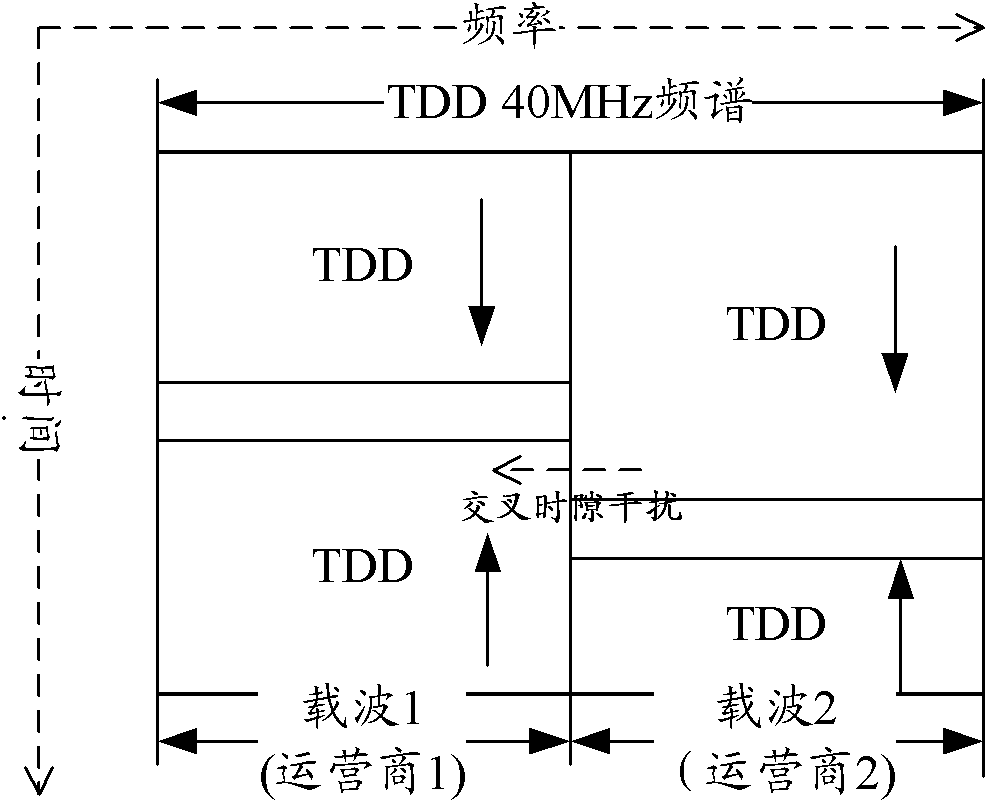
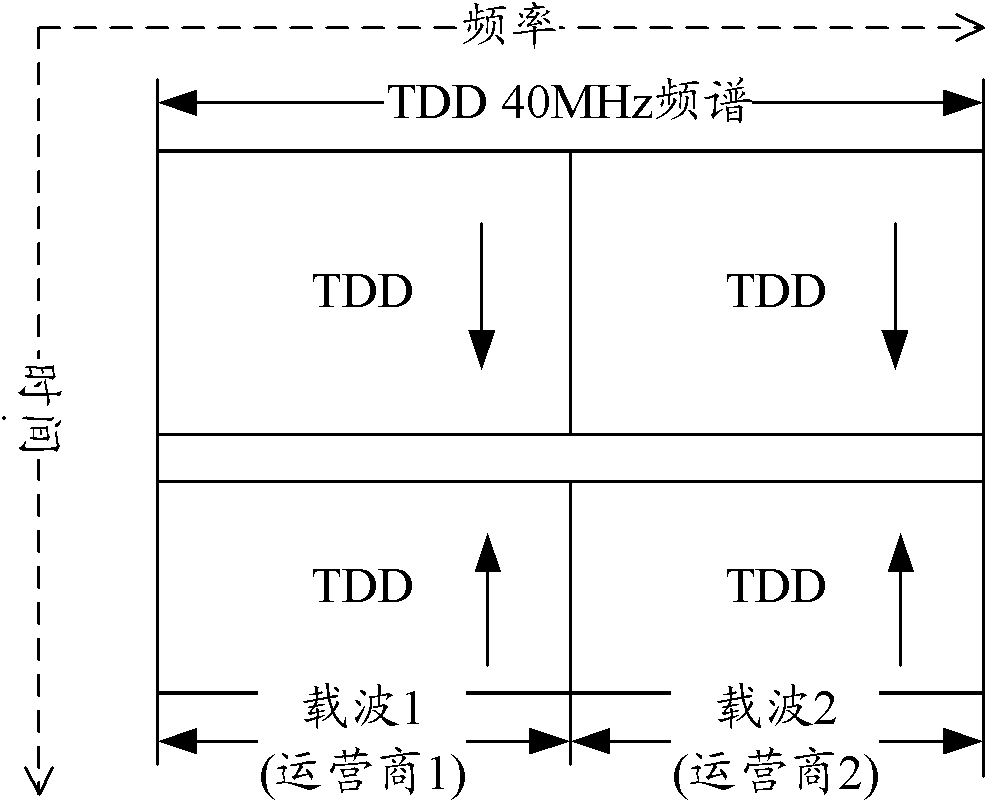
Examples
Embodiment 1
[0077] Such as Figure 5 As shown, resource 1 is aggregated to the downlink part of carrier 1 by carrier aggregation technology to form an extension carrier (Extension Carrier) or carrier segment (Carrier Segment). In these two aggregation methods, no synchronization signal is sent on resource 1 , broadcast, public pilot and other cell characteristic signals cannot provide UE camping, and even only PDSCH can be sent without sending control channels. At this time, the PDSCH transmission in resource 1 is determined by the downlink scheduling signaling (DL grant) scheduling. The difference is that resource 1 exists as an independent downlink carrier in the former, but only exists as some physical resources in the latter.
[0078] Correspondingly, the resource 2 is aggregated into the uplink part of the carrier 2 by using the carrier aggregation technology to form an extended carrier or a carrier segment. Only the PUSCH may be sent in the resource 2 part, and the uplink control ...
Embodiment 2
[0080] Such as Image 6 As shown, resource 1 is aggregated to the downlink part of carrier 2 for bundled use to form extended carriers or carrier segments, and cell characteristic signals such as synchronization signals, broadcasts, and common pilots are not sent in resource 1, and UE camping cannot be provided. It is even possible to send only the PDSCH without sending the control channel. At this time, the PDSCH transmission in resource 1 is scheduled by the downlink scheduling signaling (DL grant) sent in carrier 2;
[0081] Aggregate resources 2 to the uplink part of carrier 1 and bundle them to form extended carriers or carrier segments.
[0082] Only the PUSCH can be sent in the resource 2 part, and the uplink control channel is not sent. At this time, the PUSCH transmission in the resource 2 is scheduled by the uplink scheduling signaling (UL grant) sent in the carrier 1.
[0083] The difference between this embodiment and Embodiment 1 is: from the perspective of carri...
Embodiment 3
[0085] Such as Figure 7 As shown, the guard frequency band is divided from the frequency domain, so that the downlink resource is divided into resource 1 and resource 1', and the uplink resource is divided into resource 2 and resource 2'.
[0086] Then resource 1 is aggregated to the downlink part of carrier 1, and resource 2' is aggregated to the uplink part of carrier 2 to form extended carriers or carrier segments; cell characteristic signals such as synchronization signals, broadcasts, and common pilots are not sent in resource 1, It is not possible to provide UE camping, and even only PDSCH can be sent without sending control channels. At this time, the PDSCH transmission in resource 1 is scheduled by the downlink scheduling signaling (DL grant) sent in carrier 1; in resource 2', only Send PUSCH, do not send the uplink control channel, at this time, the PUSCH transmission in resource 2' is scheduled by the uplink scheduling signaling (UL grant) sent in carrier 2;
[008...
PUM
 Login to View More
 Abstract
Description
Claims
Application Information
 Login to View More