Circulating self-correlation-based signal phase difference estimation device and method for antenna array

A technology of antenna array and signal phase, applied in the field of deep space exploration, can solve problems such as complex algorithms and limited signal-to-noise ratio conditions, and achieve the effects of low estimation deviation, reduced calculation amount, and high estimation variance

CN102055512BActive Publication Date: 2013-08-07NAT ASTRONOMICAL OBSERVATORIES CHINESE ACAD OF SCI
3 Cites 0 Cited by

Patent Information

Authority / Receiving Office
CN · China
Patent Type
Patents(China)
Current Assignee / Owner
Publication Date
2013-08-07

Smart Images

  • Figure 1
    Figure 1
  • Figure 2
    Figure 2
  • Figure 3
    Figure 3
Patent Text Reader

Abstract

The invention provides a circulating self-correlation-based signal phase difference estimation device for an antenna array. The antenna array comprises a plurality of antenna receiving units, wherein the antenna receiving units are used for calculating the phase difference of circulating stable signals of the antenna array and comprise at least one matching filter, one or two circulating self-correlation modules, one or two initial phase solving modules and a phase difference solving module. The invention also provides a circulating self-correlation-based signal phase difference estimation method for the antenna array, a signal synthesis device with the phase difference estimation device and a signal synthesis method comprising the phase difference estimation method, and an antenna array signal receiving system with the signal synthesis device and an antenna array signal receiving method comprising the signal synthesis method.
Need to check novelty before this filing date? Find Prior Art

Description

technical field

[0001] The invention relates to the field of deep space exploration, in particular to a technology for calculating the phase difference of signals in deep space signal reception so as to synthesize antenna array signals. Background technique

[0002] The rapid development of long-distance communication and navigation in deep space exploration and radio astronomy has put forward new requirements for the performance of radio telescopes. Due to the increase of development costs and technical limitations, the improvement of the G / T value of a single antenna has come to a standstill. The US Deep Space Network (DSN) strategic plan has identified a possible growth path: using radio frequency bands, and obtaining higher antenna gain through a large number of small antenna arrays. Antenna arrays offer the advantage of being able to receive data at a higher data rate than can be received with a single antenna, which has many desirable advantages: better performance, g...

Examples

Embodiment Construction

[0056] Various details involved in the technical solution of the present invention will be described in detail below in conjunction with the accompanying drawings. It should be pointed out that the described embodiments are only intended to facilitate the understanding of the present invention, rather than limiting it in any way.

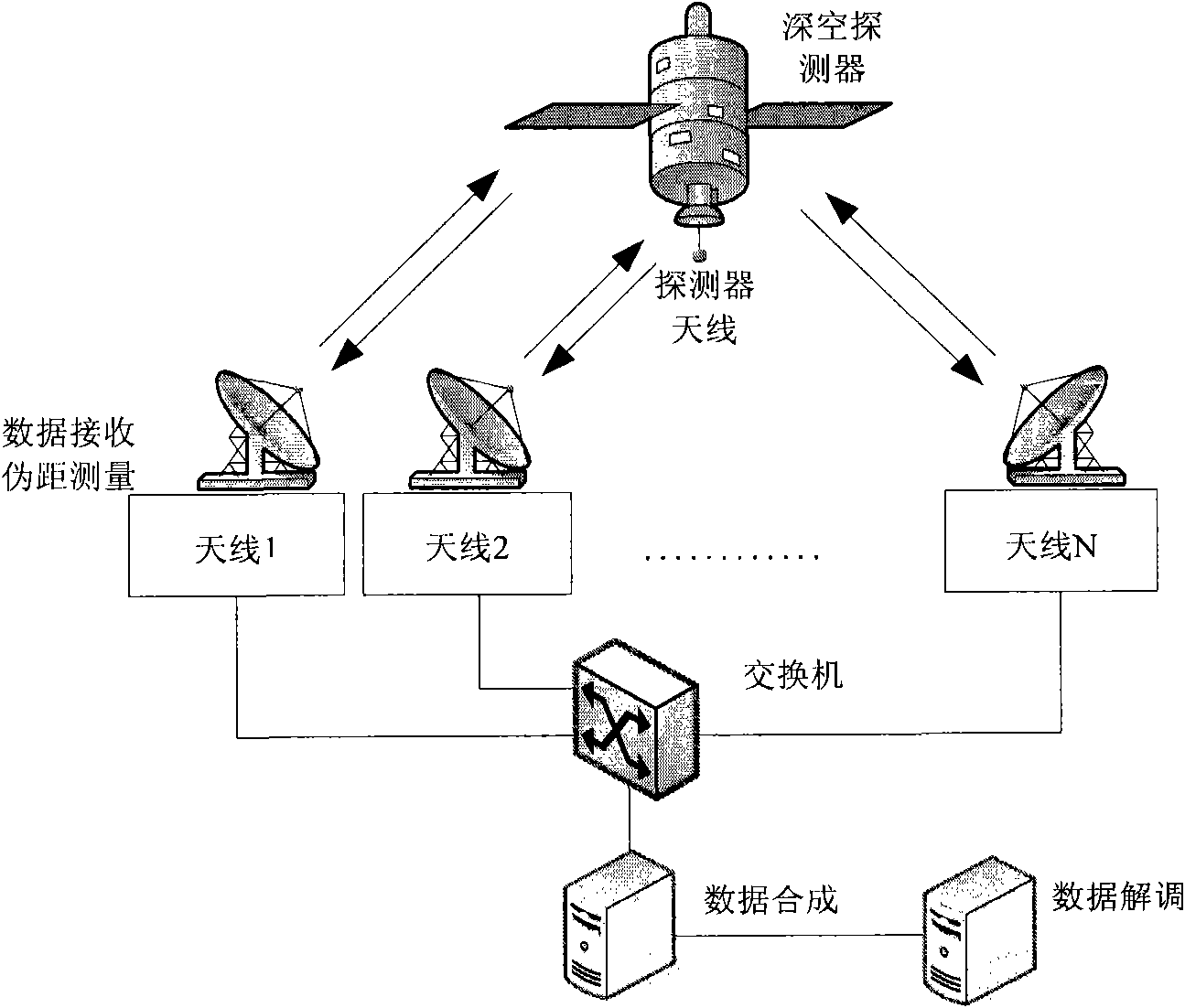
[0057] figure 1 It is a schematic diagram of antenna array in deep space exploration.

[0058] exist figure 1 In , the deep space probe communicates with each antenna (1, 2...N) in the antenna array on the ground through its probe antenna, and performs operations such as data reception and pseudo-range measurement on the ground. Each antenna transmits data to the data processing equipment through the switch, and the detector signals received by each antenna are synthesized and then demodulated, which can greatly improve the data receiving ability of the signal. Similarly, the antennas in the array can also transmit uplink data to the detector at ...