Check patentability & draft patents in minutes with Patsnap Eureka AI!

Adaptive molecule for delivery of adenovirus vectors

An adenovirus and virus technology, applied in the field of peptides, can solve the problems of low cell specificity, unsuitable for in vivo methods, and time-consuming

Inactive Publication Date: 2011-07-20
PROYECTO DE BIOMEDICINA CIMA +1
View PDF23 Cites 0 Cited by
  • Summary
  • Abstract
  • Description
  • Claims
  • Application Information

AI Technical Summary

Problems solved by technology

However, systems based on recombinant adenoviruses showing altered tropism may face many problems due to the broad tropism of the modified fibrin, resulting in low cell specificity and making them unsuitable for in vivo methods
Furthermore, these systems require the construction of modified adenoviral vectors, which is often time-consuming

Method used

the structure of the environmentally friendly knitted fabric provided by the present invention; figure 2 Flow chart of the yarn wrapping machine for environmentally friendly knitted fabrics and storage devices; image 3 Is the parameter map of the yarn covering machine
View more

Image

Smart Image Click on the blue labels to locate them in the text.
Viewing Examples
Smart Image
  • Adaptive molecule for delivery of adenovirus vectors
  • Adaptive molecule for delivery of adenovirus vectors
  • Adaptive molecule for delivery of adenovirus vectors

Examples

Experimental program
Comparison scheme
Effect test

Embodiment 1

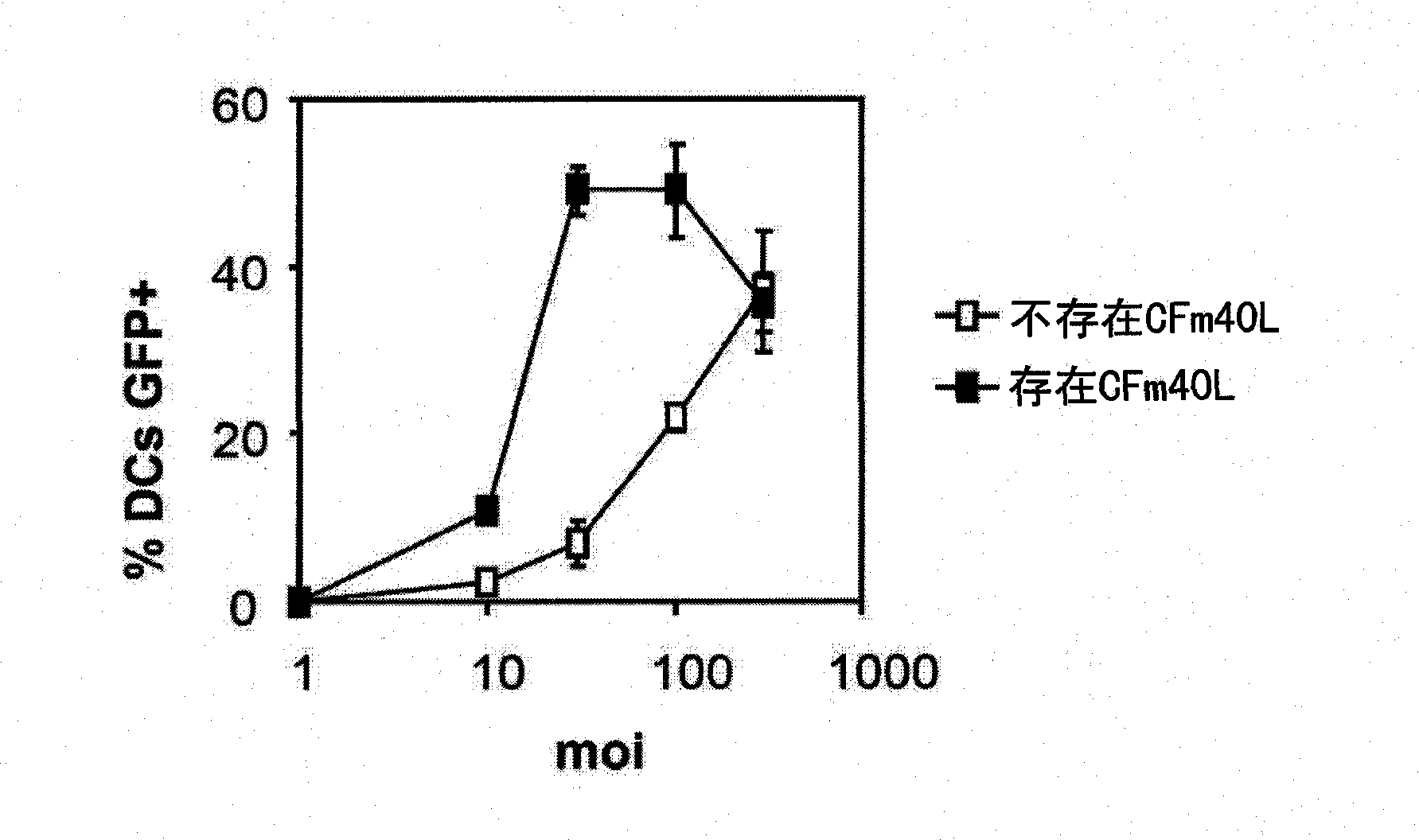
[0220] Example 1 Utilization of CFm40L to increase the efficiency of transduction of dendritic cells with adenovirus.

[0221] Dendritic cells (DCs) of C57BL6 mice were obtained from bone marrow precursors using the method described by Zabaleta et al. (Mol. Ther., 2008, 16:210-217). For this, femoral and tibial bone marrow was extracted using a lysis buffer solution (0.15M NH 4 Cl, 10mM KHCO 3 , 0.1 mM Na 2 EDTA) to lyse red blood cells. This was followed by washing with RPMI 1640, and lymphocytes and granulocytes were removed by incubating a mixture of antibodies against different cell populations and rabbit supplements.

[0222] - Anti-CD4 antibody (100 μg / mL): obtained from hybridoma GK1-5 (Dialynas et al., 1983, J Immunol. 1983 Nov; 131:2445-51).

[0223] - Anti-CD8 antibody (100 μg / mL): obtained from rat hybridoma H35.17.2 (Pierres et al., 1982, Eur. J. Immunol. 12 (1982), 60-69.).

[0224] -Ly-6G / Gr1 (BD Pharmingen; San Diego, Calif.), 10 μl / mL.

[0225] - CD45R / B2...

Embodiment 2

[0228] Example 2 Transduction of dendritic cells with AdNS3 in the presence of CFm40L to induce their in vitro maturation: expression of surface markers.

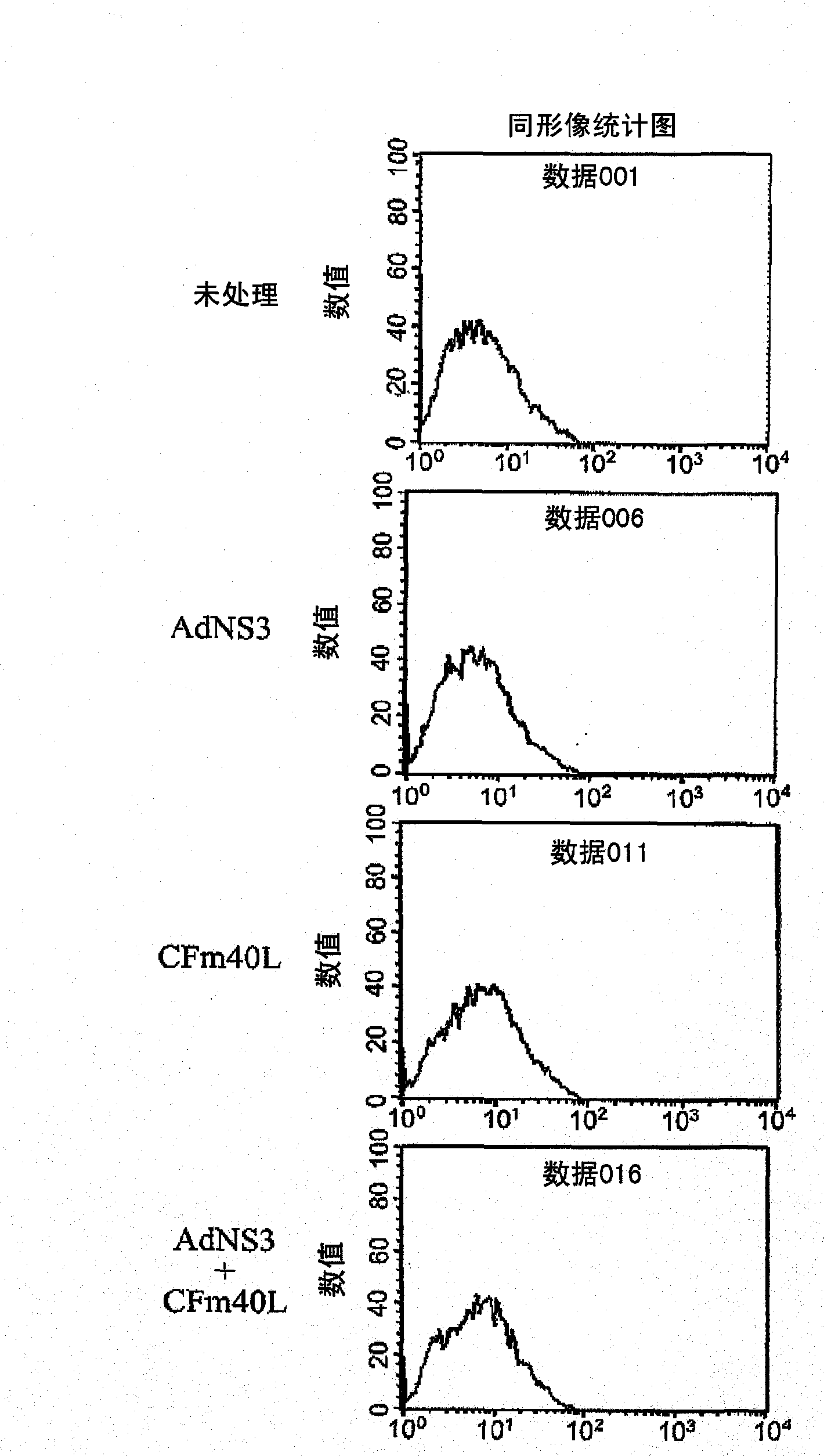
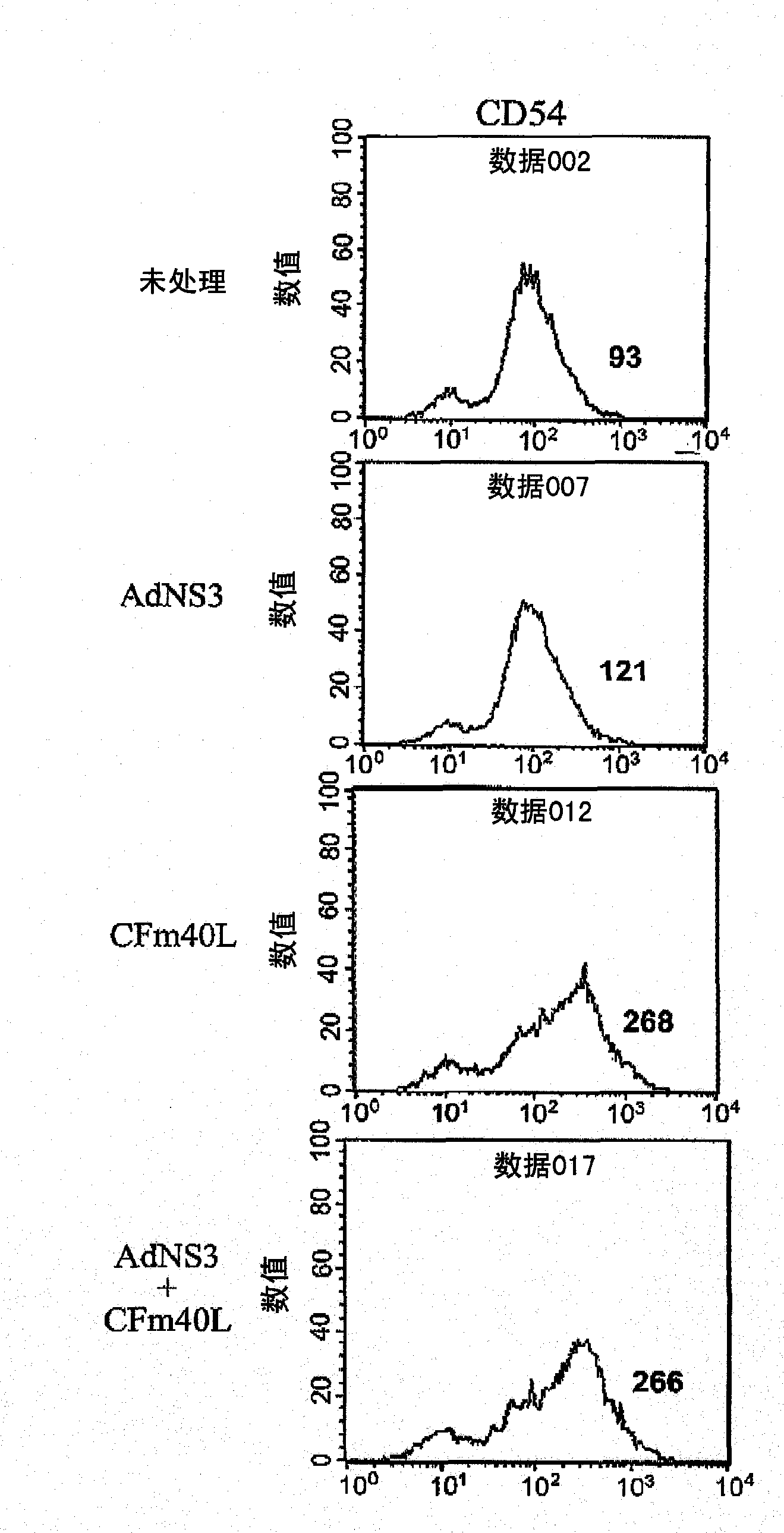
[0229]Dendritic cells from C57BL6 were prepared according to the method of Example 1 and transduced with AdNS3 (moi 30) in the presence or absence of CFm40L. Untreated dendritic cells or dendritic cells treated with CFm40L alone were used as controls. Dendritic cells were harvested one day later and their degree of maturation was studied by analyzing surface markers by flow cytometry. Antibodies against the markers CD54, CD80, CD86, I-Ab (MHC class II) were used, as well as controls (all from BD Pharmingen). Labeling was performed at 4°C in PBS with 2% FBS. After 30 minutes, cells were washed and analyzed for expression of different surface markers. The result is shown in Figure 2.

Embodiment 3

[0230] Example 3 - Transduction of dendritic cells with AdNS3 in the presence of CFm40L to induce their maturation in vitro: Cytokine production.

[0231] Dendritic cells were prepared according to Example 2, and divided into the same groups (untreated, AdNS3, CFm40L and CFm40L+AdNS3), cultured for 24 hours, and then the culture supernatant was collected. The amount of IL-12, IL-10 and IL-6 produced in these supernatants was determined by ELISA (BD-Pharmingen, Franklin Lakes, NJ, USA), performed according to the manufacturer's instructions. The result is as image 3 shown.

the structure of the environmentally friendly knitted fabric provided by the present invention; figure 2 Flow chart of the yarn wrapping machine for environmentally friendly knitted fabrics and storage devices; image 3 Is the parameter map of the yarn covering machine
Login to View More

PUM

No PUM Login to View More

Abstract

The invention relates to an adaptive protein comprising a coxackievirus and adenovirus receptor (CAR) region and a human CD40 ligand and to the uses thereof for promoting adenoviral transduction of dendritic cells while at the same time promoting maturation of the DCs. The invention also relates to pharmaceutical compositions comprising said adaptive protein and an adenovirus encoding an antigen and the uses thereof in a method for eliciting an immune response against the antigen encoded in said adenovirus as well as to antigen-loaded dendritic cells obtained, the adaptive protein and an adenovirus and to the uses thereof in a method of eliciting an immune response against the antigen encoded in the adenovirus.

Description

[0001] Cross Reference to Priority Application [0002] This application claims priority to US Provisional Application No. 61 / 055,332, filed May 22, 2008, which is hereby incorporated by reference in its entirety. [0003] Statement on Commonwealth Funded Research [0004] This invention was made with government support under No. 5 U54 AI057157-04 awarded by the National Institutes of Health. The government has certain rights in this invention. Background technique [0005] Hepatitis C virus (HCV) infection is characterized by its high tendency to be chronic, which in some cases can develop into cirrhosis and eventually liver cancer. The prevalence of this infection is estimated to be 1-2%, which, combined with the inefficiency of currently available treatments for the chronic phase of the infection, makes vaccine development very important. The importance of the immune response to HCV infection has been highlighted by studies that have demonstrated that those individuals w...

Claims

the structure of the environmentally friendly knitted fabric provided by the present invention; figure 2 Flow chart of the yarn wrapping machine for environmentally friendly knitted fabrics and storage devices; image 3 Is the parameter map of the yarn covering machine
Login to View More

Application Information

Patent Timeline
no application Login to View More
Patent Type & Authority Applications(China)
IPC IPC(8): C12N15/62C12N15/861A61K48/00A61K39/00
CPCA61K2039/5256C07K2319/21C12N2810/855C07K2319/735C07K2319/32C12N2710/10343A61K2039/5154C07K14/005C12N2770/24222C07K14/705A61K2039/55C07K2319/74C12N15/86C07K14/70575A61K39/29C12N2710/10345A61K2039/5156C12N2770/24234C07K2319/33A61K39/12A61P31/14A61P37/04A61K39/4622A61K39/464417A61K39/4615A61K2239/38A61K39/4631A61K39/464838A61K2239/31
Inventor 亚历山大·佩雷博埃威乔治·楚拉泽伊戈尔·博格达申意驰尔·爱彻利维亚贝斯特吉胡安·何塞·拉萨尔特萨加斯蒂韦尔萨赫苏斯·玛丽亚·普列托巴尔图埃彻巴勃罗·萨罗韦乌加里萨
Owner PROYECTO DE BIOMEDICINA CIMA
Features
  • R&D
  • Intellectual Property
  • Life Sciences
  • Materials
  • Tech Scout
Why Patsnap Eureka
  • Unparalleled Data Quality
  • Higher Quality Content
  • 60% Fewer Hallucinations
Social media
Patsnap Eureka Blog
Learn More