Preparation method for copper complex of glycine-salicylaldehyde Schiff base

A technology of copper complexes and salicylaldehyde, which is applied in the direction of copper organic compounds, animal feed, animal feed, etc., can solve problems such as polluting the environment and endangering human health, and achieve the effects of reducing dosage, promoting growth, and highlighting technological progress

CN102180893AInactive Publication Date: 2011-09-14XINJIANG AGRI UNIV
0 Cites 2 Cited by

Patent Information

Authority / Receiving Office
CN · China
Current Assignee / Owner
Publication Date
2011-09-14
Estimated Expiration
Not applicable · inactive patent

Smart Images

  • Figure 1
    Figure 1
  • Figure 2
    Figure 2
  • Figure 3
    Figure 3
Patent Text Reader

Abstract

The invention provides a preparation method for a copper complex of a glycine-salicylaldehyde Schiff base. The preparation method comprises the following steps of: dissolving 0.1 mol of glycine and 0.1 mol of potassium hydroxide into 50 to 70 milliliters of methanol; adding 30 to 35 milliliters of 0.1 mol methanol solution of salicylaldehyde dropwise with stirring; reacting for 3 hours with stirring; cooling and filtering; and concentrating to obtain crystal glycine-salicylaldehyde Schiff base; dissolving the crystal into a proper amount of methanol; adding equal mol of saturated methanol solution of copper acetate dropwise with stirring; reacting for 2 to 3 hours with stirring to obtain the copper complex; and washing the precipitate with 95 percent ethanol twice and washing the precipitate with diethyl ether once to obtain the finished product. The LD50 of the complex is 1,135.0 to 1,424.9; and the complex has no toxicity, no residues and no adverse effect. The complex has high inhibition effect on staphylococcus aureus and typhoid bacillus. The inhibition effect on Gram-positive bacteria (staphylococcus aureus) is obviously stronger than that on Gram-negative bacteria. After broilers are fed with the complex in the dose of 100 mg / Kg, the daily gain is averagely increased by 23 percent.
Need to check novelty before this filing date? Find Prior Art

Description

technical field

[0001] The invention relates to the preparation of a copper complex of glycine-salicylaldehyde Schiff base, which can replace antibiotics, reduce the dosage of antibiotics, and provide guarantee for increasing production and safety of animal husbandry. Background technique

[0002] In order to solve the problems of endangering human health and polluting the environment caused by antibiotic residues, people are committed to research and development of green, non-toxic and harmless antibiotic substitutes. Eichhorn et al. (1956) synthesized glycine-salicylaldehyde metal copper complex [sal-gly] Cu2+ in solution for the first time; Nakahara (1959) confirmed its structure by means of IR, 1HNMR, elemental analysis, etc. Compound synthesis laid the foundation. Amino acid-salicylaldehyde Schiff base metal complexes have attracted widespread attention as vitamin B6 catalyzed amino acid enzymatic reactions (Casella et al., 1986; Li Huaina et al., 1995). These compound...

Examples

Embodiment

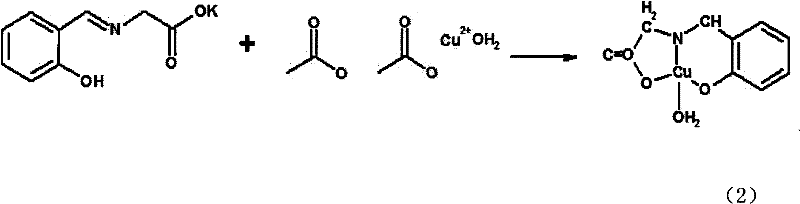
[0017] Method operation: Dissolve 0.1 mol of glycine and 0.1 mol of potassium hydroxide in 65 ml of methanol; drop 0.1 mol of salicylaldehyde in methanol solution 35 ml under stirring, stir for 3 hours, then cool, filter and concentrate to obtain crystalline glycine- Salicylaldehyde Schiff base; dissolve the above crystals in an appropriate amount of methanol, add dropwise an equivalent mole of copper acetate saturated methanol solution under stirring, and stir for 2-3 hours to obtain a precipitated copper complex; wash the precipitate with 95% ethanol Twice, washed once with ether to obtain the finished product of the copper complex of glycine-salicylaldehyde Schiff base.

[0018] 1. Antibacterial effect test

[0019] (1) Acute Toxicology Test of Copper Complex of Glycine-Salicylaldehyde Schiff Base