
Metal alloy XRF spectrometry utilizing new sample preparation technology
A metal alloy, fluorescence spectroscopy technology, used in the preparation of test samples, material analysis using wave/particle radiation, measurement devices, etc., can solve the problem of high melting point, reduce the matrix effect, and achieve the effect of high accuracy
- Summary
- Abstract
- Description
- Claims
- Application Information
AI Technical Summary
Problems solved by technology
Method used
Image

Examples
Embodiment Construction
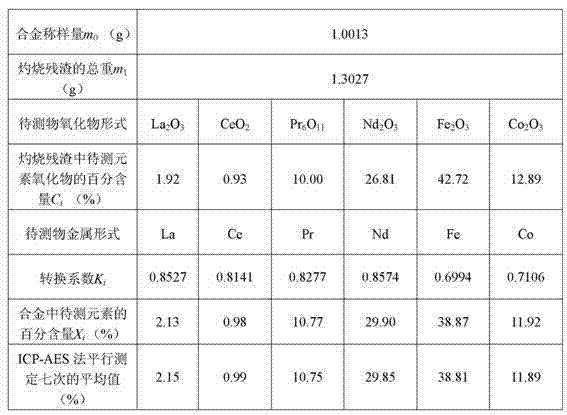
[0018] The metal alloy X-ray fluorescence spectrum detection method using the new sample preparation technology described in the present invention, hereinafter by selecting the neodymium-iron series rare earth permanent magnet alloy (the main components are six elements of La, Ce, Pr, Nd, Fe, Co) As the best embodiment of the present invention, the detailed description is as follows:
[0019] 1. Accurately weigh about 1.0 g (accurate to 0.1 mg) sample into a 50 mL glass beaker, add (1+1) HNO 3 20 mL, cover with a watch glass, heat and boil on an electric stove until the sample is completely dissolved, remove it, cool to room temperature, wash the watch glass with a small amount of distilled water, and combine the cleaning solution with the sample solution.
[0020] 2. Add (1+1) ammonia water dropwise to the above sample solution, and stir while adding, until the pH value of the sample solution is 8. At this time, each metal element was precipitated in the form of hydroxi...
PUM
 Login to View More
 Abstract
Description
Claims
Application Information
 Login to View More